


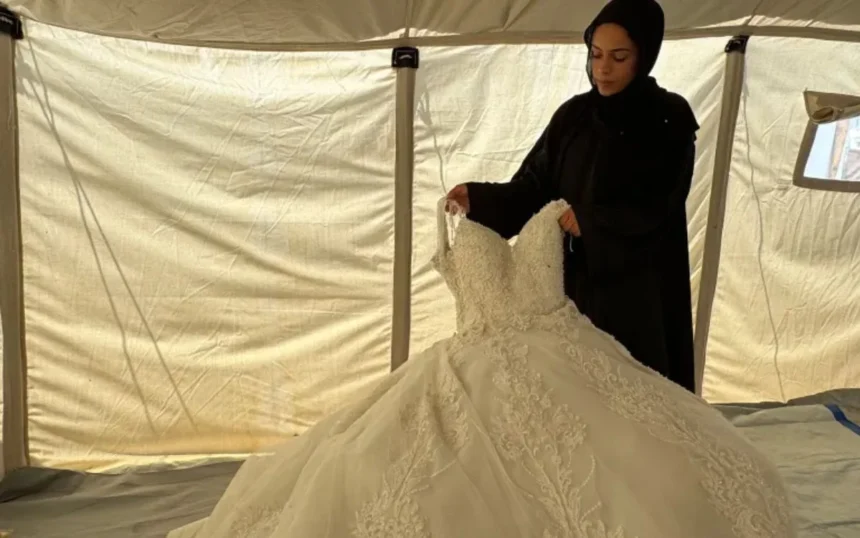
As reported by Al Jazeera, weddings in Gaza have become difficult to afford even at their most modest, with couples trying to celebrate amid war, displacement and sharply higher prices. The article describes how some families now hold ceremonies in tents or improvised spaces because traditional wedding halls and apartments are out of reach.
According to Al Jazeera, one groom, Mohammed, said he spent about 1,500 shekels on a tent, roughly 2,500 shekels on wood, more than 2,000 shekels on tarpaulins and another 3,000 shekels for a basic bathroom. He also said he rented a small former café for about 1,500 shekels because he could not afford a proper wedding hall, which he said costs more than 8,000 shekels.
The article says that before the conflict, rental apartments in Gaza were available for about $250 to $300 a month. That contrast underscores how far everyday costs have moved beyond what many young couples can manage.
What Couples Are Facing
The report also focuses on Saja, a bride who struggled to find an affordable wedding dress as rental prices climbed well beyond what she could pay. She told Al Jazeera that dress shops were asking more than 2,000 shekels for a single night, while beauty salons charged about 700 shekels to prepare a bride.
Saja said the costs are being driven higher by expensive crossings, goods and coordination, along with shortages tied to electricity and fuel. Her remarks show how wedding expenses have become part of a wider economic crisis, rather than an isolated family burden.
The article presents marriage as a cultural milestone that is now being stripped of many of its usual elements. Instead of large celebrations, couples are forced to make painful tradeoffs between tradition and basic survival.
How Families Are Adapting
Al Jazeera reports that some couples are choosing the most basic possible ceremonies in order to begin married life at all. That means reducing guest lists, using temporary structures and postponing anything that is not essential.
The article describes these celebrations as a “humble beginning” that still comes at a high price in Gaza. Even the simplest arrangements can demand cash that many families no longer have because of the broader collapse in living conditions.
The reporting also suggests that weddings, once a marker of stability and social continuity, now reflect the limits of what people can still afford. The costs mentioned in the story show how inflation and scarcity have spread into the most personal parts of life.
Why Prices Keep Rising
The article links high wedding costs to the wider wartime economy in Gaza, where access to goods is restricted and ordinary services have become expensive. That includes construction materials, rental spaces, cosmetics and other items needed even for a stripped-down ceremony.
Al Jazeera’s reporting indicates that fuel and electricity shortages are part of the pressure pushing prices higher. When basic logistics become unstable, every part of wedding planning becomes more costly and more uncertain.
The story also shows how displacement has changed the physical setting for weddings. Instead of homes and traditional venues, some couples must build temporary spaces from scratch or borrow whatever location is available.
What This Means Ahead
The reporting suggests that weddings in Gaza will remain constrained as long as prices, shortages and displacement continue. Couples entering marriage are doing so in conditions where even symbolic celebrations require major financial sacrifice.
The article does not indicate any immediate relief in costs, and the examples it gives point to a continued squeeze on family budgets. For many young people, the path to marriage now depends less on ceremony than on endurance.
As reported by Al Jazeera, the story is ultimately about more than weddings; it is about how war has reshaped the most ordinary milestones of life. In Gaza, even starting a household has become an act of financial survival.
Feeling like a real boss with the wins I’ve been getting here. The platform is secure and the gaming environment is just fantastic. Join the fun at jilibosslogin.
The variety of betting options here is just incredible. I love how easy it is to navigate the site even on mobile. Had a great run last weekend! Give vnx88bet a try if you want some real action.
Best spot for anyone looking for exciting gameplay and good rewards. The community here is great and the vibes are always positive. planet888
I just signed up and the process was super smooth. Really impressed with how fast I got my account ready. Check out 91jililoginregistration for a great start!
Great customer support and a very professional layout. It is hard to find a site this reliable these days. I will definitely be sticking with idroyal1000.
Smooth experience and very user friendly. I love how quickly I can access my games through jljl5login. It makes gaming so much more convenient.
The game selection is fantastic and I have had some lucky wins here recently. It is a very entertaining platform. Go for bundaslotlogin.