


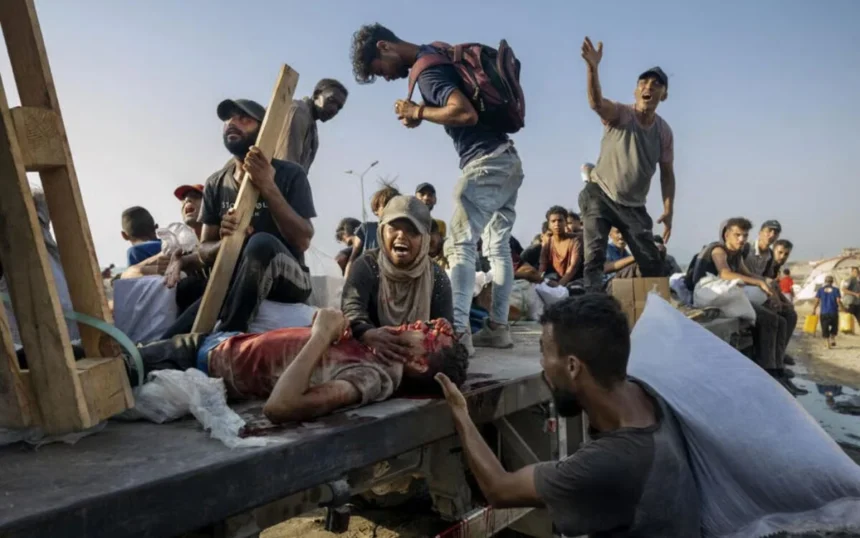
The New York Times has publicly defended Saher Alghorra, its Gaza‑based contributing photographer, after a press‑watchdog group and other critics began questioning the authenticity of some of his Pulitzer‑winning work. As reported by the Jewish Telegraphic Agency (JTA) and other outlets, Alghorra, a Palestinian photojournalist from Gaza, was awarded the 2026 Pulitzer Prize for Breaking News Photography for a portfolio of images depicting “devastation and starvation in Gaza,” much of it published in the Times. The Pulitzer board commended his work as “haunting, sensitive” and said jurors saw it as a “distinguished example” of breaking news photography.
According to the Times, Alghorra’s portfolio centered on scenes of injured and emaciated civilians, including a widely circulated image of two‑year‑old Yazan Abu al‑Foul, shown in his mother’s arms, that became emblematic of claims of widespread famine in Gaza. The Pulitzer‑prize committee’s citation praised his ability to capture the human toll of the 2023–2025 war, and the Times has described his work as documenting “hundreds of starving and malnourished children” in Gaza under extreme personal risk. However, after the prize announcement, Honest Reporting and other media‑watch organisations began scrutinising individual images, arguing that some scenes showed repeated, near‑identical poses and suggested that the famine narrative was being selectively packaged and possibly staged.
How the controversy over the images began
The scrutiny of Alghorra’s work intensified quickly after the Pulitzer announcement. As reported by outlets including the Free Beacon and JTA, the press‑watchdog group Honest Reporting accused the Times and the Pulitzer board of promoting a prize “built on staged scenes, a manufactured ‘famine’ narrative, and intimate access to Hamas terrorists.” Honest Reporting pointed to the image of Yazan Abu al‑Foul, noting that the original wire‑service caption described him as having a pre‑existing medical condition affecting muscle development and that the same mother‑and‑child pairing had been photographed by multiple agencies in nearly identical positions. The group argued that this repetition raised questions about consent and the extent to which the same subjects were being reshaped for a global narrative of starvation caused by Israel.
The New York Times has acknowledged that the boy’s medical history was later clarified in the text of the piece. According to coverage by JTA and the Times of Israel, the newspaper amended its story to note that Yazan suffered from a medical issue that inhibited his physical development and removed a quote from his mother stating that he had been healthy before the war began on October 7, 2023. The Times did not retract the broader claims about malnutrition and food‑shortage crises in Gaza but instead insisted that the Pulitzer board’s recognition was based on Alghorra’s broader body of work, not on that single image alone.
Reactions from the New York Times and the Pulitzer board
The New York Times has issued a direct, public rebuttal to the accusations against Alghorra. As reported by the Free Beacon and JTA, the newspaper defended him in a statement posted on X, saying, “Saher Alghorra has documented hundreds of starving and malnourished children in Gaza, conducting intrepid photojournalism at personal risk so readers can see the consequences of war. This attack on his work is baseless.” The Times added that the Pulitzer jurors had described his coverage as “spontaneous” and grounded in real hardship, and that the watchdog’s allegations of “staged scenes” did not reflect the board’s findings or the newspaper’s editorial review of the photographs.
The Pulitzer board’s public citation, as quoted by the JTA and the Times of Israel, stands by the original wording, describing Alghorra’s work as “a distinguished example of breaking news photography” for scenes in Gaza that were largely under the control of Hamas. The board has not issued a separate statement retracting or revising the award, and the Times has reiterated that the peer‑review process at the Pulitzer Prize Program supported the decision. Within the Times, editors and senior staff quoted in the Free Beacon’s account have said that the newspaper has multiple layers of editorial and fact‑checking oversight for its Gaza coverage and that the concerns raised by critics fall short of providing evidence that the images were deliberately staged or fabricated.
Supporting details and expert commentary on the debate
The debate over Alghorra’s images has become a flashpoint in a wider controversy about visual coverage of Gaza. As reported by the Times of Israel and the JTA, independent analysts and press‑freedom groups have emphasised that photojournalists in Gaza operate under severe constraints, including Hamas‑imposed restrictions on movement and access, Israeli military operations and the risk of targeting of civilians and media workers. Several experts cited in these outlets note that repeated use of the same families or individuals is common in conflict zones because photographers have limited access and a small pool of visible, willing subjects. They argue that repetition does not automatically imply staging, though it can complicate the public’s perception of context.
Journalists covering media ethics have told the Times of Israel and the Free Beacon that the current controversy underscores the broader challenge of verifying images in Gaza, where independent access is minimal and many outlets rely heavily on local contributors like Alghorra. Some commentators argue that the Times could have done more to transparently explain medical histories and the conditions under which certain images were taken, while others caution against conflating critique of editorial choices with allegations of fraud. The Times’s own statement, as reported by the Free Beacon and JTA, stresses that Alghorra studied public relations, media and photography at the University of Palestine and has worked extensively in Gaza for years, including for the Times and other outlets.
Implications for the newspaper and the press environment
The question of how the controversy will affect the New York Times’ reputation and future Gaza coverage is central to the current debate. As reported by the Free Beacon and JTA, the newspaper’s swift and firm defense of Alghorra signals that it views the accusations as a serious challenge not only to one photographer but to its broader credibility in covering the Israeli‑Palestinian conflict. The Times has pointed out that the Pulitzer board undertook its own review and that the award remains in place, suggesting that the paper is unlikely to formally withdraw support for Alghorra unless new, concrete evidence emerges. At the same time, the newspaper’s amendments to the Yazan Abu al‑Foul story indicate that it is willing to adjust factual details when challenged, even as it continues to stand behind the overall narrative of widespread malnutrition in Gaza.
For press‑freedom advocates, the episode raises broader questions about the balance between holding media outlets accountable and protecting journalists working in dangerous environments. As reported by the Times of Israel and the JTA, some analysts warn that aggressive attacks on Gaza‑based photographers could deter local contributors from taking risks to document abuses and humanitarian crises, while others argue that vigorous scrutiny is necessary to prevent the spread of selective or misleading imagery. The fact that Alghorra’s work has been honoured by the Pulitzer board yet simultaneously attacked as staged or manipulated illustrates the tension between institutional recognition and the polarised public‑opinion landscape in which Gaza coverage now unfolds.
What this episode means for Gaza‑focused photojournalism
The controversy surrounding Saher Alghorra is likely to influence how news organisations handle Gaza‑related imagery in the coming years. As reported by the JTA and the Free Beacon, some media‑watch groups and commentators have called for more explicit disclosures about the context, medical conditions and repeated use of subjects in Gaza photography, arguing that such transparency can help readers better interpret what they see without undermining the urgency of the humanitarian story. The Times has indicated in its public statements that it remains committed to covering the human impact of the war in Gaza through photography, but that it will continue to review its processes for contextualising sensitive images.
For Alghorra personally, the episode represents a complex mix of recognition and exposure. The Pulitzer Prize has elevated his profile as a leading Gaza‑based photojournalist, yet the attacks on his integrity have drawn attention to the precarious position of local contributors who operate under Hamas control while being relied upon by international outlets. As reported by the Times of Israel and the JTA, colleagues and Gaza‑based journalists have expressed solidarity with Alghorra, describing his work as a critical record of civilian suffering in a territory where visual documentation is increasingly difficult. The New York Times’ongoing defense of him, even amid mounting questions, suggests that the newspaper sees his role as inseparable from its broader effort to present Gaza’s humanitarian crisis to global audiences, even when that presentation itself becomes contested.
Everything is just spot on. From the loading speeds to the overall design, it is just perfect. brwww444 is a gem of a site for anyone who loves online gaming.
I’ve been using this app for a few weeks now and the interface is super smooth. Definitely one of the best experiences I’ve had lately. Check out 8999bdapp for more details.
I’ve tried a few sites lately but this one is surprisingly smooth. The games load fast and the interface is very user friendly. Definitely recommend checking out pkj2game for a great time.
Really impressed with the loading speed and the overall vibe of the site. It makes gaming so much more enjoyable. Give bdab777 a shot if you want a reliable site.
Finally found a way to get the app running without any glitches. The installation was a breeze and the experience is top notch. Check out 567winappdownloadapk if you want a seamless mobile setup.
I’ve tried a few platforms recently but this one is surprisingly smooth. The interface is intuitive and the payouts are fast. Definitely recommend checking out vnggk88 if you are looking for a reliable spot.