


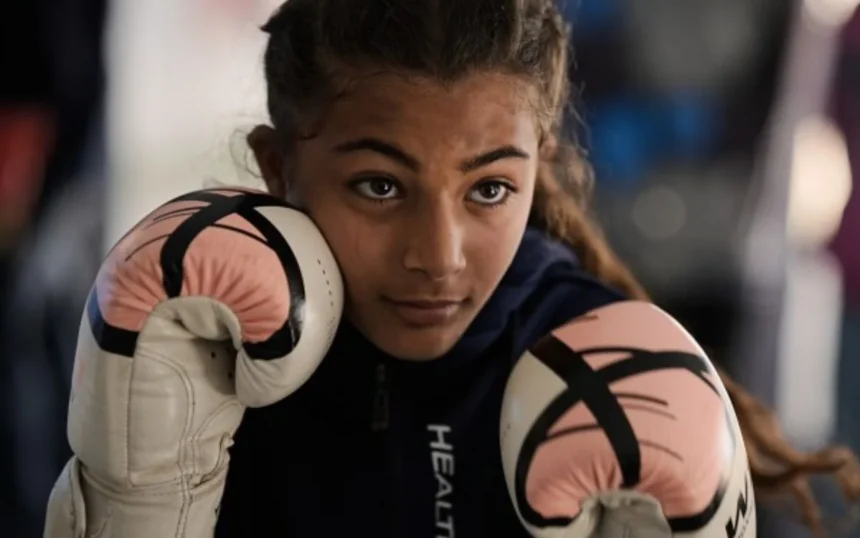
In Khan Younis, in the southern Gaza Strip, a small women’s boxing club has become a visible space where Palestinian girls are training in the ring, under the guidance of local coaches. The Associated Press photo gallery documenting the scene shows young girls in gloves and headgear shadow‑boxing, sparring lightly and practicing on punching bags, their expressions a mix of focus and determination. The images were curated by AP photo editors and published by multiple outlets, including WTOP News and the Las Vegas Sun, which credited the AP photo‑gallery package as the primary source of the visuals and basic context.
According to descriptions accompanying the gallery, the club is located in Khan Younis, a city that has endured repeated Israeli military operations and is now grappling with widespread destruction, displacement and a fragile economy. The boxing space is described as a women‑only or women‑focused facility, providing a rare environment where girls can engage in physical activity and self‑defense training in a conservative, war‑scarred setting. The AP‑curated text notes that the club represents a small but visible effort to sustain normalcy, youth engagement and gender‑specific opportunities amid an otherwise constrained social landscape.
Why this boxing club matters
The photos capture more than a physical training session; they illustrate how informal sports spaces can function as islands of resilience for Palestinian youth in Gaza. As reported by outlets republishing the AP gallery, Khan Younis was heavily affected during the 2023–2025 war, with large parts of the city destroyed and tens of thousands of residents displaced. In that context, the sight of girls in a boxing gym signals continuity—an attempt to preserve education, exercise and socialization for a generation that has grown up under blockade, repeated hostilities and economic hardship.
The Independent and other outlets recurring the AP visuals noted that such spaces are uncommon for girls in many parts of Gaza, where traditional gender roles, security restrictions and limited infrastructure often limit women’s access to public sport. The existence of a women‑centred boxing club therefore stands out as a modest but concrete example of local initiatives working to expand opportunities for girls, even when official sports programs and broader reconstruction efforts remain stalled.
Context and reactions from Gaza
The AP‑curated gallery does not include detailed interviews, but accompanying labels and captions describe the club as a women’s boxing space in Khan Younis and emphasise that the girls are training in a structured, supervised environment. The photos show them wearing headgear, gloves and training vests, working with punching bags, shadow‑boxing and sometimes sparring in pairs, all under the watch of coaches. The visual sequence suggests a formal, recurring program rather than a one‑time event, underscoring the role of such clubs as consistent outlets for physical activity.
Public commentary shared via social media and compiled by outlets such as the Las Vegas Sun and the Independent highlights mixed reactions. Some viewers describe the images as empowering and hopeful, seeing them as symbols of strength and agency amid ongoing conflict. Others note that the existence of a girls’ boxing club in Khan Younis reflects a broader effort by Gazan communities to rebuild not only homes and infrastructure but also social institutions such as sports and youth clubs. At the same time, media analyses emphasise that these individual initiatives exist against a backdrop of severe humanitarian constraints, with many families still living in temporary shelters or overcrowded camps.
Supporting details and broader patterns
The AP‑edited gallery sits within a wider pattern of reporting on women’s and girls’ activities in Gaza. Other outlets, including the BBC and Al Jazeera, have documented how Gazan women have founded sewing cooperatives, community kitchens, education‑support groups and informal sports initiatives in response to war and blockade. These efforts are often portrayed as critical for mental health, social cohesion and economic survival, particularly for those who have lost relatives, homes or livelihoods. The boxing club in Khan Younis appears to be part of that same grassroots ecosystem, using sport as a tool for resilience rather than as a purely competitive enterprise.
Experts cited in broader reporting on youth and gender in Gaza have noted that spaces explicitly geared toward girls’ physical activity are still relatively rare and often operate with limited resources. The AP‑curated gallery does not provide specific membership numbers or funding details for the Khan Younis club, but the images suggest a modest‑scale operation, with a handful of trainers and a small group of participants at a time. The presence of a ring, basic equipment and proper protective gear indicates that some level of investment—whether local, community‑based or externally supported—has gone into the facility, even as Gaza’s overall reconstruction remains under‑financed and fragmented.
What this could mean for youth and women in Gaza
The persistence of a women’s boxing club in southern Gaza raises questions about the longer‑term role of sports in postwar recovery and gender‑specific development. As reported by outlets that have covered similar initiatives, sports and physical activity are increasingly seen as part of psychosocial support programs for children and adolescents affected by trauma. The simple act of training in a ring, following a structured routine and engaging with peers can provide a sense of control, routine and identity that is otherwise difficult to secure in an environment of insecurity and displacement.
For Palestinian girls in particular, the existence of a boxing club in Khan Younis may signal a gradual expansion of acceptable public roles. The Associated Press‑edited gallery and the accompanying coverage do not claim that the club has changed broader social norms, but they do present it as a visible exception: a space where girls are allowed, and even encouraged, to use their bodies in visibly athletic and assertive ways. For some observers, this is seen as a small step toward normalising girls’ participation in public sport, which could, over time, influence attitudes toward women’s roles in education, employment and civic life.
How this fits into Gaza’s current situation
The timing of the AP photo gallery is notable: it appears against the backdrop of a fragile ceasefire and uneven reconstruction in Gaza. Reports from the United Nations and humanitarian agencies have described thousands of homes still in ruins, intermittent access to electricity and water, and a severely restricted economy. Amid that reality, the image of girls training in a boxing club in Khan Younis offers a different kind of narrative—one that focuses on agency, routine and resilience rather than solely on suffering and loss.
Reuters and other outlets covering Gaza have used similar imagery to underscore how local initiatives, from sports clubs to community‑based aid groups, are filling gaps left by under‑funded or politically constrained international programs. The Khan Younis boxing club, as presented in the AP‑curated gallery, is framed as one such initiative: not a solution to the broader crisis, but a tangible example of how Gazans are trying to preserve a sense of normal life for their children. The photos do not depict the war’s destruction, yet they are implicitly framed by the wider context of displacement, trauma and limited opportunities that define much of Gaza today.
What happens next for these girls and their club
The future of the women’s boxing club in Khan Younis depends on multiple factors, including security conditions, funding, and the broader political and humanitarian trajectory in Gaza. The AP‑edited gallery does not include projections or statements from club organisers about expansion plans, but the repeated documentation of training sessions suggests that the program is intended to be ongoing rather than a one‑off event. If the current ceasefire and reconstruction efforts solidify, such local sports initiatives may gain more visibility and support from both local authorities and international donors interested in youth development and psychosocial recovery.
At the same time, media analyses emphasise that individual programs like this boxing club cannot substitute for comprehensive aid, infrastructure rebuilding and political solutions. The images of girls training in Khan Younis are presented as hopeful, but they also highlight how much relies on small‑scale, community‑driven efforts in the absence of large‑scale, coordinated recovery. The girls’ presence in the ring, under the watch of local coaches, stands as a quiet assertion of continuity—a reminder that even in the shadow of war, Palestinians in Gaza continue to invest in the physical and emotional development of their youngest generation.
Ready to win big? 988betlogin looks promising. The login process seems straightforward. Worth a shot, right? Get yourself logged in 988betlogin.
v88bet… Gave it a gamble! Pretty straightforward betting platform. Nothing too flashy, but it does the job. See if you can win big: v88bet
Gamvipg88? Yeah, I’ve messed around on there. It’s got some cool stuff, definitely something different. Give it a try, you might like it! Check it out: gamvipg88
Love the variety of slots available. It feels very fair and the customer support is actually helpful. Give pkxs777 a try!
Solid platform with no lag during peak hours. I love how straightforward the registration process is. I’m sticking with pk988wan from now on.