


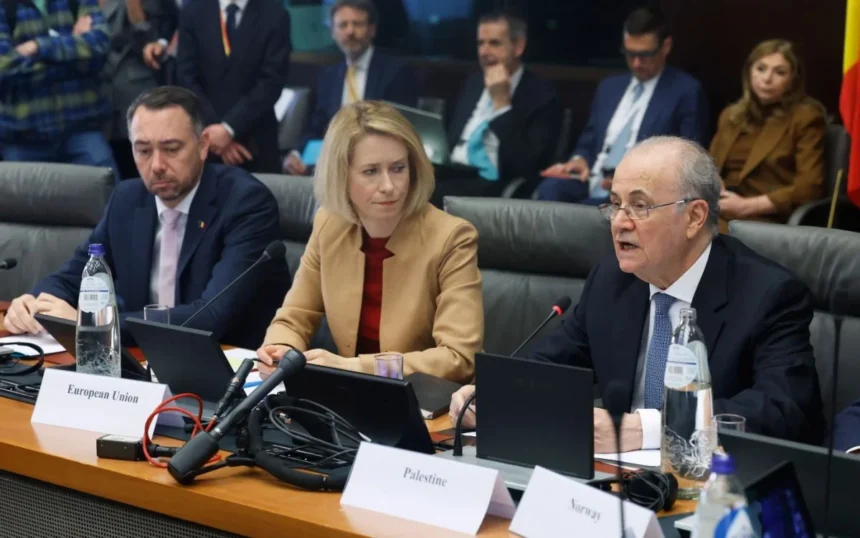
More than 60 nations have sent representatives to Brussels to attend a European‑Union‑hosted conference on security, stability, and long‑term peace in Israel, the West Bank, and Gaza, underscoring the bloc’s attempt to expand its role in the Middle East. As reported by Associated Press correspondents, the meeting comes amid growing European frustration over the ongoing conflict in Gaza and deepening skepticism about the viability of a two‑state solution. The European Union, long the largest single donor to the Palestinian Authority, has repeatedly called for a two‑state outcome but has often found itself sidelined in actual peace‑shaping decisions by other powers.
According to the AP dispatch, the gathering brings together Palestinian officials, EU leaders, and foreign envoys to discuss governance, reconstruction, and security frameworks in the occupied territories. Belgian Foreign Minister Maxime Prévot, who co‑hosted the session with European Commission Vice‑President and top diplomat Kaja Kallas, described the current situation as making the two‑state solution “increasingly challenging each day.” He nonetheless emphasized that Belgium and many European and Arab partners still regard that formula as the only realistic route to lasting peace for Israelis and Palestinians as well as regional stability.
What this peace conference aims to address
According to the reporting, the Brussels conference focuses on three broad pillars: restoring effective Palestinian governance, rebuilding infrastructure in Gaza, and establishing a cohesive security architecture under legitimate Palestinian authority. Palestinian Prime Minister Mohamed Mustafa told the meeting that Gaza requires “state, government, law and goal,” stressing the need for a unified security framework that can coordinate Palestinian security institutions with international actors. He reiterated that security must remain a single, coherent system rather than being fragmented among competing armed groups.
The AP article notes that the European Union has already pledged substantial financial and technical support to the Palestinian Authority, including backing reforms and institutions meant to underpin any future state. Belgium and several EU members have moved to recognize Palestinian statehood in recent months, partly in response to the humanitarian crisis in Gaza and perceived Israeli intransigence on negotiations. Those recognitions are framed by participants as a way to strengthen the Palestinian Authority’s legitimacy and bargaining position without prejudging final‑status issues.
Why Europe is stepping up its push
As reported by the Associated Press, the EU has long been Israel’s largest trading partner and a major buyer of Israeli arms, which complicates its ability to act as a neutral mediator in the conflict. At the same time, mounting public anger across several European capitals over images of civilian suffering in Gaza has pushed governments to condemn Israel’s conduct of the war more openly. Senior European officials argue that unless the bloc uses its economic leverage and diplomatic weight more assertively, it risks becoming a passive bystander in a region where the United States, regional powers, and others increasingly shape outcomes.
According to the AP dispatch, growing EU dissatisfaction with the pace and direction of U.S.‑led initiatives has also contributed to the decision to host this high‑level gathering. By convening more than 60 countries around Palestinian‑led proposals for security and governance, the EU aims to position itself as a center for alternative diplomatic momentum if Washington‑led efforts stall or fail to gain broader buy‑in. The conference is designed both to signal European solidarity with Palestinians and to test whether a wider coalition can coalesce around a common vision for a post‑war political order.
What critics and regional actors say
According to the AP report, some European officials privately acknowledge that the EU’s ability to impose concrete changes on the ground remains limited because Israel controls key borders, airspace, and security decisions in the occupied territories. Skeptics also warn that fragmented internal positions within the EU—on issues such as weapons exports, sanctions, and recognition of Palestinian statehood—can undermine the bloc’s credibility. The AP notes that Israeli leaders have at times accused European governments of inconsistency, praising them for financial support while criticizing their political statements on settlement activity and Gaza.
Regional reactions have been mixed. The article quotes European diplomats as saying that several Arab partners welcome the initiative, especially those that have grown wary of overly U.S.‑centric approaches to Middle East diplomacy. At the same time, some observers caution that any serious peace track will still require the active participation of Israel, which has not been formally invited to the Brussels conference and has not signaled clear support for its outcomes. The AP notes that without at least tacit Israeli engagement, even well‑attended European‑led forums may struggle to move beyond declarations and symbolic gestures.
What the conference could mean for the future
According to the AP piece, organizers do not expect the Brussels meeting to produce an immediate breakthrough in the Israeli‑Palestinian conflict but instead to lay groundwork for a more structured, EU‑backed process. The article notes that follow‑up mechanisms are expected, including working groups on security cooperation, governance reform, and reconstruction in Gaza and the West Bank. If those groups can secure sustained funding and political backing, they could help stabilize Palestinian institutions and create a clearer roadmap that external actors—including the United States and Gulf states—might later build upon.
The AP also highlights that the EU’s broader Middle East strategy, as outlined in recent internal documents, is tied to a two‑state framework with an Israeli and a Palestinian state living side by side in peace and security. In that context, the Brussels conference is portrayed less as an isolated event and more as a test of whether Europe can translate its financial leverage and diplomatic convening power into tangible influence over the region’s political trajectory. Over the coming months, the success or failure of the initiative will likely be measured by how many states convert political statements into concrete support for Palestinian institutions and security arrangements rather than mere rhetorical backing.
Finally found a site that actually pays out on time. The experience has been great so far and the bonuses are legit. Highly recommend ph291jili
The customer support is top notch and they solved my deposit issue in minutes. Great service and fair odds at okebet36.
I love the way the promotions are handled here. Everything is transparent and the winning streaks are real. You should definitely try laga88slotlogin today.
I finally found a platform that actually works without any lag. The registration process was super smooth and I started playing in minutes. Definitely check out 555tayaregister if you want a hassle-free experience.
This site has a great vibe and the community is awesome. I had a great run last night and the withdrawal was instant. Check out idbuaya77 for real action.