


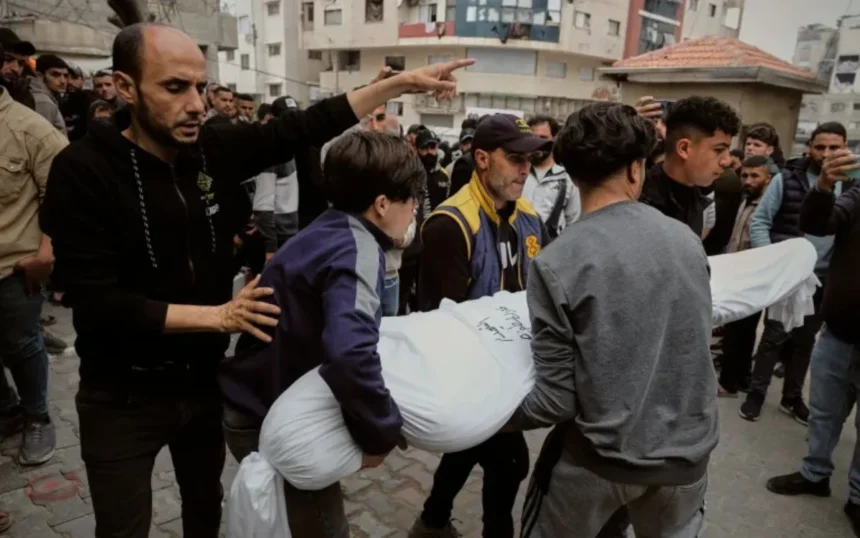
Palestinian communities in Gaza and the occupied West Bank have faced another week of intensified Israeli military operations, settler violence, and official evictions, according to reporting from Gaza‑based correspondents and international humanitarian agencies. The latest figures on casualties and displacement underscore a deepening crisis in both territories, even as diplomatic talks continue on the sidelines.
What happened this week
In Gaza, Israeli airstrikes, gunfire from ground forces, and drone operations have continued through the week, striking multiple neighborhoods and refugee camps. Reporting from Gaza indicates that a strike on a police vehicle along Al‑Nq Street in Gaza City on April 14 killed four Palestinians, including three‑year‑old Yahya al‑Malahi, whose family told medics they were leaving a wedding. Later the same day, an attack on the Shati refugee camp killed at least five more people.
On April 16, two brothers, Malek and Abdel‑Sar al‑Attar, were killed in Beit Lahiya in an area witnesses described as outside explicit Israeli military “control” zones. The following day, drone fire killed two brothers, Mahmoud and Eid Abu Warda, while they tried to fetch water in Shujayea; another drone strike on a nearby water‑desalination facility claimed a third life. Two days later, Israeli troops shot and killed two Palestinian contractors delivering water on behalf of UNICEF in northern Gaza.
UN humanitarian agencies report that, as of April 20, at least 777 Palestinians have been killed in Gaza since the formal ceasefire in October, with more than 2,193 injured. The Gaza Ministry of Health’s updated figures place the total Palestinian death toll since October 7, 2023, at 72,553, after accounting for an additional 196 cases previously under review.
Coordinated settler attacks in the West Bank
In the occupied West Bank, a wave of coordinated settler assaults has hit several villages northeast of Ramallah. Attention has focused on Turmus Aya, Khirbet Abu Falah, and al‑Ughayir, where three new illegal Israeli outposts have been established over the last two months on privately owned Palestinian land. In Turmus Aya, multiple settler vehicles arrived and set fire to a home and a car, with nearby Israeli military personnel reportedly not intervening.
In Khirbet Abu Falah, settlers gathered at the new outpost before attacking Palestinian homes, shortly after Israeli soldiers raided the village. In al‑Ughayir, Israeli forces stopped two children playing, forced them to the ground, and then left, only for settlers to later attack a Palestinian driver on a nearby road. These incidents come amid broader figures from the United Nations Office for the Coordination of Humanitarian Affairs (OCHA), which notes that settler violence now accounts for 75 percent of all recorded displacements in the West Bank so far in 2026, with March marking the highest monthly toll of injuries from settler attacks since documentation began in 2006.
Evictions and demolitions in East Jerusalem
In occupied East Jerusalem, the pace of demolitions and evictions has also accelerated. Israeli authorities recently demolished the home of 80‑year‑old Abu Kamel Dweik, a cancer patient, in the al‑Bustan neighborhood of Silwan, making it at least the third such demolition in that area in recent months. OCHA reports that since January 6, Israeli authorities have ordered the demolition of at least 170 Palestinian‑owned structures in East Jerusalem, displacing well over 250 people; many demolitions have been carried out by the owners themselves to avoid additional fines.
The extended Basha family, comprising six households with 12 members, most of whom are over 60, faces a court‑ordered eviction from their residence in the Muslim Quarter of Jerusalem’s Old City by April 26. A separate OCHA‑led report notes that over 2,500 Palestinians have been displaced in 2026 overall due to demolitions, settler violence, and evictions, with more than 1,000 of those displacements affecting children.
How are authorities and international bodies reacting?
Within Israel, Finance Minister Bezalel Smotrich urged Prime Minister Benjamin Netanyahu to direct the military to fully occupy the Gaza Strip and establish settlements if Hamas did not disarm, speaking at a ceremony marking the re‑establishment of the previously dismantled Sa‑Nur settlement in the West Bank. International human‑rights experts have described Israeli actions in the West Bank as part of an “ethnic cleansing” campaign, citing assaults that have killed and injured Palestinians, driven people from their homes, and devastated farmland and livelihoods.
UN officials have also voiced alarm over the scale of forced displacement. One panel stressed that the pattern of attacks, demolitions, and settler‑led land seizures reflects a broader strategy to alter the demographic makeup of Palestinian areas. OCHA has warned that the cumulative displacement from the northern West Bank refugee camps, combined with ongoing settler violence, is creating a “multi‑layered” humanitarian emergency.
What these developments may mean going forward
The persistence of Israeli military operations in Gaza, despite the formal ceasefire, suggests that many communities remain under open‑ended threat. A Gaza‑based correspondent told international media that Israel appears to have “no intention of reducing its assaults,” noting that repeated strikes are re‑igniting trauma among displaced families who had only recently begun to rebuild. At the same time, donors and UN agencies continue to estimate that long‑term recovery and reconstruction in Gaza will require tens of billions of dollars over the coming decade.
In the West Bank, the consolidation of new outposts and the record level of settler violence may harden constraints on Palestinian movement and land use. OCHA has warned that the rising number of displacements driven by settler attacks could push already vulnerable communities into deeper poverty and dependence on aid. In East Jerusalem, the tightening of eviction and demolition orders raises the risk of further community fragmentation and the erosion of longstanding Palestinian presence in neighborhoods such as al‑Bustan and the Old City.
What is confirmed so far
Over the past week, Israeli forces have struck multiple locations in Gaza, including Gaza City and Shati refugee camp, killing at least 11 civilians and adding to an overall death toll that now exceeds 72,000 since October 2023. In the West Bank, coordinated settler attacks around Ramallah‑area villages have coincided with new illegal outposts and a sharp rise in displacement linked to settler violence. In East Jerusalem, recent demolitions and looming court‑ordered evictions are further reducing Palestinian‑held housing and increasing the number of displaced families, according to UN and local monitoring reports.
Finally found a site that actually treats players right. Great variety of options and the customer support is top notch. Highly recommend idayam11
I’ve been playing for a week and the experience has been flawless. The site loads fast and the games are very engaging. I highly suggest winph55login for all enthusiasts.
This place has a great community and the rewards are legit. I’ve recommended it to all my friends because it is simply the best. Visit pkpa777 and start your luck today.
Honestly the best experience I have had in a long time. The bonuses are actually generous and the games load instantly. Definitely sticking with 5k5k777 from now on.
Solid platform with a very intuitive design. I can get into my favorite games in just a few clicks. Definitely a win for yolo365login.
The interface is super smooth and easy to navigate. I really appreciate the variety of games available here. Highly recommend acc444bet to everyone!