


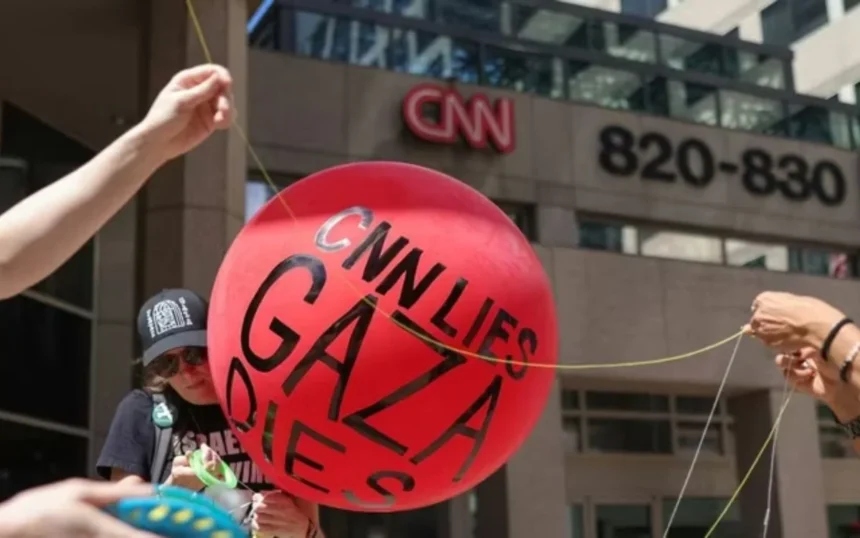
A new book by media analyst Adam H. Johnson examines U.S. corporate media’s coverage of Israel’s military campaign in Gaza.
Titled How to Sell a Genocide: The Media’s Complicity in the Destruction of Gaza, it argues that outlets systematically sanitized war crimes.
The work draws on data analysis to highlight patterns in reporting since October 2023.
General Context
As bombs fell on Gaza starting October 2023, global images showed mass destruction, according to descriptions in the book’s promotional materials.
Johnson’s analysis targets major outlets like The New York Times, CNN, and MSNBC for repackaging the conflict as a “war on terror.”
He details how coverage obscured U.S. involvement and dehumanized Palestinians through selective empathy and omissions.
According to Google Books listing for the book, Johnson uses original data to dissect propaganda mechanics.
This includes repetition of state falsehoods, demonization of aid workers, and skewed campus protest reporting.
The book positions media complicity as key to sustaining what it calls one of modern history’s worst mass killings.
Reports from outlets like Common Dreams have long noted similar patterns in Gaza coverage.
A 2024 analysis found top U.S. papers showed “consistent bias” against Palestinians in assault reporting.
Johnson’s book builds on such critiques with in-depth examples from leading networks.
What Are the Key Criticisms?
Reactions to Johnson’s book emphasize its data-driven approach.
In a podcast discussion, host Chris Hedges described it as “must-listening” for fighting genocide, praising Johnson’s role as media critic.
The interview highlighted the book’s focus on sustaining biased narratives over time.
Media watchdogs have echoed these points.
A Media Bias Meter report revealed Western outlets sidelined Gaza perspectives since October 7, 2023, amplifying Israel-centric views.
North American and European coverage consistently favored one narrative, per the findings.
According to a UK-based analysis by CfMM, major newspapers like The New York Times and The Washington Post heavily favored Israeli perspectives.
It cited over 200 examples of failures in fact-checking and verification.
Outlets like the Guardian rarely mentioned genocide allegations directly.
Supporting Details
Johnson’s work indicts media for overt racism and strategic omissions in Gaza reporting.
It argues these tactics hid Israel’s actions and U.S. support, per book summaries.
All royalties go to the Middle East Children’s Alliance, signaling the author’s intent.
A Common Dreams article from January 2024 detailed bias in The Los Angeles Times, The Washington Post, and The New York Times.
These papers reliably tilted against Palestinians during the assault’s early phases.
Johnson’s book extends this to broader networks like MSNBC.
The CfMM report analyzed six themes, finding overwhelming anti-Palestinian bias.
It criticized lack of balance in presenting Israeli claims without scrutiny.
Sky News and others showed minimal counter-narratives.
Podcast coverage on Apple Podcasts frames the book as exposing how media incites devastation.
Johnson, co-host of a media analysis show, brings insider perspective to propaganda mechanics.
Listeners noted its moral clarity on complicity.
What Do Implications Look Like?
Confirmed implications point to eroded public trust in U.S. media over Gaza.
Johnson argues the genocide “could not have been sustained” without media’s active role.
This raises questions on propaganda’s real-world impact.
Future developments may include wider adoption of Johnson’s data methods.
Media bias reports continue, with groups like Media Bias Meter tracking language disparities.
Western coverage patterns persist post-2023, per ongoing analyses.
Expert commentary suggests reforms in verification processes.
CfMM urged outlets to address failures exposed in Gaza reporting.
Johnson’s book donates proceeds, potentially funding further child aid amid fallout.
Reactions from platforms like Facebook amplify calls for balanced narratives.
TRT World shared findings on sidelined Palestinian voices.
This fuels demands for accountability in North American and European press.
Book listings on library systems like Bibliocommons note its relevance to 2023 events.
As awareness grows, it could influence journalism training on conflict coverage.
Podcasts position it as a tool against crimes against humanity.
Johnson’s analysis covers dishonest protest coverage, linking it to broader dehumanization.
Implications extend to policy, as obscured U.S. roles affect aid and arms flows.
Verified reports confirm sustained patterns into 2026.
The book’s release in April 2026 aligns with ongoing debates.
Common Dreams coverage ties it directly to Gaza assault bias.
It prompts scrutiny of how outlets frame humanitarian crises.
Media outlets face pressure from such critiques.
Past reports led to internal reviews at some papers.
Johnson’s work may catalyze similar responses at CNN and others.
All royalties support Gaza aid, tying critique to action.
This model could inspire other analysts.
Developments hinge on reception in journalism circles.
Bias studies like CfMM’s provide baselines for future monitoring.
They document failures that Johnson’s book quantifies.
Next steps involve applying these to emerging conflicts.
Podcast engagements suggest growing discourse.
Hedges’ platform reaches audiences seeking alternatives.
This could shift how media complicity is discussed publicly.
The book’s moral force, as described, challenges sustained narratives.
Implications include potential legal or ethical challenges to outlets.
Verified data strengthens calls for change.
News Summary
Johnson’s How to Sell a Genocide indicts U.S. media for enabling Gaza’s destruction through biased coverage.
It details sanitization of crimes, hidden U.S. roles, and dehumanization tactics since October 2023.
Supporting reports confirm patterns in top outlets, with data on language and omissions.
Royalties aid children, while critiques fuel accountability pushes.
The book sustains focus on verified media failures amid the assault’s fallout.
Ongoing analyses track persistent imbalances in reporting.
Скачивание музыки на https://melodyua.com/ru/ — это быстро и удобно. Есть топ чарты, новинки, классика. Нашёл все нужные треки в хорошем качестве без лишних усилий.
Check out: https://kassetaua.com/ – always my go-to place. [kabk]
Bài viết rất hữu ích, cảm ơn đã chia sẻ! Letco là công ty tư vấn du học Hàn Quốc uy tín, hỗ trợ trọn gói từ hồ sơ, visa đến học bổng. Tham khảo thêm tại letco.vn nhé.
Really helpful, thank you. While I’m here. If you open https://ujua.xg12367.com/, you’ll find a well-organised careers platform — both local and remote work you can filter exactly how you want. Thanks again!
Quick tangent, hope that’s OK. Whenever someone I know is between roles, I point them to https://jtbh.playermetrics.site/. It’s a job board where listings stay up to date — narrow down by salary and title in seconds.
Appreciate the details here. Came across candidatewing.shop recently and it lines up well with this.
Finally found a place that doesn’t lag during peak hours. Had a great run yesterday and the support team was super helpful. Give xbajee5 a try, you won’t regret it.
Really impressed with the customer support and the overall layout of the site. Everything is very transparent and fair. Give idmacaubet a try!
The interface is super clean and easy to navigate even on my phone. Really loving the variety of games available on kr32red.
Really impressed with the customer service and the overall vibe of the site. It is easy to navigate and very rewarding. Visit xojilicasinologin soon.
Finally an app that actually delivers on its promises. Easy installation and a great user interface. Download getjiliapp today.
The login process is super quick and the games are top notch. Had a great run last night and won big. Highly recommend 178jililogin
Everything about this site just works. It’s stable, fast, and the rewards are generous. If you are looking for a new spot, vnw88yes is it.
clases de cupones para el casino