


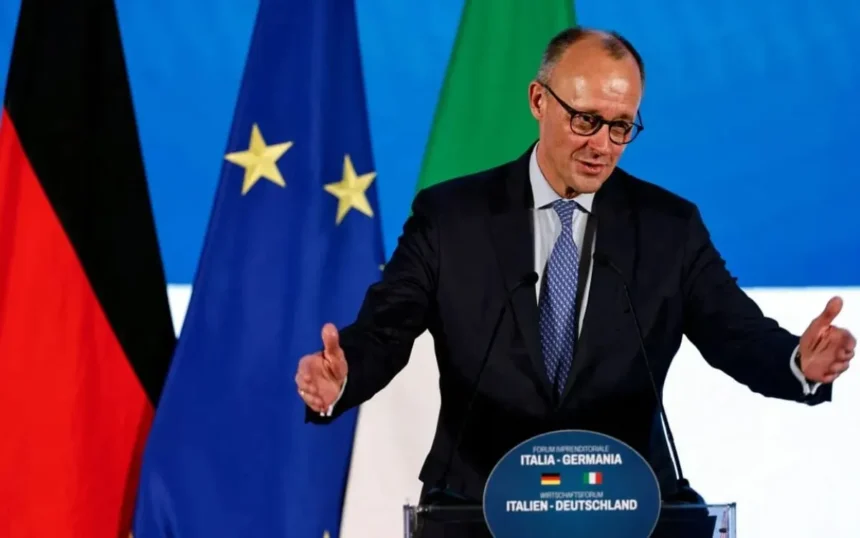
German lawyers have filed a criminal complaint against Chancellor Friedrich Merz and several other senior officials, accusing them of aiding and abetting what the plaintiffs allege is Israel’s genocide in Gaza. The complaint was submitted to the Office of the Federal Prosecutor in Karlsruhe and is backed by the European Legal Support Center (ELSC), the Palestine Institute for Public Diplomacy (PIPD), and the NGO Law for Palestine.
According to The Jerusalem Post, the complaint targets former Federal Chancellor Olaf Scholz, former Foreign Minister Annalena Baerbock, former Economy Minister Robert Habeck, current Foreign Minister Johann Wadephul, current Economy Minister Katherina Reiche, and Defense Minister Boris Pistorius. Top executives at German arms manufacturers Rolls‑Royce Solutions GmbH, Dynamit Nobel Defence GmbH, and RENK Group AG are also named.
The 100‑page filing alleges that Israel has committed genocide, crimes against humanity, and war crimes in Gaza and that German officials have materially assisted these acts by approving arms exports. The lawyers argue that the German government has knowingly enabled crimes against the Palestinian population through its weapons policy.
How does the complaint describe Germany’s role in Gaza?
As reported by The Jerusalem Post, the lawyers describe Germany as the second‑largest arms supplier to Israel, after the United States. They state that between October 7, 2023, and May 12, 2025, the German government issued export licenses worth more than €485 million. The government initially suspended new licenses in August 2025 but later resumed them in November 2025.
The complaint specifies several German‑supplied weapon systems allegedly used by the Israeli military in Gaza, including Heron TP combat drones, Sa’ar 6‑class corvettes, 120 mm tank ammunition, and other munitions and mechanical parts. The lawyers say these systems have been deployed in densely populated areas, contributing to civilian casualties and destruction.
Nadija Samour, a senior legal officer at the European Legal Support Center, is quoted as saying that German officials have “openly and repeatedly boasted about their unconditional and unlimited support for Israel.” The complaint argues that, given the documented consequences of that support, the defendants bear responsibility under international criminal law.
What are the legal and political reactions?
Lawyer Benjamin Düsberg of the Berlin Lawyers’ Collective told The Jerusalem Post that the Federal Public Prosecutor must now open an investigation if there are sufficient grounds for suspicion, as required by the UN Convention on the Prevention and Punishment of the Crime of Genocide. He warned that a failure to investigate would signal that Germany applies double standards in enforcing international law.
In a related development, an earlier appeal by the Berlin Lawyers’ Collective to enforce an immediate ban on arms deliveries to Israel was rejected by the Administrative Court of Berlin in June 2024. The court ruled that the federal government claimed it had not approved further weapons exports to Israel since February 2024, rendering the requested injunction moot. The lawyers disputed this, arguing that they had no confidence the government would abide by its obligations under international law.
One of the plaintiffs, Dr. Qassem Massri, a Gaza‑born German pediatrician, described losing family members, old friends, and colleagues during the Gaza conflict. He stated that Germany’s weapons and political rhetoric had supported what he called a “horrendous genocide” and that the complaint seeks to ensure that “Never Again must be Never Again for everyone.”
What are the likely next steps and implications?
Under German law, the Federal Public Prosecutor is obliged to review the complaint and determine whether there is sufficient evidence to open a formal investigation into charges of aiding and abetting genocide. No decision on whether to launch such an investigation has been announced yet, and the office has not publicly commented on the case beyond its standard procedural obligations.
If the prosecutor opens an investigation, it could lead to witness hearings, seizure of documents related to export licenses, and potential indictments. Even if no charges are brought, the case may intensify domestic and international scrutiny of Germany’s arms‑export policy toward Israel and its compliance with international humanitarian law.
The complaint also adds to a broader legal and political debate in Europe over whether certain states’ support for Israel in Gaza could amount to complicity in genocide. Similar legal actions have been brought in other countries, while governments and human‑rights groups continue to dispute the appropriate legal characterization of Israel’s conduct in Gaza.
German lawyers have filed a criminal complaint against Chancellor Friedrich Merz and ten other officials over their alleged aiding and abetting of Israel’s genocide in Gaza through arms exports and political support. Moves by the Federal Public Prosecutor in the coming weeks will determine whether the case advances to a formal investigation.