


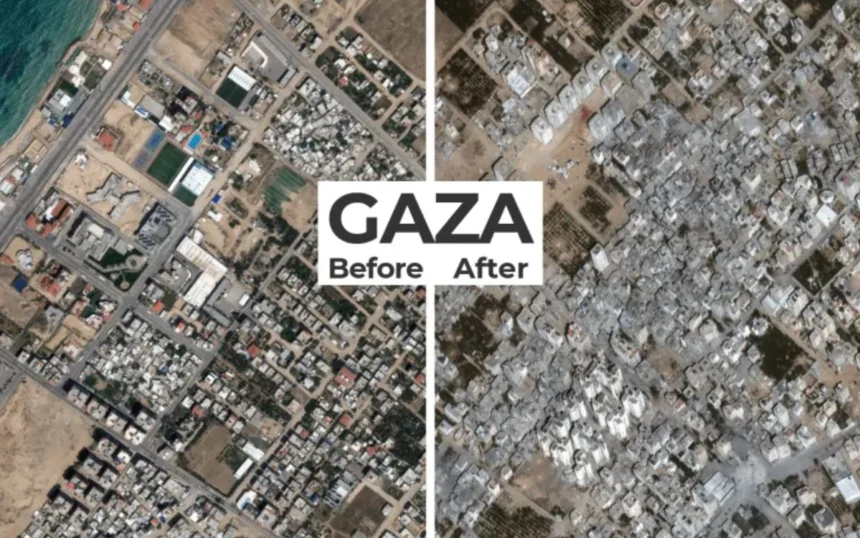
Gaza has changed dramatically since the start of the Israel-Hamas war, with aerial and satellite reporting showing widespread destruction across neighborhoods, roads, homes, and civilian infrastructure. Reporting from BBC, Reuters-linked coverage, and the United Nations has described a territory where large parts of the built environment have been reduced to rubble.
As reported by BBC Verify, the damage is extensive enough that rebuilding will take years and require a vast clearing effort before reconstruction can begin. The UN has estimated the cost of restoring Gaza at about $70 billion, while also saying that destruction across the enclave is around 84 percent, and even higher in Gaza City.
What changed in Gaza?
Before the war, Gaza’s cities, ports, roads, and residential districts formed a densely populated coastal enclave with fragile infrastructure and limited economic space. Since then, drone and satellite imagery have shown once-busy urban areas flattened, with high-rise buildings replaced by tent encampments and collapsed concrete filling streets.
According to the United Nations, 92 percent of housing units have been destroyed or damaged, 70 percent of all structures have been hit, and roughly 1.3 million people have needed emergency shelter. The same reporting says more than 94 percent of Gaza’s farmland has been destroyed, intensifying food and recovery concerns.
Context and reactions
How are aid agencies describing the scale of loss?
The UN Development Programme has called the reconstruction challenge “worse than starting from scratch,” because the territory is covered not by open ground, but by debris left from months of bombardment. That assessment reflects the practical difficulty of clearing rubble, restoring utilities, and rebuilding homes at the same time.
BBC Verify reported that more than 60 million tonnes of debris may need removal, and the UNDP has said clearing the rubble could take years even under favorable conditions. UN officials have also warned that aid remains far below what is needed to support displaced families and begin recovery.]
Supporting details
The visual record has become one of the clearest ways to understand the change in Gaza. Reuters-style and broadcast coverage have relied heavily on satellite images and drone footage to show how districts that once contained apartment blocks, markets, and roads now appear as leveled or heavily scarred terrain.
That damage has also altered daily life in Gaza, where many residents have returned to find their neighborhoods unrecognizable or inaccessible. BBC reporting said the destruction in some areas reaches 92 percent, and that the rebuilding challenge includes not just homes but schools, clinics, utilities, and other basic services. In UN terms, the crisis is not only about demolition, but about the removal of the remnants of war before any sustained reconstruction can begin.
What comes next?
What does recovery in Gaza depend on?
Confirmed reporting points to three immediate requirements: sustained ceasefire conditions, safe debris removal, and large-scale financial support for reconstruction. Without those, humanitarian agencies say rebuilding cannot move beyond planning and emergency shelter.
The UN has said that around $20 billion would be needed in the first three years alone to begin the reconstruction process, while the broader recovery bill stands near $70 billion. Even with that funding, the road back would be slow because infrastructure repair, housing replacement, and utility restoration all depend on secure access and continued aid delivery.
Conclusion
The verified reporting shows a Gaza that has been transformed from a crowded urban enclave into a landscape marked by destruction, displacement, and urgent humanitarian need. What remains now is not just physical rebuilding, but the far larger task of clearing rubble, restoring basic services, and creating conditions for people to live safely again.
Had a lucky streak here last night! The system is transparent and the wins feel legit. Can’t wait to go back to pk999win
Such a friendly community and the support team is actually helpful. It feels more personal than other sites. Glad I found phjdlove.
Honestly, this is one of the most stable sites I have used recently. The loading speed is great and the interface is very friendly for beginners. Highly recommend phjljl7777 for anyone looking for a smooth experience!