


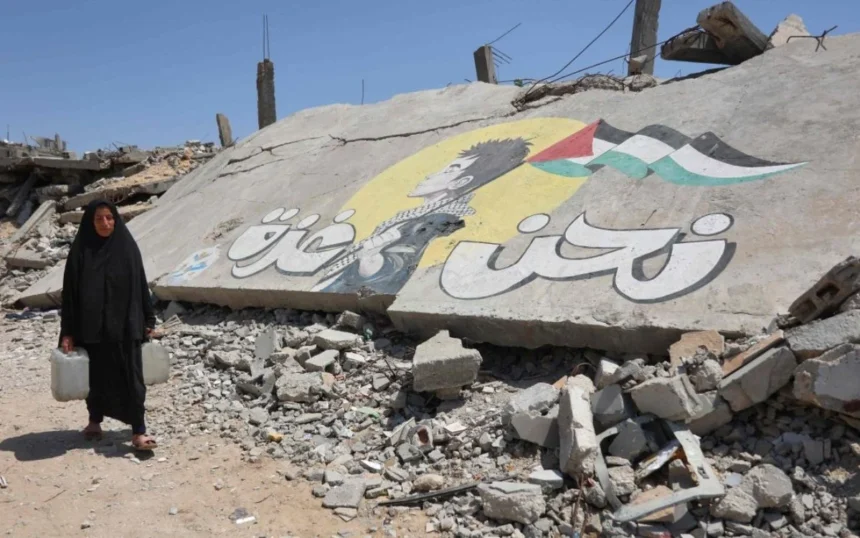
An estimated 8,000 Palestinian bodies remain buried beneath the rubble of buildings in the Gaza Strip, while less than 1% of the wartime debris has been removed so far. According to the Turkish Daily Sabah, quoting an Israeli newspaper and a United Nations official, the number of unrecovered remains reflects the scale of destruction and the very slow pace of recovery since the latest phase of the conflict ended. The report highlights that, despite the lifting of active hostilities in parts of the enclave, Gaza still functions in many areas as an open, largely un‑cleared graveyard.
The figure of 8,000 bodies is based on data compiled by Gaza’s Civil Defence and other Palestinian‑led emergency services, which have been cataloging casualties and search‑and‑recovery operations since Israel’s major military campaign began in October 2023. As reported by Daily Sabah, Civil Defence officials say their teams have exhumed hundreds of bodies from collapsed homes, shelters, and hospitals, but massive swaths of urban areas remain too dangerous or logistically inaccessible to clear. The outlet notes that the organization has repeatedly warned that equipment shortages, damaged roads, and the presence of unexploded ordnance have hampered its ability to systematically remove debris.
The United Nations Development Programme (UNDP) has also contributed to the assessment, with an unnamed UNDP official telling the Israeli newspaper Haaretz that the rate of debris removal is so low that it could take up to seven years to clear most of the rubble at the current pace. According to Daily Sabah’s summary of that interview, the official said thousands of bodies are still trapped beneath collapsed buildings across Gaza and that the slow clearance leaves families in prolonged uncertainty about the fate of missing relatives. UNDP’s own public briefs elsewhere estimate that the war has generated tens of millions of tonnes of rubble, creating what the agency describes as one of the largest post‑conflict debris challenges in recent history.
How much rubble remains?
The amount of rubble in Gaza is staggering. Other credible outlets, including TRT World and UNDP‑cited analyses, report that the conflict has left roughly 60–68 million metric tons of debris across the 365‑square‑kilometer strip. According to Daily Sabah’s reporting, less than 1% of that total has been cleared so far, leaving vast neighborhoods of Gaza City, Khan Younis, and Rafah still buried under collapsed structures, broken concrete, and twisted metal. The outlet notes that even in areas where ceasefires or temporary pauses in hostilities have been observed, the scale of destruction makes mechanical clearance extremely slow.
Rubble removal is not only a humanitarian necessity but also a precondition for rebuilding homes, hospitals, schools, and water and power infrastructure. As reported by Daily Sabah, UNDP and other reconstruction bodies have stressed that until the majority of debris is cleared and safely disposed of, large‑scale reconstruction cannot begin in most of the hardest‑hit districts. The outlet adds that the few operational sites where rubble is being crushed and recycled are vastly insufficient to keep up with the total volume, and that funding and equipment constraints limit the number of such sites Gaza can host at any one time.
Civil Defence officials quoted in related reporting warn that the incomplete clearance also poses serious health and safety risks. According to Daily Sabah’s coverage, the organization says unexploded ordnance, contaminated rubble, and the structural instability of half‑shattered buildings complicate rescue and recovery missions. The outlet notes that search teams often must pause or reroute operations when they encounter unstable structures or suspected munitions, which further slows progress and increases the emotional toll on both rescuers and families waiting for news.
Families and missing loved ones
The persistence of 8,000 unrecovered bodies has profound psychological and cultural implications for Palestinian families. As reported by Daily Sabah, many relatives of those who died during the war have not been able to perform basic burial rites or to visit graves, because the bodies remain entombed under concrete and steel. The outlet notes that Palestinian civil‑defense and humanitarian groups have described this as a delayed form of mourning, in which families live in a state of suspended grief, unsure even of the precise location of their loved ones’ remains.
Daily Sabah also cites Gaza Civil Defence statements that say the number of missing people may be even higher than the 8,000 bodies trapped under rubble. The outlet reports that Civil Defence has warned of several thousand additional missing individuals whose status—alive, dead, or detained—remains unknown. This uncertainty, the outlet explains, leaves families in a limbo that can last for months or even years, as they struggle to reconcile incomplete information from hospitals, shelters, and overcrowded morgues.
Some families have begun makeshift memorial practices, such as marking known locations of destroyed homes with stones or plaques, in the absence of formal graves. According to Daily Sabah, these informal memorials are multiplying in neighborhoods where systematic clearance has not yet begun. The article notes that local volunteers and religious leaders have tried to organize small‑scale recovery efforts, but they are constrained by the lack of heavy machinery, protective gear, and mine‑clearance expertise.
International and humanitarian responses
The scale of the buried‑bodies problem has drawn repeated attention from international organizations and humanitarian actors. According to Daily Sabah’s reporting, UNDP and other UN agencies have repeatedly called for expanded access, more equipment, and greater funding to accelerate rubble removal and victim recovery. The outlet notes that assessments by UNDP and UN Environment Programme have warned that at the current pace, clearing most of Gaza’s rubble could take years, even if international support is significantly increased.
Daily Sabah also highlights that some international organizations have raised concerns about the long‑term health and environmental impact of the rubble. The outlet reports that UN agencies have pointed to the presence of hazardous materials, including asbestos, heavy metals, and unexploded ordnance, which can contaminate soil and water supplies if not properly managed during clearance. The article says these risks are particularly acute in densely populated urban areas where rubble has mixed with sewage and other waste, creating what some officials describe as a public‑health time‑bomb.
Some regional and international donors have pledged support for rubble removal, but the outlet notes that disbursements have been slow and coordination among parties remains challenging. According to Daily Sabah, UNDP estimates it will need around 110 million U.S. dollars immediately to scale up rubble‑clearance operations and maintain a seven‑year timeline for completing most of the work. The article adds that donor governments and NGOs face legal, security, and political constraints in operating within Gaza, which further complicates the logistics of large‑scale debris removal.
Future reconstruction and recovery
The estimate of 8,000 bodies still under rubble is closely tied to the broader question of how and when Gaza can be rebuilt. As reported by Daily Sabah, UNDP and Palestinian officials have stated that safe and thorough rubble removal must precede large‑scale reconstruction, because it is impossible to construct new homes or infrastructure on top of unstable, contaminated debris. The outlet notes that the agency has already begun pilot projects to crush rubble and recycle it into construction materials, but these efforts cover only a small fraction of the total debris volume.
Daily Sabah also reports that UNDP and housing‑sector partners have started constructing temporary shelters and housing units for displaced Palestinians, in parallel with the slower rubble‑removal work. The outlet says the UNDP‑led program aims eventually to provide hundreds of thousands of temporary units, as a stop‑gap measure while the more complex, long‑term reconstruction of homes and neighborhoods is planned. The article notes, however, that many displaced families remain skeptical they will ever be able to return to their original neighborhoods, especially where entire blocks are reduced to rubble.
The persistence of so many unrecovered bodies also raises difficult questions about documentation, accountability, and commemoration. According to Daily Sabah, civil‑defense and humanitarian groups have warned that without systematic recovery and identification, some deaths may never be properly recorded in official statistics. The outlet reports that these organizations are urging more investment in forensic and documentation capacity, as well as in processes that allow families to verify the identities of recovered remains and to participate in dignified burial procedures.
In practical terms, the situation means that large parts of Gaza will continue to function as zones of partial, fragmented recovery rather than as stabilized, rebuilt communities. Daily Sabah’s reporting suggests that unless the pace of rubble removal increases significantly, the 8,000 unrecovered bodies, along with tens of thousands of tons of debris, will remain a visible and buried reminder of the war’s human and physical toll for years to come.
Honestly the win rates here are impressive. I had a lucky streak yesterday that I cannot believe. If you want a fair game visit idimbagacor
Such a great vibe on this site. The graphics are crisp and the gameplay is very fair. I always have a blast on ph9ajili.
The VIP treatment is the real deal here. Fast deposits and even faster withdrawals. I am sticking with br44vip for sure.
Really impressed with the game variety here. I spent all night trying different slots and hit a decent jackpot. Give g7777login a try if you love slots.
I really appreciate the fair play and the transparency of this site. It is hard to find such honest platforms these days. Check out 9ajilicom.