


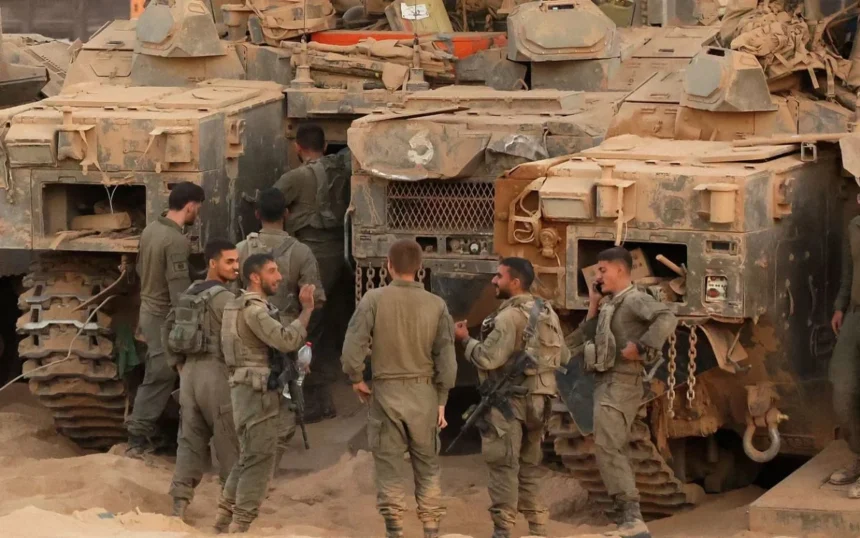
Israel has expanded its military control over nearly 60 percent of the Gaza Strip. This development comes despite an ongoing ceasefire. Army Radio reported the expansion on Sunday.
Senior military officials cited by the broadcaster argue now is the optimal time to defeat Hamas. Operational plans for renewed attacks are complete. A final decision awaits political approval.
General Context
As reported by Mera Aladam of Middle East Eye, Israel has pushed the so-called “Yellow Line” to absorb more territory. This leaves Gaza’s population confined to roughly 40 percent of the enclave.
Troops remain stationed across 59 percent of Gaza in the south, north, and east. The US-brokered ceasefire began in October to halt attacks and allow aid flow.
According to Army Radio, Israeli forces reduced presence in southern Lebanon. Brigades redeployed to Gaza and the occupied West Bank.
The military noted a recent increase in attacks. Palestinian health ministry figures show at least 832 Palestinians killed in near-daily shelling since the truce.
Overall, more than 72,000 Palestinians have been killed since October 2023. Thousands more are missing under rubble.
Under the ceasefire, Israel was to allow up to 600 aid trucks daily. Gaza authorities report averages below 200 trucks due to restrictions.
When the truce started, Israel controlled nearly half of Gaza via the unilateral “Yellow Line.” Later phases planned gradual withdrawal.
What Are the Reactions?
New maps issued by Israel show control over nearly two-thirds of Gaza. Reuters reports an expanded restricted area marked by an orange line beyond the Yellow Line.
As reported by Pesha Magid, Nidal al-Mughrabi, and Alexander Cornwell of Reuters, the orange line covers 11 percent more territory. Aid groups received these maps in mid-March.
COGAT, Israel’s military agency, states the zone requires coordination for humanitarian movements. It aims to enable aid while safeguarding personnel.
Displaced Palestinians express fears of being targeted. Rani Ashour, living near Gaza City, said residents lack water and aid due to risks.
Jad Isaac of the Applied Research Institute-Jerusalem estimates Israel controls at least 64 percent of Gaza. He notes the population squeezed into a coastal sliver.
Amjad al-Shawa of the Palestinian NGOs Network cited confusion over shifting boundaries. Lines move without warning, he said.
Since the ceasefire, over 800 Palestinians killed by Israeli fire near the Yellow Line. Four Israeli soldiers also died in the period.
Supporting Details
Israeli Prime Minister Benjamin Netanyahu stated in March that more than half of Gaza is under control. He emphasized proactive military initiative.
The expanded zones raise doubts on U.S. plans for Gaza. Discussions stalled over Hamas disarmament amid other regional conflicts.
Behind the Yellow Line, Israel bulldozed buildings and displaced civilians. U.S. and UAE drafted development plans for the area.
At least three aid workers killed in the orange zone since mid-March. Two from UNICEF, one from WHO, amid reported threats.
Israel describes seized areas as buffer zones against attacks. This follows the October 7, 2023, Hamas-led assault.
Army Radio reports military pressing for resumption. They cite completed plans pending leadership nod.
Ceasefire violations include shelling. Palestinian medics confirm hundreds dead post-truce.
How Will This Evolve?
Plans for renewed war hinge on political approval. Senior officials push for action now.
The ceasefire’s later phases foresaw full withdrawal. Israel has steadily expanded instead.
Aid restrictions persist below agreed levels. Gaza faces ongoing shortages.
Netanyahu’s government includes voices calling for Palestinian departure. This fuels concerns over permanent control.
Buffer zones in Gaza, Syria, and Lebanon aim to prevent militant threats. Boundaries remain dynamic per military assessment.
Trump administration’s Gaza plan delayed. Expansion casts further uncertainty.
Military redeployments signal preparation. Forces shift from Lebanon to Gaza.
Shifting lines complicate aid and civilian life. Coordination required in expanded zones.
Israel weighs Hamas truce offers separately. A 60-day proposal included partial withdrawal from 75 percent control.
Qatari mediators noted pathways to end war. Hostage releases and aid tied to deals.
Hamas ceasefire proposals unmet by response. Escalations continue amid talks.
Israeli maps not public. Aid groups briefed privately.
Population of nearly 2 million confined tightly. Viability concerns rise.
Developments monitor political decisions closely. Military readiness high.
Army Radio highlights optimal timing argument. Hamas defeat in focus.
International calls for truce grow. Operations intensify pre-U.S. visits.
COGAT updates boundaries per operations. Signs warn of dangers.
Fears of permanent hold persist. Displacement deepens.
Israel controls expanded territory via lines. Humanitarian access challenged.
Plans complete for potential resumption. Approval awaited.
Gaza authorities decry aid shortfalls. Trucks far below 600 daily.
Military coy on troop numbers. Operations dubbed Iron Swords earlier.
Jabalia raids killed around 100 in past. Advances through open areas.
Buffer zones stoke expulsion fears. Arab concerns mount.
Netanyahu video affirms control. Surprises enemies, he said.
Aid workers’ deaths prompt questions. Coordination unclear in some cases.
Palestinian think tank maps 64 percent hold. Coastal confinement total.
NGOs note boundary confusion. Daily shifts reported.
Ceasefire intended to end two-year conflict. Violations tally high.
Over 72,000 dead overall. Rubble hides missing.
Political leadership to decide next. Military prepared.
Israel seizes nearly 60 percent of Gaza despite the ceasefire. Plans to resume war are ready, per Army Radio. Population faces confinement and aid woes as lines expand.
Really loving the variety of options available here. It keeps things exciting and I never get bored. Cheers to the team at bdzb777 for this awesome experience.
Finally found a platform that doesn’t lag during peak hours. The registration process was a breeze. Great job guys at phjljl1.
Best experience I have had in a while. The payouts are fair and the customer support is actually helpful. Highly recommended for anyone in PH looking for a reliable site. Visit 85phcom
Super convenient app for gaming on the go. Everything works perfectly and the user interface is very modern. 0kzzapp