


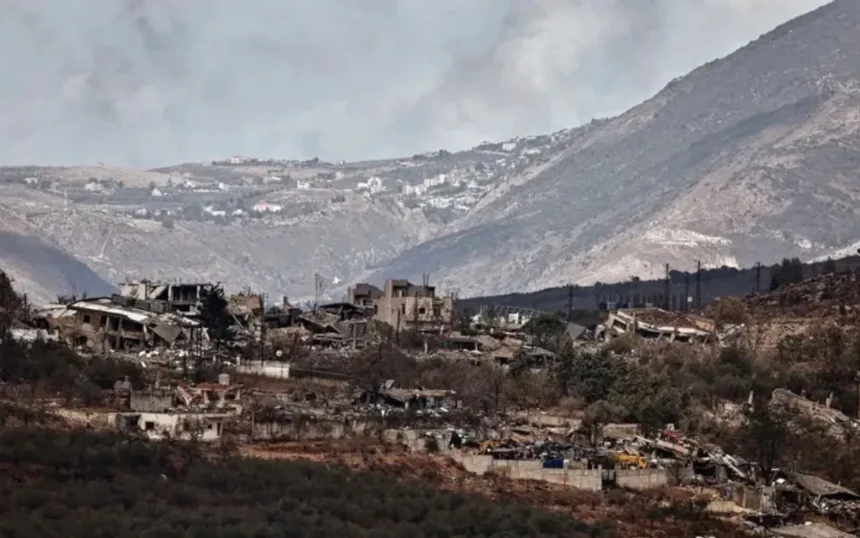
Israel’s military says it has established a “Yellow Line” demarcation in southern Lebanon, similar to the one it uses in Gaza to separate its forces from territory still held by Hamas. As reported by Naharnet, the Israeli military announced on April 18 that the line serves as a forward boundary in its operations against Iran‑backed Hezbollah along the Israel–Lebanon frontier. According to the same outlet, the IDF stated it had already struck suspected militants who approached its troops along the newly declared line.
As reported by The Straits Times, the Israeli military said its forces operating south of the Yellow Line in southern Lebanon identified “terrorists” who violated ceasefire understandings and approached troop positions from north of the line in what it described as a threatening manner. The IDF’s statement emphasized that the moves were carried out within the framework of arrangements tied to the broader ceasefire still in effect along the border.
The Israeli military has refrained from publicly detailing the exact geographic coordinates of the line, but regional reporting notes that the Yellow Line follows a similar logic to the demarcation used in Gaza, where it marks the outer limit of Israeli troop deployment and the threshold beyond which movement is treated as a security threat. According to Le Monde, the concept is meant to signal a clearly defined operational boundary, even as the nature of the conflict diffuses across border towns and rural areas.
What the Yellow Line means on the ground
The introduction of a Yellow Line in southern Lebanon effectively carves out a new de‑facto security strip, within which Israeli forces reserve the right to open fire on anyone approaching in a manner they assess as threatening. As reported by Naharnet, the IDF said that over a 24‑hour period its units recorded multiple incidents in which individuals approached the line from the north, prompting targeted strikes.
Regional analysts quoted in Le Monde contextualize the move as part of a broader shift toward consolidating control along a defined forward line, rather than pursuing deeper, large‑scale incursions into Lebanese territory. The line is being treated as a walking‑back distance from the actual border, allowing Israeli forces to maintain a buffer while limiting the appearance of a full occupation.
Reactions and security concerns
The Lebanese Army has not issued an explicit response specific to the Yellow Line designation, but previous statements on Israeli border activity warned that any incursion or redeployment deemed to violate agreed‑upon understandings would be treated as a provocation. According to Annahar, Lebanon’s military has been repositioning units near southern border towns in reaction to repeated Israeli strikes, underscoring the fragile nature of the present ceasefire framework.
Rights groups cited by regional coverage have expressed concern that vague rules of engagement around such a line could increase the risk to civilians in nearby villages, as people may be unaware of the exact location or the criteria that define “threatening” behavior. The lack of clear public cartography for the Yellow Line, in contrast to visible markers used in parts of Gaza, has prompted questions from local residents and humanitarian actors about how to safely navigate the area.
Implications and future developments
The establishment of a Yellow Line in southern Lebanon suggests that Israel intends to institutionalize a fixed forward boundary in its campaign, mirroring the Gaza model where the line functioned as a key operational and legal marker for its forces. According to The Straits Times, this could signal a move toward a more static, zone‑based posture rather than open‑ended ground operations, even as low‑level clashes continue.
Outside observers note that the proliferation of such demarcation lines along multiple fronts raises complex questions about long‑term security architecture and the potential for future flare‑ups if the lines are redrawn or tested again. As reported by regional outlets, any expansion, adjustment, or re‑negotiation of the Yellow Line is expected to be closely watched by neighboring states and international mediators monitoring the broader ceasefire arrangements.
Israel’s military says it has established a “Yellow Line” demarcation in southern Lebanon, similar to the one it enforces in Gaza, and has already carried out strikes on suspected militants who approached its troops along the new boundary. The move sharpens the rules of engagement along the border but leaves the precise location and long‑term durability of the line subject to ongoing military and diplomatic negotiations.
Finally found a site that doesn’t lag during the peak hours. The interface is super clean and easy to navigate. Love the vibes at rusia777login
Really appreciate the customer support here. They helped me out quickly. Great vibes at phjili49!
Finally found a site that doesn’t lag during peak hours. The interface is super clean and getting in is a breeze. Highly recommend ph7777login for a hassle-free session.
The community here is great and the promotions are always exciting. It feels like a premium experience every time I log in to phjilipark22.
Super reliable site. I’ve had some issues with other links before but this login page is stable and secure. Happy with the service at muliajitulogin.