


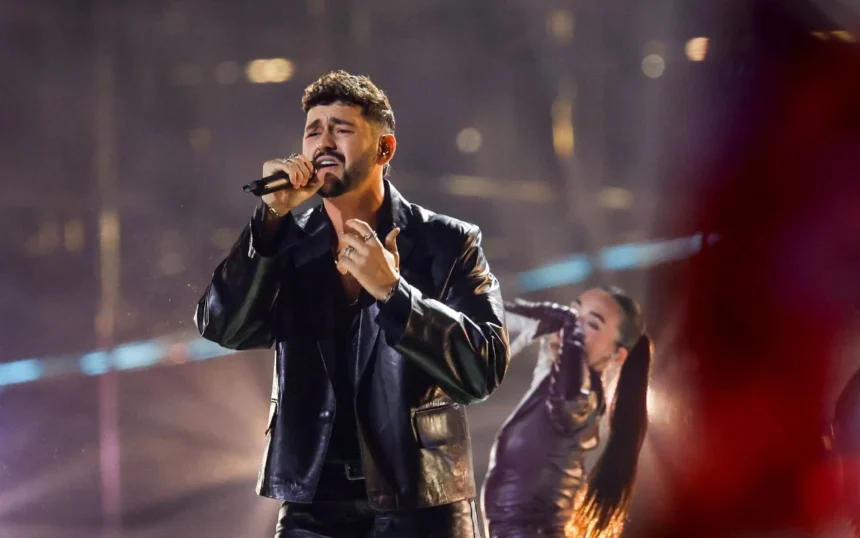
The 70th Eurovision Song Contest opened in Vienna on Tuesday under unusually political and emotional strain, as Israel’s participation in the first semi‑final reignited debate over the war in Gaza and fueled both protests and a multi‑country boycott. As reported by Reuters journalist Francois Murphy, the event began in the Austrian capital with a planned pro‑Palestinian demonstration scheduled just hours before Israel’s performance, underscoring how the usually upbeat music‑show format has become entangled in a broader geopolitical conflict. According to Reuters, this year’s contest features 35 entries, the smallest field since 2003, after five public‑broadcasting nations withdrew in protest over Israel’s inclusion.
The five countries that have boycotted Eurovision 2026 are Spain, the Netherlands, Ireland, Iceland, and Slovenia, several of which are long‑standing European heavyweights in the competition. As reported by Al Jazeera, their public broadcasters cited the humanitarian crisis in Gaza and allegations of disproportionate Israeli military force as the primary reasons for their withdrawal. The European Broadcasting Union (EBU), which oversees Eurovision, has consistently maintained that Israel meets the contest’s eligibility criteria and that political neutrality is formally upheld at the institutional level, even as member states remain divided over the optics of Israel’s presence on stage.
Hours before the first semi‑final in Vienna’s Wiener Stadthalle, a preliminary protest was expected to draw several hundred people to central parts of the city, according to Reuters. Austrian police told media that they anticipated “blockades and disruption attempts” around contest venues and said extra security measures had been put in place for the week. The police also noted that spontaneous demonstrations could occur, especially during Saturday’s grand final, reflecting the friction between the organizers’ aim to present a festive, non‑political spectacle and the reality of a deeply polarized audience.
Israel’s slot in the first semi‑final, announced in January during the official allocation draw, placed it among 14 other countries vying for 10 qualifying spots to the final. According to Greek‑based outlet Greek City Times, the draw placed Israel alongside past winners such as Sweden, Finland, Greece, Portugal, Estonia, and Serbia, intensifying the focus on its performance. The Israeli representative, chosen by the country’s public broadcaster, is competing in a contest that has repeatedly faced pressure campaigns in recent years to exclude Israel, with artists and activists arguing that participation serves as de facto normalization for its conduct in Gaza.
Several former Eurovision winners and high‑profile figures have publicly criticized Israel’s participation. As reported by Reuters, Austrian singer JJ, who won the 2025 contest, stated in an interview that Israel should be excluded from Eurovision 2026 because of its conduct during the Gaza war. JJ’s comments echoed broader unease among segments of the European music community, some of whom argue that allowing Israel to compete risks turning the contest into a platform for political messaging, even though the EBU officially prohibits political statements in the performances themselves.
Why is Gaza casting a shadow over Eurovision?
The Gaza war, which began after the Hamas‑led cross‑border raid on October 7, 2023, has claimed tens of thousands of lives and displaced much of Gaza’s population, according to multiple international news outlets covering the conflict. As reported by Al Jazeera, Gazan health authorities and several humanitarian organizations have cited figures exceeding 70,000 deaths in the enclave, predominantly civilians, triggering widespread condemnation and calls for sanctions or other forms of diplomatic pressure on Israel. Eurovision organizers have stressed that the contest is not a political body, but many viewers and activists argue that cultural events cannot be fully insulated from the politics of their participants.
Israel’s participation in Eurovision has long been a magnet for controversy, with critics accusing the state of using the contest for soft‑power diplomacy during periods of military action. In previous years, the European Broadcasting Union rejected Israeli song entries deemed too overtly political, including a version of a song referencing the October 7 attacks, which Al Jazeera reported clashed with the EBU’s own rules on political neutrality. This history has made the 2026 inclusion of Israel especially sensitive, as audiences scrutinize lyrics, staging, and post‑performance comments for any hint of political messaging.
The boycott by five countries has significantly altered the landscape of this year’s competition. As reported by The Express Tribune, the withdrawal of Spain, the Netherlands, Ireland, Iceland, and Slovenia has reduced the field to 35 entries, the smallest number since 2003. The article notes that Austrian authorities and organizers had anticipated smaller crowds and lower broadcasting interest as a result, worrying that the political controversy could undercut the event’s commercial appeal and its role as a unifying cultural moment in Europe.
How are fans, artists, and governments reacting?
Within fan communities, reactions have been sharply divided. Some viewers say they want Eurovision to remain a space for music and entertainment, regardless of the political climates of the participating countries. Others argue that refusing to acknowledge Israel’s role in Gaza would amount to complicity, and have urged their national broadcasters to follow the example of Spain, the Netherlands, Ireland, Slovenia, and Iceland. Social‑media footage and commentary shared in the days leading up to the contest show both pro‑Israel and pro‑Palestinian slogans circulating among fans, as well as demands for EBU‑imposed sanctions or suspension of Israel’s membership.
At the same time, some artists and production teams have expressed concern that the tense atmosphere could overshadow their performances. The Express Tribune reported that several delegations privately told producers they feared the contest would be remembered more for its politics than for the songs. Organizers have reiterated that the rules prohibit any political statements on stage, yet they have struggled to enforce that boundary in a media environment where even neutral gestures—such as flags, colors, or stage imagery—can be interpreted as political signals.
European governments have largely avoided direct intervention, with the EBU describing member broadcasters’ decisions as editorial and political choices made at the national level. Spain’s public broadcaster RTVE, for example, stated that its withdrawal was prompted by “the tragic loss of lives in Gaza and the humanitarian crisis,” according to Al Jazeera, while Dutch and Irish broadcasters echoed similar humanitarian‑based reasoning. None of these governments have threatened to cut funding to the EBU, but the boycotts have raised questions about whether the union’s commitment to neutrality can withstand sustained pressure from both pro‑Israel and pro‑Palestinian camps.
What does this mean for Eurovision’s future?
The 2026 edition of Eurovision may mark a turning point in how the contest navigates geopolitics, especially as the Israeli‑Palestinian conflict remains unresolved. As Reuters has reported, there is growing nervousness among smaller broadcasters that future contests could see more withdrawals or even larger‑scale boycotts if the EBU continues to allow Israel to compete without imposing additional conditions. Some analysts quoted by European media outlets warn that a perception of biased membership rules could erode trust in the EBU’s neutrality and diminish the contest’s appeal across politically sensitive regions.
Commercially, the reduced number of participating countries and the polarization among audiences pose risks for advertising and sponsorship. The Express Tribune noted that several major brands had privately scaled back their marketing commitments for the 2026 show, wary of being associated with the controversy. Organizers in Vienna have emphasized that security and logistics are being tightly managed, but even a peaceful week of performances may not be enough to restore the image of Eurovision as a purely celebratory, apolitical spectacle.
For Israel, participation in Eurovision has long been a tool of cultural diplomacy, used to project a modern, creative, and outward‑looking national image. Yet the boycotts and street protests in Vienna have made it far harder to separate that image from the ongoing war in Gaza. As Reuters reported, Israeli officials privately acknowledged that the contest would be closely watched as a barometer of Europe’s appetite for normalisation amid the conflict, even as the EBU continues to insist that Israel’s participation is evaluated solely on artistic and procedural grounds.
What has already happened on the opening night?
On the night of the first semi‑final in Vienna, security was visibly heightened around the Wiener Stadthalle, with police cordons and additional checkpoints in place. Reuters reported that several hundred demonstrators gathered in central Vienna earlier in the day, carrying Palestinian flags and banners criticizing Israel’s military actions in Gaza. The protest remained largely peaceful, but police warned that tensions could rise in the run‑up to the Saturday final, when the largest crowds and international TV audiences are expected.
Inside the arena, the show proceeded with its usual mix of glitter, choreography, and light‑hearted banter, according to early international coverage. Israel’s performance was not singled out for hostile on‑screen commentary by the official hosts, in line with the EBU’s stance that politics should remain offstage. However, social‑media feeds and commentary in several countries indicated that many viewers were watching not only for the music, but for any subtle cues that might signal political alignment or dissent.
In the days ahead, attention will focus on whether the contest can regain its footing as a primarily musical event or whether the shadow of Gaza will continue to define Eurovision 2026 in the public eye. The boycotts, the reduced field, and the planned protests have already reshaped the edition’s narrative, and whoever claims the trophy on Saturday will inherit a win that is likely to be discussed as much for its political context as for its musical merit.
Quick and secure access every time. I appreciate the stability of this portal. For the fastest entry go with bosku777login.
Finally a site that understands what players actually want. The gameplay is fair and the rewards are generous. I am really enjoying my time on pkbatpkrgame.
Finally found a site that doesn’t lag during peak hours. The game variety here is insane and the rewards are actually fair. Give bat939game a shot, you won’t regret it.
Playing here has been such a refreshing change of pace. I love how transparent they are about game rules and bonus terms right from the start. The virtual table games feel incredibly realistic and the chat function adds a nice social touch. It is nice to finally play somewhere that respects its players and delivers on every promise. bdcv111