


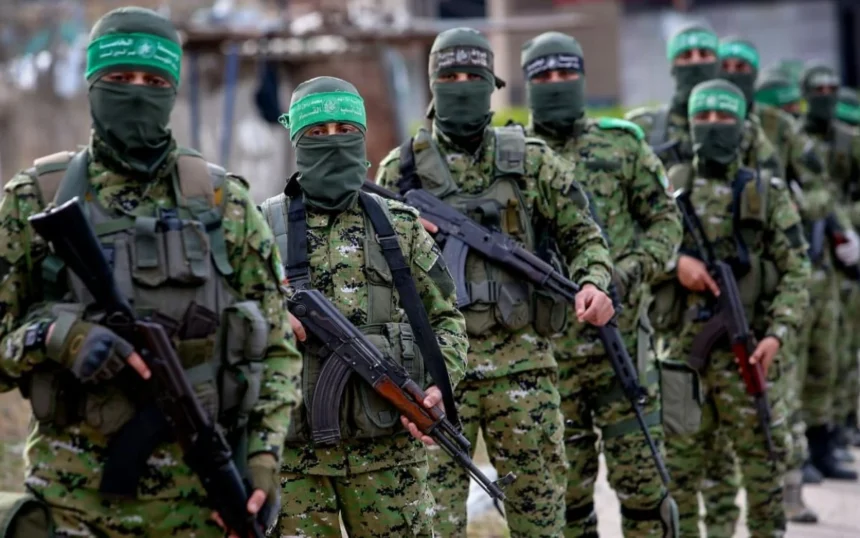
Indirect negotiations over Hamas’s disarmament in the Gaza Strip have reached an impasse, with Israeli security demands colliding against Hamas’s insistence on guarantees for its own members and the withdrawal of Israeli forces. As reported by Amichai Stein of The Jerusalem Post, senior officials in President Donald Trump’s Board of Peace, including Nickolay Mladenov, have been engaged in intensive talks on how to implement the 20‑point Gaza peace plan while managing the future of Hamas’s weapons. Stein writes that two sources told the paper Hamas has not accepted the plan and that significant gaps remain, although discussions continue amid broader debate about postwar governance in Gaza.
According to Stein, the core of the current deadlock lies in sequencing: Hamas wants an Israeli withdrawal and the entry of an international stabilization force before disarming, while Israel insists on substantial demilitarization before any further pullback. This “chicken‑and‑egg” dynamic has stalled the second phase of the plan, which is built on the premise that Israel will withdraw from parts of Gaza, reconstruction will begin and Hamas will give up its weaponry. Multiple regional and international actors are now examining whether this sequencing can be adjusted without undermining Israel’s security or Hamas’s sense of survival.
What Hamas wants before giving up weapons
Dr. Bishara Bahbah, a Palestinian‑American scholar, former hostage‑deal mediator and board member of the Gaza Soup Kitchen, has been in regular contact with key figures in the region and has described Hamas’s position to The Jerusalem Post. Bahbah said Hamas leaders have told him they are willing to hand over heavy equipment and, eventually, smaller arms, provided their “paramount fears” are addressed. One Hamas leader told Bahbah, “We are not only willing to hand over our weapons, but we can destroy those weapons in front of the world,” a statement Stein attributes directly to the unnamed leader via Bahbah.
Bahbah told Stein that the main obstacle is Hamas’s demand for personal security guarantees. “Hamas needs guarantees that the Israelis won’t come after them individually, that they won’t be targeted and assassinated,” he said. Hamas also views the current guarantors—represented by the United States, Egypt, Qatar and Turkey—as insufficient to prevent future Israeli operations against its members. In his remarks to the paper, Bahbah added that for any agreement to hold, “the issue of amnesty must be addressed,” suggesting that criminal or security‑related protections for former fighters could be a precondition for serious disarmament discussions.
How Israeli control affects the deadlock
Another major point of friction is the mapped extent of Israeli‑controlled territory in the Gaza Strip. Bahbah told Stein that data he has seen indicate Israeli‑controlled areas have expanded from about 51 percent to roughly 59 percent of Gaza. This widening of what is commonly called the “yellow line” has created situations where many Palestinians are unaware that certain lands are now formally under Israeli control, leading to further clashes and deepening mistrust. Bahbah argued that this expansion has hardened Hamas’s position, because it perceives that Israel is not fully honoring earlier commitments to withdraw and reduce its footprint.
Bahbah also described the humanitarian situation in Gaza as dire but slightly eased compared with the peak of the war. “I don’t get calls from people saying they are starving,” he told Stein, citing the 14 soup kitchens his organization operates seven days a week across Gaza. “But prices are high because the Israelis restrict the number of trucks. Many people cannot afford to eat chicken or beef on a regular basis.” He warned that Gaza remains “a hostage” to broader regional tensions involving Iran, recalling that during previous escalations Hamas strongly resisted his suggestion that the Gaza issue be decoupled from Iran‑related conflicts.
Why trust is so low on both sides
The environment in which these talks are taking place is one of near‑total mistrust, according to Bahbah’s assessment to Stein. Hamas fears that any move toward disarmament will be followed by targeted killings or renewed military pressure, even if an international force is present. For Israel, the experience of the 2023–2025 war and the capture of hundreds of hostages has made any step that might leave armed elements intact politically and strategically unacceptable. Multiple regional and international officials quoted in other outlets, including Reuters and the BBC, have said that both sides see the other as exploiting the current pause to consolidate their positions rather than to lay the groundwork for lasting peace.
According to the BBC, Hamas has communicated to regional mediators that it will not enter serious discussions on implementing the second phase of the 20‑point plan until Israel fully complies with first‑phase obligations, including a complete halt to attacks and full humanitarian access. Israel, in turn, has stated it will not proceed without measurable progress on Hamas’s disarmament, according to the same reporting. Egyptian, Qatari and Turkish mediators have shuttled between the parties, but the structural tension between “withdrawal first” and “disarmament first” has so far resisted compromise.
Supporting details from experts and aid groups
Bahbah’s comments to Stein are echoed by broader reporting on Gaza’s humanitarian and political condition. Middle East Eye and the Arab‑West Understanding platform have highlighted that reconstruction has barely begun, with tens of thousands still living in temporary shelters or overcrowded camps. The aid organization Gaza Soup Kitchen, which Bahbah helps lead, reports that logistical constraints—such as the small number of heavy‑duty excavators available—have left between 8,000 and 10,000 people buried under rubble, slowing recovery and public‑health efforts. The group also notes that only one tractor is currently available in the entire Gaza Strip to dig out bodies, underscoring the material paralysis that hampers any return to normal life.
Security analysts cited by outlets such as Reuters and Middle East Eye have said that Hamas’s internal politics also complicate disarmament. The movement is divided between factions that prioritize continued armed resistance and others that see demilitarization as a necessary step toward political survival and aid‑driven stabilization. These outlets report that any final agreement would likely require buy‑in from multiple Hamas committees, including its military wing and political leadership, which could slow internal decision‑making even if external parameters are clarified.
What the stalemate means for Gaza’s future
The question of how the disarmament deadlock can be overcome is central to the next phase of the Gaza peace plan. As Stein reports, the second phase of the 20‑point plan envisages disarmament, the establishment of a technocratic local administration acceptable to both sides, and the launch of large‑scale reconstruction with international funding. However, current reporting from the BBC and Middle East Eye indicates that without resolution on sequencing and guarantees, this phase risks being indefinitely postponed. The Board of Peace has reportedly signaled that it may reassess the ceasefire terms if Hamas continues to reject the disarmament proposal, while Hamas insists that Israel’s own violations of the ceasefire outline—such as continued limited strikes and partial control of territory—undermine its willingness to move first.
According to the BBC, Israeli officials argue that any further withdrawal without a clear commitment to demilitarization would create a security vacuum that other armed groups or militias could exploit. At the same time, Hamas and allied Palestinian officials quoted in Arab‑language outlets stress that Gaza cannot be expected to accept a structure that leaves Israeli forces in place while disarming Palestinian factions. Regional mediators, including Egypt’s intelligence chief and Qatari officials, are reportedly exploring sequencing formulas—such as phased withdrawals tied to specific disarmament milestones—but none of these have yet been accepted by both sides.
What could happen if talks continue to stall
If negotiations remain stuck, reporting from The Jerusalem Post and other outlets suggests several possible trajectories. One scenario is a gradual erosion of the existing ceasefire, with both sides accusing the other of violations and using those accusations to justify limited military actions. The BBC has noted that public statements from residents in Gaza indicate rising frustration with Israel’s continued control of large parts of the Strip and the slow pace of reconstruction, fueling skepticism about any negotiated settlement. Arab‑language outlets such as Al‑Araby Al‑Jadeed and Al‑Akhbar have warned that if Hamas is not given a credible security and political horizon, it may fall back on the rhetoric of resistance, while hard‑liners in Israel will resist any concessions that they see as rewarding terrorism.
Another possibility under discussion among diplomats and analysts is a partial implementation of the 20‑point plan that focuses on reconstruction and governance while leaving the weapons question unresolved for a longer period. Reuters and Middle East Eye have reported that some Western officials support such a “pragmatic” approach, arguing that economic and administrative stability could gradually weaken Hamas’s reliance on arms. However, these same sources note that Israel is unlikely to accept a long‑term arrangement that does not clearly preclude a rebuilt Hamas military structure, and that Hamas would resist any framework that effectively disarms it without guarantees of political survival and personal safety for its members.
Where the talks stand now
For the moment, the official line from both sides is that talks are ongoing, but substantive progress is limited. Stein reports that high‑level officials in the Board of Peace continue to shuttle between capitals and mediators, reworking language on sequencing, amnesty and the status of the yellow line. Bahbah told The Jerusalem Post that despite the current gridlock, he remains optimistic that a solution is “a question of time,” though he acknowledges that regional tensions with Iran and Lebanon continue to complicate the focus on Gaza. Other outlets, including the BBC and Reuters, similarly describe the situation as fragile but not yet at the point of collapse, with both Israel and Hamas publicly reaffirming their commitment to the ceasefire framework even as they argue over its interpretation.
In practical terms, Gaza remains divided between pockets of partial normalcy, heavily damaged neighborhoods and areas still under Israeli control or military oversight. The slow entry of aid, restrictions on truck numbers, and the lack of heavy machinery for rubble removal keep many communities in a state of suspended suffering. As Stein and others report, the path out of this situation depends on bridging the gap between Israel’s demand for security and Hamas’s demand for guarantees, a task that has so far eluded even the most intensive diplomatic efforts.
Really impressed with the fast payouts here. The interface is smooth and everything works perfectly on my mobile. Highly recommend jljl7login to everyone!
Very reliable site with a great layout. I’ve had a few big wins recently and the withdrawal was processed almost instantly. Love jilibet88login.
The login process is so fast and I never have issues accessing my account. Really impressed with the service at 6jililogin.
The app version is so convenient. I can place my bets while on the move without any glitches. Love using 3winapp daily.