


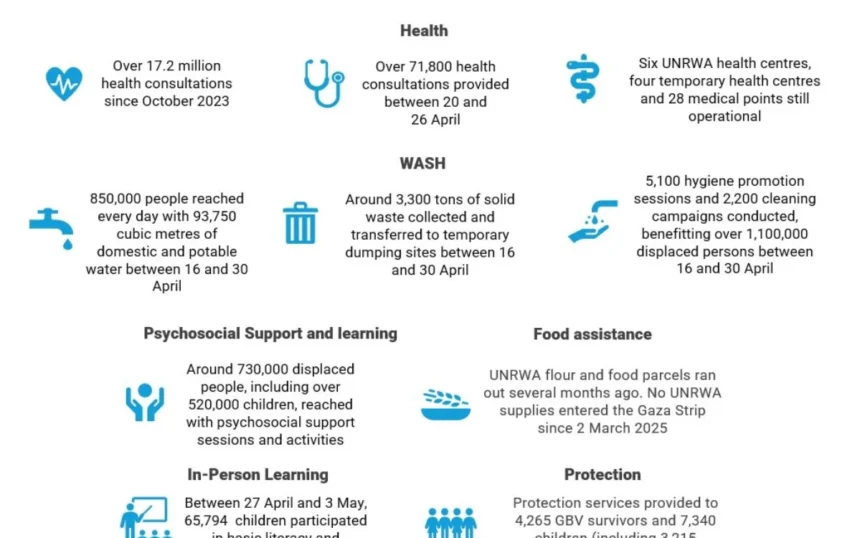
The United Nations Relief and Works Agency for Palestine Refugees in the Near East (UNRWA) has published its Situation Report 220 detailing the worsening humanitarian conditions in the Gaza Strip and the occupied West Bank, including East Jerusalem. The report, covering the period from 13 March to 27 March 2018, outlines how infrastructure deficits, political tensions and access restrictions continue to undermine basic services for Palestinians in both areas. It underscores the deepening dependence of Gaza’s population on emergency aid and points to the long‑running economic and social strain caused by more than a decade of blockade.
In the Gaza Strip, UNRWA and the United Nations Office for the Coordination of Humanitarian Affairs (OCHA) describe electricity and water sectors in severe disrepair. According to OCHA’s January 2018 Humanitarian Bulletin cited in the report, power shortages persist, with piped water reaching households for only a few hours every four to five days. Desalination plants, a primary source of potable water, operated at less than 60 percent of their capacity in early 2017. Approximately 1.2 million Gaza residents are reported to have no access to running water, and up to 97 percent of the water supplied through the aquifer is too polluted with salt and sewage to drink.
Matthias Schmale, Director of UNRWA Operations in Gaza, emphasized these conditions in a World Water Day op‑ed quoted in the report. He noted that less than 5 percent of aquifer water meets international drinking standards, forcing roughly 90 percent of Gaza residents to rely on desalinated water purchased from private providers. The cost of one cubic metre of such water ranges from 30 to 50 new Israeli shekels, compared with 1 to 1.3 shekels for water supplied through the municipal network. This price differential significantly increases the financial burden on Palestinians in Gaza, including the roughly one million refugees who depend on various forms of humanitarian assistance.
The report also highlights the growing demand for UNRWA’s services, even as funding gaps remain substantial. UNRWA states that it faces rising needs due to the expanding number of registered Palestine refugees, their heightened vulnerability and deepening poverty. Funding for emergency programmes and key projects continues to fall short of requirements. Prioritised needs in Gaza for the 2018 occupied Palestinian territory (oPt) Emergency Appeal include around 80 million U.S. dollars for emergency food parcels for nearly 1 million people, at least 10 million dollars for temporary cash‑for‑work opportunities through the Job Creation Programme, and 7 million dollars for the Community Mental Health Programme. In addition, following the 2014 conflict, 316 million dollars has been pledged toward UNRWA’s emergency shelter programme, but an estimated 720 million dollars is required, leaving a shortfall of 404 million dollars.
Movement restrictions at border crossings remain a key driver of the humanitarian situation in Gaza. UNRWA notes that Israel prevents all access to and from Gaza by sea and air, leaving movement of people and goods to three crossings: Rafah, Erez and Kerem Shalom. Rafah is controlled by Egypt and formally facilitates the passage of authorized travelers, Palestinian medical cases and humanitarian arrivals. Erez is controlled by Israel and permits limited movement of aid workers and some authorized travelers, again including medical and humanitarian cases. Kerem Shalom, also under Israeli control, is designated for authorized goods only. The report includes a table indicating that, during the reporting period, these crossings were frequently closed or operated under tight restrictions, sharply limiting the flow of people and supplies.
Throughout the reporting period, the operational environment in Gaza remained tense. Israeli patrol boats opened fire towards Palestinian fishing boats off the coast on eight occasions, forcing them back to shore. On 11 occasions, Israeli forces opened fire from the perimeter fence toward Gaza areas, resulting in one reported injury. Protests against the U.S. decision to move its embassy to Jerusalem occurred near the border fence on six occasions, with Israeli forces responding with gunfire and teargas when some youth approached the fence and threw stones; 16 injuries were reported. An improvised explosive device detonated near the convoy of then‑Palestinian Prime Minister Rami Hamdallah on Salah al‑Din Road, damaging three vehicles but causing no injuries. A mortar shell fired from Egyptian territory landed in western Rafah without exploding, also causing no damage or casualties.
In the occupied West Bank, including East Jerusalem, the situation is framed as one of protracted economic and social strain under occupation. UNRWA and accompanying UN documentation referenced in the report describe obstacles to movement, restrictions on access to land and resources, and recurrent coercive measures that heighten vulnerability. In East Jerusalem, home demolitions and revocation of residency rights have contributed to displacement and insecurity for Palestinian families, many of whom are registered refugees. The report notes that these conditions, combined with limited access to services and employment, exacerbate poverty and dependence on humanitarian support.
What the report says about nutrition and health
UNRWA’s Situation Report 220 stresses that the combination of power outages, water shortages and limited access to health care has a direct impact on nutrition and public health in Gaza. Reliance on expensive, privately desalinated water forces households to cut spending elsewhere, including on food and medicines. The report does not claim that Gaza is in a formal state of famine during this period, but stresses that the chronic shortage of electricity and clean water undermines the ability of basic services such as hospitals, clinics and water‑treatment plants to function reliably. OCHA data cited elsewhere in the broader UN humanitarian pipeline indicate repeated spikes in water‑borne illnesses and malnutrition‑related stress, particularly among children and pregnant women.
Matthias Schmale warned that should UNRWA’s services be further destabilized, additional downward pressure on already stressed households could push them toward negative coping mechanisms. In his International Women’s Day speech reproduced in the report, he said “should UNRWA’s work be further and significantly destabilized, increased poverty, stress and tension can lead people to rely on negative coping mechanisms such as physical or verbal violence, child marriage, divorce, school dropouts, and social unrest.” He framed continued support for UNRWA as essential to preserving decades of investment in education, health and social services for women and girls in Gaza.
How funding and political support are shaping the response
Internationally, UNRWA’s Situation Report 220 points to a high‑level Ministerial Conference in Rome that took place on 15 March 2018 and was dedicated to preserving UNRWA’s mandate and services for Palestine refugees. The conference, entitled “Preserving Dignity and Sharing Responsibility: Mobilizing Collective Action for UNRWA,” brought together senior officials from more than 70 countries and major international organizations. United Nations Secretary‑General António Guterres also attended. The meeting led to approximately 100 million dollars in additional pledges to UNRWA, aimed at addressing the Agency’s funding shortfall and sustaining its operations in Gaza, the West Bank, Lebanon, Syria and Jordan.
Despite these pledges, UNRWA notes that significant gaps remain. The report identifies a 173.4 million‑dollar shortfall in its Programme Budget, 97.6 million dollars in the oPt Emergency Appeal, and 165.5 million dollars in the Emergency Appeal for the Syria regional crisis. It underscores that the scale of needs is outpacing the level of voluntary contributions from member states and institutions. The report presents Rome as a marker of global political backing for UNRWA but also as a call to widen the donor base and secure more predictable, sustainable funding. Without this, UNRWA warns that its ability to maintain education for over 525,000 registered Palestine refugee students and to provide health, social and protection services would be in jeopardy.
Reactions from humanitarian actors and rights bodies
Humanitarian actors and UN agencies referenced in or alongside the report have repeatedly underlined the broader structural causes of Gaza’s crisis. OCHA and other UN bodies have documented how the blockade, recurrent hostilities and restrictions on imports and movement have eroded Gaza’s infrastructure and economy. UNRWA officials, including Schmale, have stated that the absence of long‑term solutions to electricity, water and shelter deficits keeps the population in a permanent state of emergency. The report itself does not attribute political motives or blame specific governments; instead, it frames the situation as a combination of access restrictions, funding shortfalls and population growth that collectively strain the humanitarian system.
Palestinian civil‑society groups and international NGOs have echoed these concerns in separate statements cited in UN and NGO humanitarian bulletins of the same period. They argue that prolonged restrictions on movement and access, combined with recurrent escalations along the perimeter fence, create a cycle in which reconstruction and development are repeatedly undermined. UNRWA’s emergency‑shelter and cash‑for‑work programmes are portrayed in these bulletins as stop‑gap measures that help families meet immediate needs but cannot substitute for durable political and economic solutions.
What this means for Gaza and the West Bank going forward
The trajectory described in UNRWA’s Situation Report 220 suggests that without sustained political will to ease access restrictions and without a substantial increase in donor funding, Gaza’s humanitarian situation will remain fragile. The report notes that even modest improvements in electricity and water supply would require large‑scale investment in infrastructure and consistent access for fuel and construction materials. In the absence of such measures, humanitarian agencies expect that coping strategies such as water rationing, reliance on expensive private water vendors and reduced visits to health facilities will persist.
In the West Bank, including East Jerusalem, the report implies that the status quo of occupation, limited access to land and recurrent demolitions will continue to push vulnerable households deeper into need. UNRWA and OCHA data referenced in parallel bulletins indicate that poverty rates among Palestinian refugees remain above the national average, that unemployment and underemployment are high, and that overcrowded shelters and substandard housing remain common. The report does not project a specific timeline for improvement but underscores that durable improvements in Gaza and the West Bank hinge on negotiated political progress as well as on predictable, multi‑year funding for UNRWA and other humanitarian actors.
In summary, UNRWA Situation Report 220 paints a picture of a protracted humanitarian emergency in both Gaza and the occupied West Bank, including East Jerusalem, where people face chronic shortages of water and electricity, restricted movement, and deep‑running poverty. It shows that humanitarian aid, though vital, is operating against a backdrop of political stalemate and funding shortfalls. The report concludes by calling for expanded international support, sustained political engagement and concrete measures to ease access restrictions, all of which it presents as prerequisites for improving living conditions and restoring basic dignity for Palestine refugees and other affected civilians.
The rewards here are insane compared to other places I’ve tried. Really feeling the luck on this site lately ph777bar
The bonuses on this platform are insane! I had a great time playing last night and the support team is very helpful. Great job vn88vv88!
Best login portal I have used for this game. No more broken links or downtime, just straight to the fun at luckyplayphlogin.
The bonuses here are actually generous compared to other sites. It feels like a real paradise for anyone who loves betting. megabetparadise