


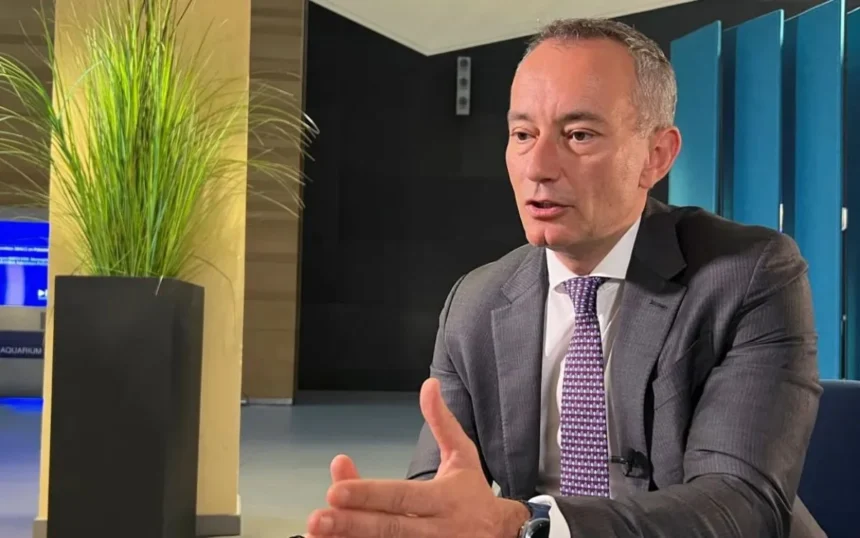
Talks aimed at consolidating a broader Gaza peace plan are running into fresh delays as Hamas signals willingness to accept only a partial form of disarmament, falling short of the full demilitarization envisioned in the framework. According to reporting in The Jerusalem Post, the current impasse revolves around the precise scope and sequencing of weapons handovers, with Hamas offering limited concessions that some Israeli and international officials argue are insufficient to guarantee long‑term security. The multi‑phase initiative, associated with President Donald Trump’s 20‑point plan for Gaza, hinges on the gradual disarming of Hamas’s military wing and the restructuring of Gaza’s security and governance, but progress has been slower than expected.
Under the Trump‑backed outline, Phase Two calls for the effective disarming and disbanding of Hamas’s armed structures, alongside the deployment of an international stabilization force and the establishment of a Palestinian administrative committee to run Gaza. As reported by The Jerusalem Post’s David Bedein and other analysts, what Hamas has reportedly put forward is a more limited formula, involving the transfer of certain police‑issue weapons while retaining core militant capabilities. Bedein and other commentators describe this proposal as falling “well short” of the complete disarmament and demilitarization envisioned in the original plan, which was intended to prevent the group from re‑establishing a military threat once Israel’s forces withdrew.
Why is Hamas offering only partial disarmament?
The partial‑disarmament signals from Hamas derive from a mix of security anxiety, political calculation, and internal bargaining dynamics. According to statements gathered by regional and international media, senior Hamas officials argue that any meaningful discussion of weapons handover must be tied to clear guarantees on Israeli withdrawal, the lifting of border restrictions, and the broader political status of Gaza and the Palestinian territories. Some Palestinian officials quoted by the BBC and other outlets say that Hamas wants all obligations under Phase One—such as the full return of hostages, the release of Palestinian prisoners, and the promised pullback of Israeli forces—to be verifiably completed before engaging in detailed disarmament talks for Phase Two.
Analysts cited in outlets such as Al Jazeera and The Guardian suggest that Hamas remains reluctant to surrender its military wing because it sees armed capability as a core source of leverage in any future settlement. As noted by regional security experts, hardline elements within Hamas and other Palestinian armed groups argue that agreeing to full disarmament without ironclad guarantees on sovereignty, borders, and the eventual fate of the Palestinian prisoners’ file could leave Palestinians defenceless if the agreement collapses. On the Israeli side, officials quoted in Israeli media stress that demilitarization is a non‑negotiable pillar of the plan, warning that failure to implement it in full could lead to renewed hostilities later in the process.
What are the main sticking points in the plan?
The central sticking points cluster around the sequencing of disarmament, Israeli withdrawal, and the introduction of international forces. According to reporting in The Jerusalem Post, Israel insists that Hamas’s weapons be verifiably removed—or at least placed under the control of an international body—before the Israel Defense Forces completely withdraw from Gaza. Israeli officials have reportedly told journalists that Washington may set a defined period, often described as around 60 days, during which Hamas is expected to begin handing over heavy weapons and dismantling key tunnel infrastructure, with the possibility of coercive measures if the group fails to comply.
Conversely, Hamas and several Palestinian officials argue that the process must be reciprocal. As quoted by the BBC and regional outlets, Hamas representatives have told mediators that they will not formally enter Phase‑Two negotiations until Israel has fully met the original commitments in Phase One and ceased what they describe as ongoing “transgressions,” including limited‑scale operations and restrictions on crossings. A senior Hamas official quoted by the BBC said that the matter of disarmament is inseparable from “a holistic resolution” that guarantees Palestinian self‑determination, not just temporary arrangements. These divergent conditions have created a circular standoff: Israel wants disarmament as a precondition for deeper withdrawal; Hamas wants full implementation of earlier obligations as a precondition for disarmament talks.
What do international actors and experts say?
International actors involved in the process, including the so‑called Board of Peace and UN‑linked envoys, have warned that making the entire agenda contingent on full Hamas disarmament could derail the broader plan. As reported by analysts at organisations such as the Royal United Services Institute and other think tanks, tying reconstruction, governance reform, and cross‑border movement strictly to the group’s complete demilitarization risks turning a fragile truce into a high‑stakes ultimatum. One London‑based expert cited by The Guardian argued that the structure effectively holds everything else “temporarily held up” until Hamas complies, which, he warned, “isn’t a situation that lends itself to positive outcomes.”
Commentators in The Jerusalem Post and elsewhere note that Hamas has already signaled a partial‑weapons formula that would involve handing over a subset of firearms, possibly police‑issue weapons, while leaving its core military wing intact. Such a proposal, analysts say, may be intended to test international and Israeli reactions and to open room for further haggling. Yet, as the same commentators observe, the Trump‑backed blueprint was designed around the principle of a genuinely de‑militarized Gaza, making it difficult for Jerusalem and Washington to accept anything that stops short of that standard. The emerging debate among officials centers on whether a phased, partial disarmament can be packaged as an interim step toward full demilitarization, or whether it opens the door to long‑term ambiguity about Hamas’s armed presence.
What comes next for the Gaza peace effort?
In practical terms, the immediate next steps depend on whether mediators can bridge the gap between Hamas’s partial‑disarmament signals and Israel’s demand for full demilitarization. As outlined in The Jerusalem Post and other outlets, high‑level envoys are reportedly exploring the possibility of a phased‑disarmament timetable, beginning with the collection of specific categories of heavy weapons and infrastructure and then moving to more sensitive assets, such as rocket systems and tunnel networks. The idea, according to described proposals, is to pair each stage of arms handover with corresponding Israeli actions, including the progressive withdrawal of troops and the opening of additional crossings, so that both sides perceive the process as mutually binding.
However, the trust deficit between the parties remains deep. Israeli security officials have pointed to alleged violations of the current ceasefire, documented by the IDF as multiple incidents of weapons‑related activity in Gaza, to argue that Hamas cannot be trusted to gradually disarm without strict enforcement mechanisms. For their part, Palestinian officials and some international observers warn that leaning too heavily on the threat of renewed force risks hardening Hamas’s position and making even a partial‑disarmament offer more difficult to obtain. As the debate continues, the broader Gaza‑peace plan sits in a holding pattern: technically still in play, but dependent on a political‑security compromise that neither side has yet agreed to in publicly verifiable terms.
Fast loading times and very secure. I feel safe putting my trust in this platform. Go for nogad88login if you want peace of mind.
Everything about this site feels premium. From the fast registration to the quick withdrawals, it is a win win. king999login
I’ve tried a few sites this month and this one really stands out. The interface is smooth and the payouts are quick. Definitely check out vntr88vip if you want a reliable experience.
The game selection is massive and the community vibes are great. I’ve met some cool people while playing here. Check out rs789game for some action.