


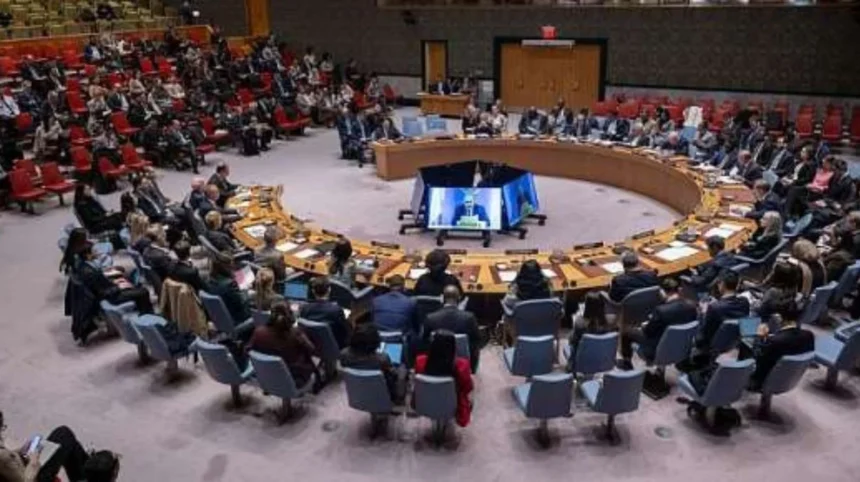
According to UN News, the United Nations Security Council heard that full commitment to a United States‑backed Comprehensive Plan to End the Gaza Conflict is essential for recovery, reconstruction and long‑term stability in the enclave. High Representative for Gaza Nickolay Mladenov, a former senior UN official, delivered his first briefing to the Council in this role during a meeting on the implementation of resolution 2334 (2016) and the more recent resolution 2803 (2025). UN News reports that resolution 2803 endorsed the US‑backed Comprehensive Plan, welcomed the creation of the Board of Peace as a transitional administration for Gaza and authorized a temporary International Stabilisation Force, or ISF, to support security on the ground.
As reported by UN News, Mladenov told Council members that the first phase of the US 20‑point plan, which led to a ceasefire between Israel and Hamas last October, is largely complete. He said the process is now entering a more delicate phase centered on the decommissioning of weapons held by Hamas and other armed groups, coupled with a staged withdrawal of Israeli forces from Gaza. Mladenov stressed that decommissioning and withdrawal must proceed in parallel and described this linkage as fundamental to the credibility of the entire process.
According to UN News, Mladenov called on Council members to remain focused on Gaza even as broader regional tensions escalate, warning that failure to follow through on the Comprehensive Plan could jeopardize both Palestinian aspirations and Israeli security. He urged the Security Council to reaffirm that decommissioning of armed groups is a fundamental requirement and the only viable path toward large‑scale reconstruction and the withdrawal of Israeli forces.
Context / Reactions: What Did Officials and Members Say?
UN News reports that Mladenov appealed to all Council members “to use all means at their disposal” to press Hamas and other Palestinian factions to accept the Comprehensive Plan without delay. He argued that full implementation is the only pathway that offers Israel durable security while opening a credible route to Palestinian self‑determination and statehood through negotiations. Mladenov stated that there can be no credible path to Palestinian statehood if Gaza remains under the control of Hamas and other armed groups, underscoring the political dimension of the disarmament effort.
According to UN News, Assistant Secretary‑General for humanitarian affairs Joyce Msuya, represented in the briefing through the presentation of the Secretary‑General’s latest report, outlined the extent of displacement and humanitarian need in Gaza. Roughly 1.4 million people remain displaced across about 1,200 sites, many of which are overcrowded and unsafe, the Council heard. The report relayed by UN News highlighted the launch of Phase Two of the US‑led plan and noted that the Secretary‑General described the establishment of the National Committee for the Administration of Gaza as an important step.
As reported by UN News, the Secretary‑General’s observations emphasized that all parties must fully abide by their commitments under the plan so that recovery can go forward in Gaza while advancing a credible political horizon toward a two‑State solution. In coordination with the Palestinian Authority, the UN has indicated its readiness to support the National Committee’s efforts to restore critical public services, facilitate humanitarian aid and lay the groundwork for reconstruction. Council members also used the session to reiterate longstanding positions on the Israeli‑Palestinian conflict, including calls for an end to settlement activity and respect for international law, according to the UN’s summary of the meeting.
Supporting Details and Background
UN News explains that the Board of Peace, endorsed by the Security Council under resolution 2803, was established as a transitional governance mechanism to oversee the implementation of the Comprehensive Plan in Gaza. It is mandated to work alongside a Palestinian technocratic committee and a vetted local police force while coordinating with the International Stabilisation Force on security issues. The plan itself grew out of US diplomacy led by President Donald Trump’s administration and centers on a 20‑point framework tying reconstruction funding and international support to demilitarization benchmarks and security arrangements.
According to UN News and related UN documentation, the Comprehensive Plan envisages that reconstruction will be financed through a trust fund backed by international donors, with the World Bank playing a key role in managing resources. The Security Council’s endorsement of the US‑drafted resolution in 2025 authorized the ISF to help secure border areas in cooperation with a trained and vetted Palestinian police force. UN officials have underscored that humanitarian and recovery efforts must be closely integrated with security and governance measures to avoid renewed cycles of violence.
UN News notes that the briefing on Gaza took place against a backdrop of rising tensions elsewhere in the Middle East, which some Council members warned could distract from the urgent needs in the enclave. Nonetheless, Mladenov insisted that the window created by the current ceasefire and the initial implementation of the Comprehensive Plan should not be squandered. He urged both regional and international actors to seize the opportunity to support structural changes in Gaza’s security, governance and economic outlook.
Implications / Future Developments: What Comes Next for Gaza?
According to UN News, the next phase of the US‑backed Comprehensive Plan will focus on the practicalities of decommissioning weapons, consolidating the ceasefire and enabling a phased Israeli military withdrawal, steps that are tied to wider reconstruction and political processes. Mladenov told the Council that effective decommissioning is a prerequisite not only for large‑scale rebuilding but also for credible progress toward Palestinian self‑determination within a two‑State framework. The success of this phase will depend heavily on the willingness of Hamas and other factions to accept the plan’s terms and on sustained engagement from regional mediators and donors.
UN News reports that the UN stands ready, in coordination with the Palestinian Authority, to support the National Committee for the Administration of Gaza in restoring basic services, facilitating humanitarian aid and preparing for longer‑term reconstruction projects. This includes efforts to improve conditions for the approximately 1.4 million displaced people and to rehabilitate critical infrastructure. The Secretary‑General’s report, as conveyed to the Council, underscores that full adherence to commitments by all sides is crucial if Gaza’s recovery is to proceed in tandem with a broader political horizon toward a negotiated two‑State solution.
Looking ahead, Council members are expected to continue monitoring implementation of resolutions 2334 and 2803, including the performance of the Board of Peace and the International Stabilisation Force, based on periodic briefings from UN officials. UN News indicates that the Security Council’s discussions will remain closely tied to developments on the ground, particularly any changes in the security situation, humanitarian access and the pace of reconstruction. For now, senior UN officials maintain that sustained political will and concrete steps by all parties to honor the US‑backed Comprehensive Plan will largely determine whether Gaza can move from temporary ceasefire toward lasting recovery and stability.
In summary, the Security Council briefing underscored that Gaza’s path to recovery hinges on full implementation of the US‑supported Comprehensive Plan, from weapons decommissioning and Israeli withdrawal to the empowerment of a transitional administration and support for a massive reconstruction effort, with the United Nations pledging continued assistance within this agreed framework.