


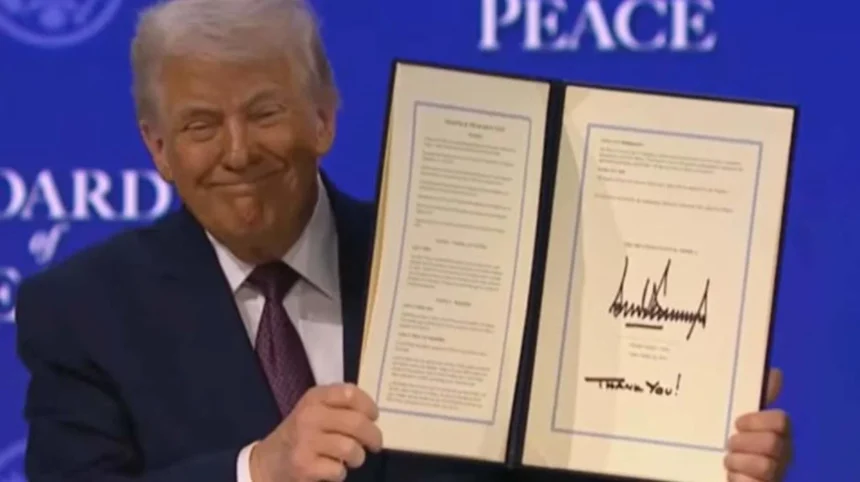
As reported by Bloomberg News and other outlets, Donald Trump’s administration created the Board of Peace as a flagship initiative to oversee post‑war governance and reconstruction in Gaza, with ambitions to expand its mandate to other global conflict zones. According to NDTV’s compilation of reporting from Bloomberg, Reuters and Agence France-Presse, the Board of Peace emerged out of a broader Gaza peace plan backed by a United Nations Security Council resolution following a ceasefire between Israel and Hamas. The plan envisioned the board supervising temporary governance, coordinating reconstruction funds and working with a Gaza-based technocratic structure under international oversight.
According to Politico, the body’s charter—circulated in leaked form—describes a mission to build “peace in areas affected or threatened by conflict,” with Gaza as the initial focus. The early stages involved commitments of several billion dollars for reconstruction and discussions of a stabilization force to support the ceasefire. NPR reports that President Trump personally chaired the inaugural session of the Board of Peace, where multiple countries pledged funds and signaled openness to participating in security arrangements around Gaza.
NDTV, citing Bloomberg, notes that Washington has sought at least 1 billion dollars from countries seeking a permanent seat on the Board of Peace, effectively tying membership to significant financial contributions. Reuters reporting summarised by NDTV adds that high-profile international figures, including former United Kingdom Prime Minister Tony Blair and Indian-American executive Ajay Banga, have been associated with Trump’s Gaza governance blueprint and the related peace board architecture. According to Agence France-Presse, the Gaza plan included six key points centred on ending active hostilities, establishing interim governance, and unlocking reconstruction funding under US-led oversight.
Where does the Board stand as Gaza, Iran conflicts intensify?
As reported by Politico, the outbreak and escalation of a US- and Israel-led war with Iran have sharply undermined the Board of Peace’s momentum and diverted diplomatic attention away from Gaza. Politico notes that what limited progress had been made—such as initial hostage-prisoner exchanges and steps toward opening Gaza’s Rafah border crossing—has slowed or stalled amid the Iran conflict. NPR likewise reports that discussions on critical next steps in the Gaza ceasefire, including Hamas disarmament and phased Israeli withdrawal, are now effectively on hold.
Modern Diplomacy writes that representatives of Hamas have met envoys from Trump’s Board of Peace in Cairo in an attempt to shore up a fragile ceasefire in Gaza as regional violence with Iran intensifies. According to sources cited by Modern Diplomacy, the board is formally tasked with overseeing Gaza’s post-war governance and reconstruction, but its work has been complicated by the shifting military balance and ongoing Israeli control over large parts of the territory. The same report notes that the next phase of the Gaza plan was supposed to focus on reconstruction, governance arrangements and the contentious question of Hamas disarmament, but these tracks have been overtaken by events in Iran.
Middle East Monitor characterizes the Board of Peace as functioning, in practice, as a tactical instrument aligned with broader US and Israeli strategies toward both Gaza and Iran, arguing that critics see it as a “smokescreen” while active operations continue. NDTV’s coverage of Trump’s interviews and statements on Iran underscores that Washington is insisting on tough terms, including restrictions on Iran’s nuclear programme and an end to regional proxy activity, as conditions for any ceasefire. According to Reuters sources cited by NDTV, Tehran has rejected ceasefire negotiations until US and Israeli airstrikes cease and compensation is discussed, further complicating the environment in which the Board of Peace is supposed to operate.
Supporting details: Membership, money and internal mechanics
NDTV, drawing on Bloomberg, reports that the Trump administration has linked permanent Board of Peace membership to a minimum 1 billion dollar contribution, with member states initially serving three‑year terms that can be extended if they exceed funding thresholds. According to reporting referenced by SAMAA TV and other outlets, invited participants have included leaders from Pakistan, Russia, Hungary and other states, reflecting a mix of Western and non‑Western governments. This funding structure and membership list have sparked debate in several capitals about cost, influence and the political implications of joining a US‑chaired body.
NPR cites Israeli peace activist and negotiator Gershon Baskin as saying that the Gaza Executive Board—designed to liaise with Trump’s Board of Peace and including figures such as Jared Kushner and special envoy Steve Witkoff—has not yet convened. According to NPR, Kushner and Witkoff were heavily engaged in nuclear negotiations with Iran shortly before the latest war, raising questions about bandwidth for Gaza-focused work. Politico adds that some Western European governments have remained noncommittal or declined participation in Trump’s peace framework, while a number of Muslim-majority countries have signaled conditional support or ongoing talks.
Reuters reporting aggregated by NDTV indicates that the Gaza plan and associated Board of Peace structures envisaged roles for prominent international personalities in supervising “temporary” governance in Gaza. The plan’s governance architecture, as summarized by NDTV and AFP, would place substantial operational authority in the hands of international appointees and technocrats, with local Palestinian bodies expected to manage day‑to‑day administration under external oversight. While those outlines remain formally in place, Politico and NPR both indicate that implementation has been severely delayed by events.
What are the implications and what happens next?
Politico reports that the Iran war has turned the Board of Peace from a showcase of Trump’s conflict-resolution agenda into a test of whether the administration can sustain parallel diplomatic tracks in Gaza and Iran. With reconstruction plans stalled, the risk, according to analysts quoted by US media, is that prolonged delay will deepen humanitarian crises in Gaza and erode confidence among countries that had pledged funds or political support. NPR highlights concerns from regional experts that the absence of movement on Hamas disarmament, Israeli withdrawal and governance arrangements could eventually destabilize the ceasefire framework the Board is meant to reinforce.
Modern Diplomacy notes that Hamas’ engagement with Board of Peace envoys in Cairo suggests all sides still see value in maintaining channels linked to Trump’s initiative, even as the Iran conflict dominates headlines. At the same time, Middle East Monitor reports that critics fear the board’s broad mandate and opaque decision‑making could allow it to be leveraged to justify prolonged external control over Gaza while confrontations with Iran continue. NDTV’s reporting on Trump’s public statements indicates that the US president remains focused on extracting far‑reaching concessions from Iran before any regional de‑escalation, a stance that may delay conditions necessary for the Board of Peace to fully implement its Gaza agenda.
According to NDTV’s and Reuters’ earlier explanations of Trump’s Gaza plan, any future progress will likely hinge on a combination of sustained ceasefire, clarity on interim governance, and secured funding from skeptical partners. Politico and NPR both suggest that until there is a recalibration of priorities between the Iran theatre and the Gaza reconstruction track, Trump’s Board of Peace will remain more a blueprint on paper than an active instrument transforming conditions on the ground.
In sum, verified reporting from Politico, NDTV, NPR, Modern Diplomacy and Middle East Monitor indicates that Trump’s Board of Peace—launched to turn the Gaza ceasefire into a broader peace-and-reconstruction project—is now struggling to maintain relevance and momentum as the war with Iran commands diplomatic and military focus.