


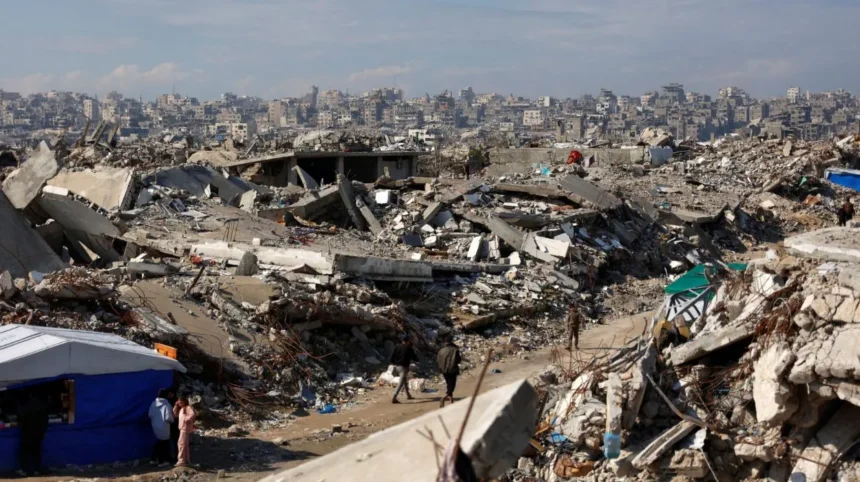
As reported by Agence France-Presse (AFP), displaced Palestinians in Gaza are sheltering amid the wreckage of homes and businesses destroyed during more than two years of Israeli assaults on the enclave, including in Jabalia refugee camp as of January 17, 2026. In Gaza City, 33-year-old displaced Palestinian Abu Mohsen said air strikes had become less frequent since Israel began its military operation against Iran, which has expanded to Lebanon. He told AFP from his tent in northern Gaza that “air strikes have diminished,” though explosions, demolitions, shelling, and the sound of warplanes and surveillance drones continue to shake the territory despite a U.S.-brokered ceasefire in place since October 10.
According to AFP, Gaza’s civil defense reported that Israeli forces killed one person and injured another in the Al-Mawasi area on Saturday, while “several” others were wounded by fire in the central Alureij camp. Residents interviewed by AFP described a situation in which the intensity of bombardment has fallen but everyday life is becoming harder as border restrictions tighten following the start of the war with Iran. On the day U.S.-Israeli assaults on Iran began, Israel closed all access points to Gaza for several days, severely disrupting the inflow of essential supplies.
A source from Gaza’s crossings authority told AFP that “a small number of trucks” managed to enter Gaza via Kerem Shalom on Wednesday, but the authority had received no official notification of a full reopening. Israeli officials informed local authorities that the Rafah crossing on the border with Egypt would remain closed until further notice, further constraining the territory’s supply routes. Gaza relies almost entirely on aid shipments for food, medicine and fuel, and even short closures quickly translate into shortages and price shocks in local markets.
How are residents reacting to fewer strikes but tighter aid?
According to AFP, some residents in southern coastal areas said the reduced frequency of air strikes has been accompanied by new constraints on essential supplies. In Al-Masi, 59-year-old Abdullah al-Astal told AFP that while Israeli bombardment had “significantly decreased,” Israel was blocking the entry of food aid and fuel, worsening daily hardships. He said he did not focus on regional geopolitics or Iran’s role, stating that he does not support Iran and that his priority is “to live like human beings.”
In another account reported by AFP, retired resident Safiya Hammouda described how panic buying began “from the very first day of the Iran war,” as people rushed to purchase whatever goods they could still find in the market. She said that basic items remain available but are starting to run out, and lamented that “Gaza is completely neglected” even as shelling has eased in recent days. She added that “they aim to obliterate Iran and transform it into a devastated nation like Gaza,” referring to the extensive destruction already documented in the territory, where the United Nations reported on October 5 that 81 percent of all structures had been damaged.
From a tent set up in a school compound, Mohammad al-Hilu told AFP that prices for some goods had doubled or more within days. He expressed concern that as international attention shifts to the conflict with Iran, “the world will forget Gaza” and ignore the ongoing suffering of its residents.
Supporting details on border closures, aid and prices
According to AFP’s reporting, Israel’s closure of all access points to Gaza in the initial days of the Iran conflict cut off the territory from aid and commercial supplies, underscoring its dependence on open crossings. A source at Gaza’s crossings authority said only a limited number of trucks were later allowed through Kerem Shalom, and that Rafah remained closed, limiting both humanitarian deliveries and trade flows.
The office of the United Nations Special Coordinator for the Middle East Peace Process (UNSCO) reported that 500,000 liters of fuel were delivered to Gaza via Kerem Shalom on Tuesday, but humanitarian officials said the disruption had already pushed up prices. Jonathan Crickx, spokesperson for the UN’s children’s agency UNICEF, told AFP that most basic necessities, including food and soap, saw price increases of 200 to 300 percent, illustrating Gaza’s extreme vulnerability and reliance on external assistance.
Felipe Ribero, head of medical charity Médecins Sans Frontières (MSF, Doctors Without Borders) in the Palestinian territories, said Gazans rushed to stock up on essentials when Kerem Shalom briefly reopened. He described “hyperinflation of prices within a few days,” attributing this in part to Gaza’s limited storage capacity, which means that any disruption in the supply chain rapidly triggers shortages and sharp price rises.
What are the implications and possible next developments?
According to AFP’s account, the combination of fewer Israeli air strikes and tighter restrictions on aid has created a paradoxical situation in Gaza: immediate physical danger from bombardment has lessened somewhat, but economic and humanitarian pressures are intensifying. Residents interviewed by AFP said that the closure of crossings, reduced aid flows, and sharp price increases are deepening an already severe crisis, even as the focus of Israeli military operations shifts toward Iran and Lebanon.
Humanitarian officials quoted by AFP warned that Gaza’s heavy dependence on external fuel, food and medical supplies makes it highly sensitive to even short-term border disruptions. With Rafah still closed and only limited traffic reportedly allowed through Kerem Shalom, aid agencies and residents remain concerned that any prolonged diversion of international attention to the war with Iran could delay relief efforts and reconstruction in Gaza.
The situation in Gaza, as described by AFP, highlights how regional conflict dynamics can quickly affect humanitarian conditions on the ground, even when local military activity temporarily decreases. Residents and aid workers alike emphasized that sustained access for humanitarian convoys, fuel deliveries and commercial goods will be critical to preventing further deterioration in living conditions while broader regional hostilities continue.
Gaza currently faces a fragile calm in terms of air strikes but a worsening humanitarian landscape driven by tightened border controls, reduced aid and soaring prices, according to AFP’s reporting. As the war involving Israel and Iran expands and captures global attention, residents and humanitarian actors in Gaza fear that their needs could be sidelined, even as much of the territory remains in ruins and heavily dependent on outside assistance.