


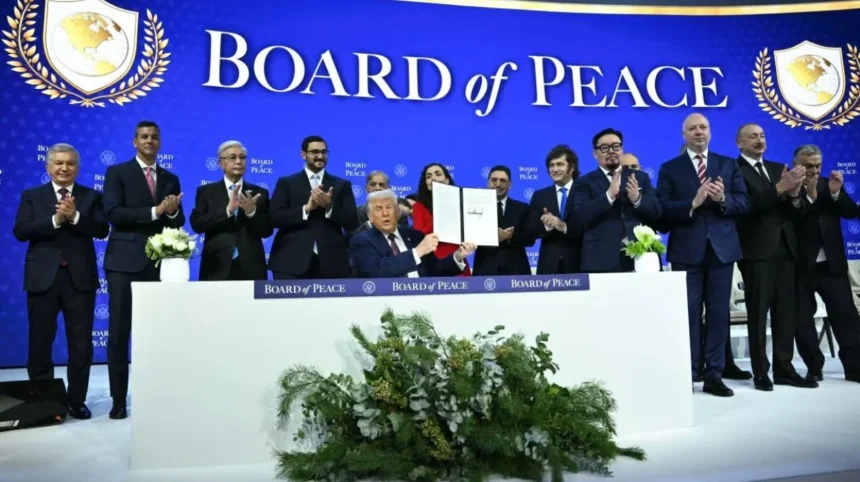
Indonesia has suspended its engagement with the United States‑led Board of Peace (BoP) initiative as it shifts diplomatic attention to the escalating conflict involving Iran and broader instability in the Middle East. According to Bernama, Foreign Ministry spokesperson Yvonne Mewengkang said Jakarta has decided to put all discussions related to the BoP “on hold” while it focuses on monitoring the situation and protecting Indonesian nationals in affected areas.
As reported by Bernama, Yvonne told a media briefing in Jakarta that the decision had already been conveyed by Foreign Minister Sugiono, underscoring that the government’s immediate priority is the safety and protection of Indonesians, particularly those in Iran and other conflict‑hit parts of the region. She added that Indonesia is also preparing anticipatory measures to deal with any impact arising from the escalation of hostilities in the Middle East.
According to TRT World, Foreign Minister Sugiono, who goes by one name, said that “all BoP discussions are on hold as all attention has shifted to the situation in Iran,” confirming that talks under the peace framework have effectively been paused. Bloomberg likewise reported that Sugiono told reporters that discussions on President Donald Trump’s Board of Peace initiative have been put on hold, noting that Indonesia is still consulting partners and coordinating with Gulf states that have also come under attack.
The Board of Peace has been presented as a US‑driven initiative linked to efforts around Gaza and broader Middle East stabilisation, with Indonesia’s participation framed domestically as a way to support peace and defend Palestinian interests from within the platform. According to coverage by Dawn and the Times of Israel, Indonesian officials and political figures have argued that Jakarta’s involvement could be used to encourage de‑escalation and promote Palestinian rights, even as public criticism of the board has intensified following the latest Iran conflict.
Context and reactions: How is Indonesia responding?
Domestic debate over Indonesia’s role in the Board of Peace has sharpened as the Iran conflict has intensified and US‑Israel military action has drawn criticism in the world’s largest Muslim‑majority country. According to Al Jazeera, President Prabowo Subianto has been discussed internationally as a potential mediator, with the Foreign Ministry signalling on social media that he is prepared to travel to Tehran to help facilitate dialogue if all parties agree.
At home, however, calls have grown for Indonesia to distance itself from the BoP framework. Asianews reported that sectors of Indonesian society, including the Indonesian Ulema Council (MUI), parliamentarians, public figures and civil society groups, have urged the government to leave the Board of Peace, arguing that the body no longer aligns with Indonesia’s long‑standing foreign policy principles. In an official statement cited by Asianews, the MUI condemned the military operation against Iran as contrary to the humanitarian values enshrined in Indonesia’s 1945 Constitution and called for an immediate revocation of Indonesia’s membership in the Board of Peace.
According to Dawn, Yahya Cholil Staquf, leader of Nahdlatul Ulama, Indonesia’s largest Muslim organisation, suggested that Indonesia could announce the board’s agenda is suspended until discussions on de‑escalation and peace linked to the US‑Israeli conflict with Iran take place. Reuters has also reported that the Indonesian Ulema Council argued Indonesia should withdraw from the board because President Trump’s actions toward Iran had rendered the initiative ineffective, while Nahdlatul Ulama instead urged the government to leverage its place on the board to press for an end to hostilities.
Foreign Minister Sugiono has attempted to balance these pressures by emphasising immediate security concerns while keeping future diplomatic options open. As reported by TRT World and Reuters, he said Indonesia would consult with “friends and colleagues in the Gulf” who are also under attack, indicating Jakarta’s intention to coordinate closely with regional partners before taking any further step on the Board of Peace.
Supporting details and diplomatic positioning
Indonesia’s decision to pause BoP discussions comes against the backdrop of its traditional support for a two‑state solution to the Israeli–Palestinian conflict and a foreign policy that emphasizes non‑alignment and peaceful dispute resolution. Reuters noted that Indonesia continues to advocate for a two‑state formula while recalibrating its engagement in US‑linked initiatives amid the Iran war.
Asianews reported that critics at home argue the Board of Peace, initially presented by President Prabowo as a vehicle to promote peace and Palestinian independence, has instead ended up exacerbating conflicts following recent attacks on Iran. In the MUI’s statement quoted by Asianews, the council said a forum that was supposed to serve as a platform for peace had contributed to heightening tensions, reinforcing its call for Indonesia to revoke its membership.
At the same time, other influential voices see potential value in remaining engaged. Dawn reported that Nahdlatul Ulama believes Indonesia can use its seat on the Board of Peace to push for de‑escalation, particularly by pressing Israel and the United States to halt hostilities in the Middle East. This divergence among key religious and civic actors highlights the complex domestic calculus facing Prabowo’s administration as it reassesses Indonesia’s role in the initiative.
Bloomberg’s reporting on Sugiono’s comments also underlined Indonesia’s attempt to maintain diplomatic flexibility. The foreign minister was quoted as saying that while discussions are paused because attention has shifted to Iran, Jakarta is still consulting partners and coordinating with Gulf states, suggesting that Indonesia does not yet consider its participation in the Board of Peace permanently closed.
Implications and future developments: What comes next?
The immediate implication of Indonesia’s move is a freeze in its active participation in the Board of Peace while it prioritises crisis management and citizen protection amid the Iran conflict. Bernama’s coverage shows that the Foreign Ministry is concentrating on monitoring developments in Iran and other affected areas, and preparing measures to safeguard Indonesians abroad. How long BoP talks remain on hold will likely depend on the trajectory of the conflict and the government’s assessment of security risks.
Politically, the pause may ease some domestic pressure on President Prabowo in the short term, but debate over whether Indonesia should stay in or exit the Board of Peace is expected to continue. Reuters and Asianews both highlight strong calls from influential religious authorities and civil society for Jakarta to sever ties with the forum, while other groups urge using membership to advance de‑escalation and Palestinian interests. Any eventual decision to withdraw or re‑engage would signal how the administration balances public sentiment, strategic relations with Washington, and its role in Muslim‑majority and Gulf partners’ diplomacy.
Internationally, Indonesia’s stance will be closely watched because of its size, its status as the world’s largest Muslim‑majority nation, and its potential role as a mediator. Al Jazeera reported that the Foreign Ministry has already indicated Prabowo’s willingness to travel to Tehran if both sides consent, underscoring Jakarta’s effort to position itself as an advocate for restraint and dialogue even as it suspends BoP discussions. Coordination with Gulf states noted by Sugiono suggests Indonesia may seek a broader coalition of states pushing for de‑escalation and humanitarian considerations as the Iran conflict unfolds.
In essence, Indonesia has publicly confirmed that all discussions related to the US‑led Board of Peace are now on hold while it focuses on the Iran conflict, the safety of its citizens and consultations with regional partners. The government has not announced a formal withdrawal from the initiative, but growing domestic pressure and the evolving dynamics of the Middle East war will shape whether Jakarta ultimately resumes engagement with the Board of Peace or chooses to step away.