


Key points
- Palestinians, aid agencies and diplomats warn that widening U.S.-Israeli military action against Iran could shift international attention away from Gaza’s fragile ceasefire and humanitarian crisis.
- The concern has emerged just over a week after President Donald Trump announced billions of dollars in reconstruction pledges for Gaza and sought to bolster an Oct. 10 U.S.-brokered ceasefire between Israel and Hamas.
- Recent U.S. and Israeli strikes on Iran and Iranian-backed groups have prompted border closures and supply disruptions in Gaza, fuelling food shortages, market panic and rising prices.
- The situation unfolds as the Muslim holy month of Ramadan approaches, complicating efforts to stabilise living conditions and maintain public confidence in the ceasefire.
- Aid organisations say progress in getting humanitarian supplies into Gaza risks stalling, while they struggle to keep Gaza on the agenda of governments now preoccupied with the conflict involving Iran.
- Key unresolved issues include disarming Hamas, deploying an international stabilisation force and enabling a newly appointed Palestinian committee to begin governing in Gaza.
- Analysts and Palestinians fear that if the regional escalation persists, it could undercut reconstruction plans, delay political arrangements and deepen Gaza’s long‑running humanitarian emergency.
Gaza’s ceasefire had momentum. Now a new war is testing it
- Key points
- Ceasefire under strain amid regional escalation
- Humanitarian fears as crossings close
- Ramadan pressures and civilian anxiety
- Trump’s ‘Board of Peace’ and unfinished diplomacy
- Unresolved security and governance challenges
- Fears Gaza will become a “secondary” crisis
- International reaction and diplomatic manoeuvring
- Aid agencies battle for attention
- Balancing regional security and Gaza priorities
- What happens next
The ceasefire in Gaza, brokered in October between Israel and Hamas, is facing new uncertainty as U.S.-Israeli airstrikes on Iran and its regional allies raise fears that global attention, political capital and resources will be diverted from the territory’s fragile recovery. Palestinian residents, humanitarian agencies and diplomats are warning that the widening confrontation risks overshadowing recent diplomatic efforts and reconstruction pledges for Gaza, even as basic needs in the territory remain acute.
Ceasefire under strain amid regional escalation
Under the U.S.-brokered arrangement that took effect on 10 October 2025, large‑scale fighting inside Gaza has diminished, though Israeli forces continue to carry out regular fire and maintain significant restrictions on movement and supplies. The ceasefire opened space for more humanitarian aid to enter the enclave and for initial steps towards reconstruction, but it stopped short of a comprehensive political settlement.
That tentative progress is now colliding with a separate but interconnected crisis: a sharp escalation between Israel, the United States and Iran, following coordinated strikes on Iranian targets and responses by Tehran and allied groups. According to reporting by the Los Angeles Times, the new phase of conflict has already begun to reshape discussion among regional governments and Western capitals, threatening to push Gaza lower down the diplomatic agenda.
Palestinians interviewed in central and southern Gaza described a rapid change in atmosphere once news of explosions in Tehran and other locations spread. “All the people rushed to markets, and they all wanted to shop and hide,” said Abeer Awwad, who was displaced from Gaza City and is now living in Deir al‑Balah.
Humanitarian fears as crossings close
Residents and aid workers say one of the most immediate impacts has been Israel’s closure of Gaza’s crossings, which are vital for the flow of food, fuel, medical supplies and commercial goods. Local traders report that when the crossings were shut, deliveries halted and stocks thinned, sending prices sharply higher for essential items.
“When the crossings shut down, everything was suspended from the market,” said Osamda Hanoda from Khan Younis. “The prices go up, and people live in misery.” Aid agencies have warned that if restrictions persist, some supplies could run out within days, particularly for vulnerable communities already dependent on international assistance.
The United Nations World Food Programme has noted a degree of improvement in food access since the ceasefire, but its latest analysis still classifies high levels of hunger in Gaza and cautions that gains remain fragile. The organisation and other humanitarian partners say they are working to keep deliveries moving where possible, while contingency plans are updated in case the regional conflict further disrupts logistics.
Ramadan pressures and civilian anxiety
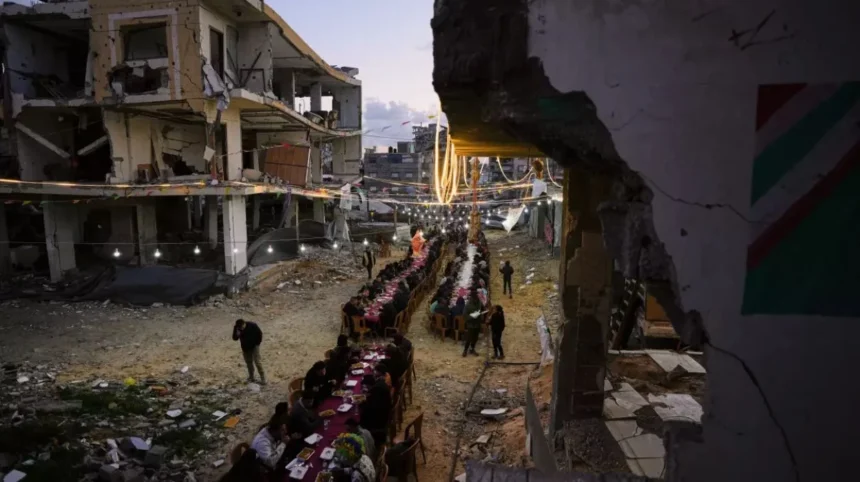
The renewed uncertainty comes as Muslims prepare for Ramadan, a period when families traditionally gather, markets are busier and food consumption patterns shift. In Gaza, displaced families and those whose homes were destroyed in earlier phases of the war say they are worried about observing the month under continued shortages and potential insecurity.
Residents described hoarding food and seeking shelter after hearing about the strikes on Iran, fearing that a broader regional war could once again bring intensified bombardment or further closures. Some local community leaders say they are urging people to remain calm while also pressing international agencies to increase distributions in the coming weeks.
Humanitarian organisations emphasise that Ramadan can add pressure to already stretched systems, from food assistance to electricity and water supply. Any prolonged disruption at crossings, they warn, could leave families unable to meet basic needs during a period that carries deep social and religious significance.
Trump’s ‘Board of Peace’ and unfinished diplomacy
The emerging crisis follows an attempt by President Donald Trump to give new momentum to Gaza diplomacy through what the White House has called a “Board of Peace,” a gathering of international leaders and donors focused on rebuilding the territory and reducing the risk of renewed conflict. At that meeting, held less than two weeks before the latest strikes on Iran, Trump announced billions of dollars in pledges aimed at reconstruction, infrastructure repair and economic support.
According to the Los Angeles Times, the initiative envisages a multi‑year programme combining physical rebuilding with political and security measures, including efforts to disarm Hamas and create space for new governance arrangements in Gaza. Supporters argue that tangible improvements on the ground could bolster the ceasefire and reduce incentives for armed groups to resume hostilities.
The strikes on Iran, however, have raised questions about whether the necessary diplomatic bandwidth and funding will be sustained, as governments confront the risk of a wider regional confrontation and potential disruptions to energy markets and shipping routes. Some analysts say the emerging conflict could complicate coordination between Western and Middle Eastern states on Gaza‑related initiatives, particularly if escalation continues.
Unresolved security and governance challenges
Even before the current escalation, substantial obstacles remained to consolidating the ceasefire and translating it into a durable political settlement. Key issues include how to address Hamas’ armed wing, the future presence of Israeli forces in and around Gaza, and the role of an international stabilisation or monitoring mission.
According to Associated Press copy carried by other outlets, proposals discussed in recent weeks have included the deployment of a multinational force to oversee security and support the transition to a new Palestinian governing structure in the territory. A newly appointed Palestinian committee intended to take on administrative responsibilities in Gaza has yet to fully establish itself on the ground, in part because of ongoing security and access constraints.
Diplomats say the regional escalation may complicate recruitment, financing and mandate negotiations for any international mission, as states weigh additional risks and competing priorities. This information could not be independently verified.
Fears Gaza will become a “secondary” crisis
For many Palestinians, the central worry is that Gaza will once again become what some describe as an “unseen” or “secondary” crisis, overshadowed by events elsewhere in the Middle East. Residents interviewed by regional media outlets have expressed concern that the territory could be used as a space for indirect confrontation between Iran, Israel and other actors, even as local communities continue to deal with the aftermath of previous fighting.
The New Arab has reported that Gazans fear paying the price for a conflict in which they have little influence, especially if cross‑border attacks or retaliatory strikes are routed through or near the enclave. Aid workers also say they are seeing signs of donor fatigue, after years of repeated appeals for emergency funding to address housing destruction, unemployment and public service collapse.
At the same time, some Palestinians note that the diversion of Israeli military assets to confront Iran and allied groups could mean fewer operations near parts of Gaza, at least temporarily. “The good thing is that the sound of booms and demolitions is rare now near the yellow line,” said Ahmed Abu Jahl of Gaza City, referring to the internal line dividing areas of control. Others caution that any perceived respite could be short‑lived if tensions spiral or if violations of the ceasefire lead to renewed clashes.
International reaction and diplomatic manoeuvring
International responses to the twin crises have been mixed, with some governments emphasising the need to uphold the Gaza ceasefire while also calling for de‑escalation between Israel and Iran. At the United Nations, diplomats have criticised reported violations of the Gaza truce and urged Israel to ease restrictions on the occupied Palestinian territories, including the West Bank.
Al Jazeera has reported that several Security Council members objected when a meeting on Gaza was rescheduled to avoid clashing with Trump’s Board of Peace event, viewing the move as symbolically sidelining multilateral diplomacy. The network also noted continuing concerns over Israeli policies in the West Bank, including settlement expansion and military operations, which many diplomats see as linked to the broader prospects for stability in Gaza.
Regional actors such as Egypt and Qatar continue to play a role in mediation, seeking to maintain channels to Hamas and other Palestinian factions while liaising with Israel and the United States. Middle East Eye has reported that Egyptian officials remain engaged in efforts to secure a longer‑term truce and humanitarian arrangements, even as Cairo weighs its own security concerns and the risk of being drawn into a wider conflict.
Aid agencies battle for attention
Humanitarian organisations operating in Gaza say one of their biggest challenges is keeping the territory visible in diplomatic and public debates as news cycles focus on the evolving conflict involving Iran. Agencies warn that while front‑line fighting in Gaza has eased, needs remain extensive, with large numbers of people displaced, infrastructure damaged and health systems under strain.
According to Associated Press material published by international outlets, aid groups are lobbying donors and governments to ring‑fence funding for Gaza programmes so that money is not redirected to new crises. They are also advocating for more predictable access at crossings, arguing that periodic closures undermine long‑term planning and increase costs.
Some organisations are attempting to use Ramadan as a focal point for renewed international attention, highlighting the contrast between religious observance and continuing deprivation in the territory. Others stress the importance of separating humanitarian assistance from political or security considerations, insisting that basic services should not be contingent on progress in ceasefire or reconstruction talks.
Balancing regional security and Gaza priorities
Analysts suggest that policymakers now face a complex balancing act: responding to missile and drone attacks, deterring further escalation and managing alliances, while avoiding the neglect of Gaza’s still‑unfinished ceasefire process. Some warn that if the ceasefire frays or collapses, it could feed back into regional instability, increasing the risk of miscalculation or broader conflict.
Commentary published by regional experts points to what has been described as an “armed peace” in parts of the Middle East, where temporary understandings coexist with unresolved political disputes and heavy militarisation. Under such conditions, the space for sustained reconstruction and governance reform in Gaza may remain limited unless a more comprehensive political framework emerges.
For communities inside Gaza, the immediate priority remains day‑to‑day survival and the hope that the ceasefire will hold despite events beyond their borders. Many residents say they are watching developments in Iran and elsewhere closely, uncertain whether the shifting regional landscape will ultimately bring greater security or renewed upheaval.
What happens next
In the coming days, attention is likely to focus on whether U.S. and Israeli operations against Iran and allied groups continue, expand or scale back, and how Tehran chooses to respond. Trump has indicated that bombing in Iran could continue through the week or longer and warned of “a force that has never been seen before” if Iran escalates further attacks, signalling a willingness to sustain pressure.
Diplomatic efforts at the United Nations and in regional capitals are expected to seek de‑escalation while reiterating calls to uphold the Gaza ceasefire and maintain humanitarian access. Aid agencies will monitor border openings, stock levels and funding commitments as Ramadan approaches, warning that any prolonged disruption could quickly reverse recent gains in food security and reconstruction.
The future of Trump’s Board of Peace initiative and related reconstruction pledges may depend on whether donors and political leaders remain engaged with Gaza amid competing crises. For now, Palestinians and humanitarian workers say their overriding concern is that Gaza does not once again slip from view as a new war commands the world’s attention.