


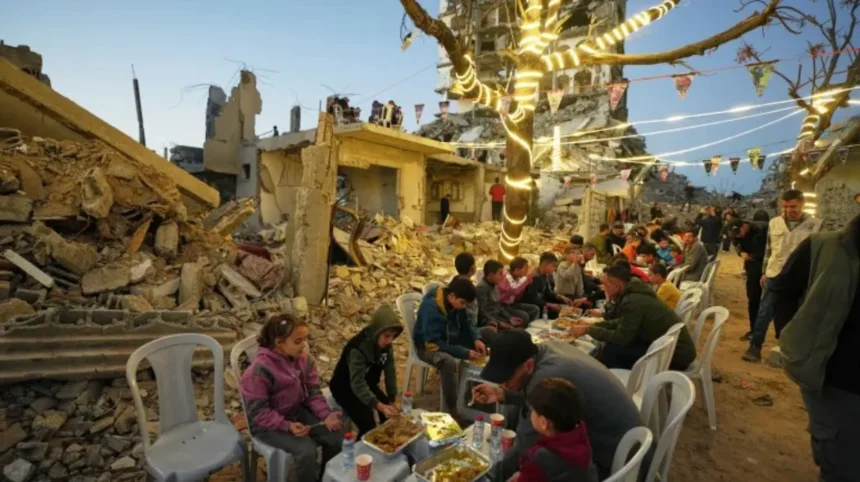
Ramadan in Gaza is unfolding under severe economic distress as food prices soar and household incomes collapse. Families who once prepared modest festive meals now struggle to secure even the basic ingredients for iftar and suhoor. According to Al Jazeera, an analysis of official pricing data shows that the cost of a typical iftar has nearly doubled compared with pre-war levels, while overall daily food costs for a medium-sized family have risen by close to 90 percent. The crisis is compounded by Israel’s continuing restrictions on goods entering Gaza and a devastated local economy with sharply reduced purchasing power.
General context: how Ramadan in Gaza changed
As reported by Al Jazeera, residents of the Gaza Strip are entering Ramadan for the third consecutive year under conditions of ongoing conflict, displacement and economic collapse. The article notes that after more than two years of war and a continuing blockade, Israel still tightly restricts the entry of food and essential goods into Gaza, even after a ceasefire announced in October 2025. This has eroded the traditional atmosphere of Ramadan in Gaza, where families would normally gather at sunset around iftar tables to break the fast with home-cooked dishes, shared desserts and social visits.
According to Al Jazeera, the combination of disrupted supply routes, damaged agricultural land and limited fuel has contributed to steep increases in the cost of basic food items used to prepare Ramadan in Gaza meals. Officials from Gaza’s Ministry of Economy told Al Jazeera that price monitoring from before October 7, 2023, through the onset of Ramadan 2026 shows sharp rises in poultry, meat, fish, dairy products and vegetables. These staples form the backbone of everyday dishes, meaning the inflation directly affects what families can place on their iftar tables.
The same reporting explains that these price spikes have occurred alongside a dramatic fall in Gazans’ income. A United Nations assessment cited by Al Jazeera found that annual income per capita in Gaza dropped from about 1,900 shekels in 2022 to roughly 650 shekels in 2024, illustrating how the war and blockade have curtailed employment, shut down businesses and destroyed productive capacity. With unemployment extremely high and many families reliant on humanitarian assistance, the gap between food prices and purchasing power has widened.
What do prices and daily meals look like now?
As reported by Al Jazeera, official data reviewed by the outlet show that the prices of key items for Ramadan in Gaza have climbed well above pre-war levels. The price of chicken, a central protein for many iftar meals, has risen by about 80 percent per kilogram compared with its cost before October 2023. Frozen red meat has increased by around 75 percent, while frozen fish prices have jumped by about 190 percent, making them far less accessible to families that previously included them in their Ramadan menus.
Eggs, another essential ingredient for both cooking and simple suhoor meals, have seen particularly steep increases. According to the Ministry of Economy figures cited by Al Jazeera, the price of a tray of 30 eggs has risen by about 170 percent. Basic vegetables such as tomatoes and cucumbers, often used in salads served with iftar in Gaza, have also climbed sharply: the cost of tomatoes has roughly doubled, and cucumbers have increased by around 300 percent per kilogram. Cheese and other dairy products used for suhoor spreads have recorded rises of up to around 110 percent.
Using these price data, Al Jazeera constructed an estimate of the cost of a basic Ramadan in Gaza iftar for a medium-sized family. The meal includes two chickens, rice, salad, appetizers, a soft drink, plus cooking gas and oil. Before the war, this meal was estimated at about 79 shekels; the same meal now costs roughly 150 shekels, an increase of around 90 percent. A simple suhoor consisting of cheese, hummus, falafel and bread has climbed from about 18 shekels to approximately 31 shekels. Taken together, Al Jazeera calculates that the total daily food cost for a medium-sized family during Ramadan in Gaza now stands at about 181 shekels, nearly 88 percent higher than in the pre-war period.
These figures come on top of earlier episodes when prices spiked even more dramatically. The Al Jazeera feature recounts that during periods when Israel fully closed or heavily tightened Gaza’s crossings, some food prices surged more than 700 percent. While there has been a modest easing from those extreme peaks since the ceasefire, the general price level remains far above what it was before the war, leaving families with little room to absorb the increases as Ramadan begins.
How are families and officials describing the crisis?
Al Jazeera’s reporting on Ramadan in Gaza includes interviews with residents who describe how soaring prices have reshaped their daily routines and religious observance. Families who once hosted extended relatives for iftar say they now prioritize securing enough bread and basic vegetables, often foregoing meat altogether. Some households report breaking their fast with simple dishes such as lentil soup and bread instead of the fuller meals they prepared in previous years, as they try to stretch limited cash and occasional aid distributions over the entire month.
According to the feature, parents express particular concern about their children’s nutrition during Ramadan in Gaza, noting that many treats traditionally associated with the month, such as sweets and meat-based dishes, have become unaffordable luxuries. The emotional toll of explaining these constraints to children is compounded by the broader trauma of war and displacement. With many homes destroyed, families also struggle with limited cooking facilities, irregular electricity and shortages of cooking gas, all of which complicate the preparation of any iftar or suhoor.
Officials and analysts quoted by Al Jazeera link the surge in food prices to structural constraints imposed on Gaza’s economy. Mohammed Barbakh, identified as the director general of policy and planning at Gaza’s Ministry of Economy, tells Al Jazeera that the ministry’s data show how prices for key commodities steadily climbed after October 2023 and spiked during periods of intensified closure. Economic analyst Abu Qamar, also cited in the feature, attributes part of the inflation to the limited number of trucks Israel allows to enter Gaza and to fees and controls that, in his assessment, discourage competition and keep costs high.
According to Al Jazeera’s account, Abu Qamar says that humanitarian arrangements technically allow up to 600 trucks of goods to enter Gaza daily, yet the Israeli authorities permit only around 200 to 250 trucks on most days. He is reported as saying that Gaza requires about 1,000 trucks a day to meet basic needs, particularly during Ramadan in Gaza, when demand for food traditionally rises. He further describes a system in which a small number of merchants are authorized to import through a handful of Israeli companies, which he argues contributes to a quasi-monopoly and price inflation in local markets.
Supporting details: blockade, war damage and economic collapse
The Al Jazeera feature situates the current cost of Ramadan in Gaza within the broader trajectory of the war and blockade. It recalls that Gaza has faced restrictions on movement and trade for years, but the situation worsened dramatically after October 2023, when the conflict escalated and crossings were repeatedly closed or heavily constrained. These measures disrupted supply chains, raised transport and coordination costs and left warehouses and shops frequently empty of key items.
According to Al Jazeera, the war has also inflicted extensive physical damage on agricultural land, livestock farms, food processing facilities and markets. This destruction has reduced local production and increased dependence on imported goods, which are themselves subject to the tight controls described by officials and analysts. With limited fuel, damaged roads and continuing security risks, moving goods inside Gaza is more expensive and difficult, further pushing prices upwards.
The feature notes that international agencies have documented severe economic decline across the Gaza Strip. Citing a United Nations report from late 2025, Al Jazeera highlights that annual per capita income fell by about two-thirds between 2022 and 2024. This collapse in income has left a large share of the population struggling to cover basic needs, even when some food items are available in markets at high prices. Humanitarian aid provides some relief, but distribution challenges and the scale of need mean that many families receive irregular or insufficient support during Ramadan in Gaza.
Al Jazeera’s analysis emphasizes that price increases for staples like chicken, eggs and vegetables, combined with falling incomes, have turned iftar from a daily focal point of communal and family life into a source of anxiety. For low-income households, the priority has shifted from preparing traditional dishes to ensuring that each family member can break the fast with at least a simple plate of food.
What are the implications for Ramadan and what might come next?
The immediate implication of these trends is that Ramadan in Gaza is being observed under conditions of deepening food insecurity. As described by Al Jazeera, many families now face a gap between the religious and cultural expectations of Ramadan and the harsh realities of their budgets. Iftar gatherings are smaller, menus are more limited and the variety of dishes is reduced. This has a social impact, as community-based traditions centered around sharing food, visiting relatives and distributing meals to poorer families become harder to sustain.
According to the economists and officials quoted by Al Jazeera, any improvement in the affordability of iftar and suhoor during Ramadan in Gaza will depend on several factors. Key among them are greater access for trucks carrying food and essential goods, reduced coordination fees and other costs linked to the movement of goods and a loosening of restrictions on which merchants can import supplies. Analysts argue that without changes to these conditions, local markets will remain constrained and prices are likely to stay high, particularly for meat, dairy and vegetables.
Humanitarian agencies and local authorities are expected to continue appealing for more aid and for easier entry of supplies during Ramadan in Gaza. The Al Jazeera feature notes that experts have called for the full opening of crossings and a shift toward a freer market environment as necessary steps to bring prices down and stabilize the economy. They argue that in the absence of structural changes, temporary fluctuations in prices will not resolve the underlying affordability crisis faced by families.
Looking beyond Ramadan, the article suggests that the economic damage from the war will have lasting effects on food security in Gaza. Rebuilding farms, infrastructure and businesses will require time and resources, while households already depleted by years of conflict may continue to struggle long after the holy month ends. The experience of Ramadan in Gaza in 2026, with the cost of iftar nearly doubling and many families unable to afford traditional meals, underscores the depth of the humanitarian and economic challenges confronting the enclave.
The reporting on Ramadan in Gaza shows that the cost of basic iftar and suhoor meals has risen sharply at the same time that incomes have fallen, leaving families with fewer options for observing the holy month in familiar ways. According to Al Jazeera’s analysis of official data and expert testimony, these conditions are linked to the prolonged war, extensive physical destruction and continuing restrictions on the movement of goods and people. As Ramadan progresses, households across Gaza are adapting their practices and expectations, focusing on securing minimal daily sustenance while broader debates continue over how to ease the blockade, stabilize the economy and support Gaza’s population in the months ahead.