


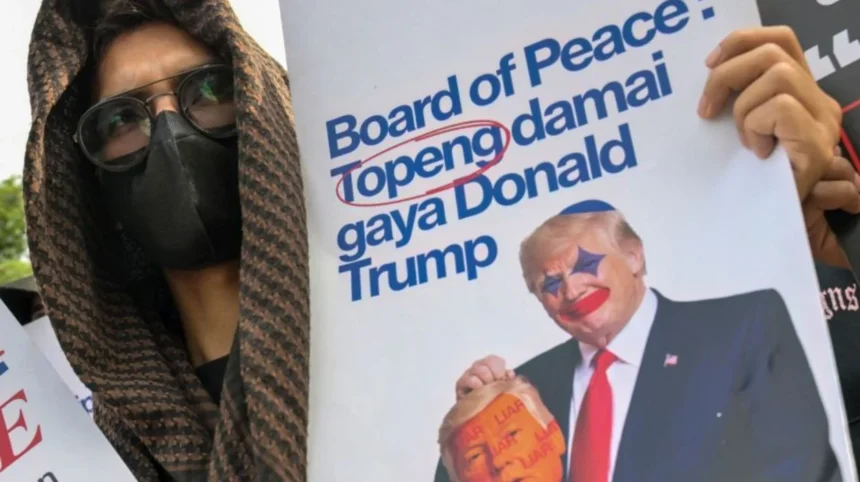
- Indonesia’s government is facing rising domestic pressure to withdraw from the United States-led Board of Peace as the US-Israel war against Iran escalates.
- The calls to quit the Board are coming from lawmakers and Islamic groups who say Indonesia’s participation risks aligning it with military action they see as aggression.
- The latest criticism intensified after US and Israeli strikes on Tehran and other Iranian cities on 28 February reportedly killed Iran’s Supreme Leader Ayatollah Ali Khamenei.
- The debate is unfolding in Jakarta in early March 2026, against the backdrop of Indonesia’s long‑standing support for Palestine and its “free and active” foreign policy doctrine.
- Critics argue that remaining on the Board of Peace could undermine Indonesia’s credibility as a neutral Muslim-majority country backing Palestinian statehood and non-alignment.
- The government maintains that joining the Board allows Indonesia to influence post-war reconstruction in Gaza and press for a two-state solution from within the initiative.
- Any decision to remain or withdraw could affect Indonesia’s ties with Washington and other Muslim-majority partners, as well as its domestic political landscape and regional diplomatic standing.
Indonesia is confronting mounting calls at home to withdraw from the United States-led Board of Peace, as US and Israeli forces wage a widening war against Iran that has sharpened scrutiny of Jakarta’s role in the controversial body. The debate pits supporters of President Prabowo Subianto’s engagement strategy against lawmakers and Islamic organisations who fear Indonesia’s participation could be seen as endorsing military actions they strongly oppose.
- Domestic criticism intensifies after strikes on Iran
- What the Board of Peace is and why Indonesia joined
- Government signals conditional engagement
- Islamic organisations and public sentiment
- Strategic calculations in Jakarta
- Balancing “free and active” policy with new realities
- International reactions and broader geopolitical stakes
- What happens next
Domestic criticism intensifies after strikes on Iran
Pressure on the government escalated after a coordinated missile strike by the United States and Israel on 28 February hit Tehran and other Iranian cities, reportedly killing Iranian Supreme Leader Ayatollah Ali Khamenei and prompting Iranian missile retaliation against neighbouring Gulf states. Lawmakers and religious leaders in Indonesia have linked these developments directly to renewed calls for Jakarta to reconsider its association with the Board of Peace.
Oleh Soleh, a member of the House of Representatives’ Commission I for the National Awakening Party (PKB), criticised what he described as Indonesia’s muted response, noting that an official statement expressing “deep regret” over the escalation did not explicitly condemn Washington and Tel Aviv. According to Tempo.co, quoted by The Jakarta Post, he urged the government to take a leading role in pushing for sanctions against the US and Israel.
Fellow Commission I legislator TB Hasanuddin of the Indonesian Democratic Party of Struggle (PDI-P) has gone further, calling for an immediate withdrawal from the Board of Peace to defend Indonesia’s long‑held “free and active” foreign policy principle and avoid any impression that Jakarta is tolerating military action against a sovereign state. He argued that remaining in the body could create “bigger problems” domestically and diplomatically if the conflict deepens.
What the Board of Peace is and why Indonesia joined
The Board of Peace was set up at the initiative of US President Donald Trump as part of efforts to consolidate a ceasefire between Israel and Hamas and oversee post-conflict reconstruction in the Gaza Strip. Indonesia accepted Trump’s invitation to join alongside several other Muslim-majority states, including Qatar, Pakistan, Türkiye and Saudi Arabia, while US allies such as the United Kingdom, Canada, Australia and France declined over concerns that the body’s mandate overlaps with the United Nations and could undercut the existing international order.
According to an official statement from the Indonesian cabinet secretariat, the Board’s mandate includes supervising the ceasefire’s implementation, stabilising security and leading reconstruction in Gaza, as well as restoring civil governance and supporting a transition to sustainable peace. Membership is restricted to countries invited directly by the Board’s chair, with participation at head-of-state or head-of-government level.
President Prabowo signed the Board of Peace Charter in January 2026, framing Indonesia’s involvement as a strategic move to ensure the Gaza transition remains anchored in a two-state solution and does not become a permanent arrangement that sidelines Palestinian rights. The government has said it intends to use the forum to advocate for a cessation of violence, protection of civilians, humanitarian access and the restoration of Palestinian civil governance, in line with international law and UN resolutions.
Government signals conditional engagement
Facing domestic criticism, the Prabowo administration has previously suggested that Indonesia’s participation in the Board of Peace is conditional and could be reversed. After meetings with Islamic organisations at the Presidential Palace on 3 February, Foreign Minister Sugiono stated that Indonesia would leave the Board if its central objectives, including Palestinian independence, were not realised.
Sugiono said Jakarta had set benchmarks for the body’s work in Gaza and Palestine, with the “primary objective” being full statehood for Palestine. He stressed that Indonesia was not obliged to follow decisions that conflict with its own positions and that President Prabowo was prepared to withdraw if the Board failed to align with Indonesia’s principles.
In a separate outreach effort, Prabowo met former foreign ministers and deputy ministers on 4 February to explain his policy, with some participants later describing the Board of Peace as the only currently available mechanism capable of addressing ongoing violence in Palestine. According to a statement from Indonesia’s Government Communication Agency summarising that meeting, diplomats and academics present viewed Indonesia’s membership as a strategic step to strengthen humanitarian diplomacy and press for an end to Palestinian suffering in Gaza.
Islamic organisations and public sentiment
Indonesia’s largest Islamic organisations, which have significant influence over public opinion and policy debates, have closely watched the government’s stance on Palestine and the Board of Peace. Some figures within these groups have supported engagement as a way to pursue humanitarian goals, while others warn that participation risks appearing to legitimise a US-led framework at a time when many Indonesians sympathise strongly with Palestinians and view Israel’s actions critically.
Analysts quoted by regional think-tank Fulcrum and other outlets note that Prabowo’s decision to join the Board is politically sensitive at home, because it coincides with a broader deepening of ties with Washington, including the bilateral Agreement on Reciprocal Trade (ART). They argue that the war against Iran has further sharpened concerns that Indonesia could be drawn too close to Western security agendas, despite its formal commitment to non-alignment.
Public demonstrations in Indonesia over Gaza and Palestine in late 2025 and early 2026 have underscored the depth of popular support for Palestinian statehood and scepticism towards Western military interventions. Reports indicate that the latest escalation involving Iran has renewed calls from some activists and commentators for the government to distance itself from US-led initiatives, including the Board of Peace. This information could not be independently verified.
Strategic calculations in Jakarta
Supporters of Indonesia’s continued role on the Board argue that leaving would reduce Jakarta’s ability to shape outcomes in Gaza and Palestine at a critical moment. They say the platform offers a rare channel through which a non-Western, Muslim-majority democracy can press for humanitarian access, reconstruction priorities and political guarantees for Palestinian self-determination.
According to Asialink and Fulcrum analyses, the government sees potential benefits in coupling its participation with a more active diplomatic posture, including offers to contribute troops or peacekeepers to Gaza as part of any internationally mandated stabilisation effort. Deutsche Welle has reported that Indonesia is preparing to send thousands of troops to Gaza as part of its engagement with the Board, a move described as politically risky but consistent with its ambition to play a larger peacekeeping role.
Critics counter that association with the Board at a time when its main sponsors are engaged in a high-intensity conflict with Iran could complicate Indonesia’s relations with other Muslim-majority states and with domestic constituencies. They point to the decision by several Western countries to stay out of the body on institutional grounds and argue that Jakarta should work through the UN and established multilateral mechanisms instead.
Balancing “free and active” policy with new realities
Indonesia’s founding foreign policy doctrine of being “free and active” – meaning independent of major power blocs while actively promoting peace and justice – is central to the current debate. Lawmakers like Hasanuddin contend that continued participation in a US-led body could be interpreted as a departure from that principle, particularly as the war against Iran intensifies.
Government officials respond that engagement does not equate to alignment, arguing that Indonesia can use its seat to challenge decisions it disagrees with and to insist on compliance with international law. They also note that Jakarta has long supported Palestinian statehood in UN forums and other multilateral settings, and that this stance remains unchanged.
Regional observers say Indonesia’s decision-making is further complicated by its aspirations to be a leading diplomatic voice in the Muslim world and in the Association of Southeast Asian Nations (ASEAN). With other Muslim-majority members also sitting on the Board of Peace, Jakarta must weigh the implications of either staying in or stepping away for its bilateral relationships with Qatar, Pakistan, Türkiye and Saudi Arabia.
International reactions and broader geopolitical stakes
The evolving US-Israel conflict with Iran is reshaping calculations for many states beyond the Middle East, including Indonesia. Analysts say Jakarta’s eventual decision on the Board of Peace will be watched closely in Washington, where Indonesia is seen as an important partner in both economic and security terms, as well as in Tehran and other regional capitals.
Major Western powers that declined to join the Board have argued that any reconstruction and political process in Gaza should be coordinated through the United Nations to avoid duplication and ensure broad legitimacy. Their stance may offer some cover for Indonesia if it chooses to step back, but could also leave Jakarta with fewer opportunities to shape events on the ground if the Board becomes the dominant mechanism.
At the same time, Indonesia’s domestic political scene is likely to remain sensitive to developments in Gaza and Iran, with opposition parties and civil society groups expected to keep pressing the government over its foreign policy choices. The balance between preserving strategic ties with the US, maintaining solidarity with Palestinians and addressing domestic expectations will continue to frame the debate.
What happens next
For now, Indonesia remains a member of the Board of Peace, but officials have reiterated that their engagement is conditional and subject to review. Future developments in the US-Israel war against Iran, as well as any progress or setbacks on Palestinian statehood and Gaza reconstruction, are likely to influence whether Jakarta decides to stay or withdraw.
The government is expected to continue consultations with parliament, Islamic organisations, diplomats and foreign policy experts in the coming weeks as it reassesses its position. Any move to leave the Board would probably be accompanied by a renewed emphasis on UN channels and other multilateral forums, while a decision to remain would likely be framed as an attempt to shape outcomes from within.
Regional observers suggest that Indonesia’s choice could carry wider implications for how middle powers in Asia navigate competing pressures from major states during periods of conflict. As the situation in Iran and Gaza continues to evolve, Jakarta’s handling of the Board of Peace issue will be an important test of its ability to maintain its foreign policy principles while managing complex geopolitical realities.

