


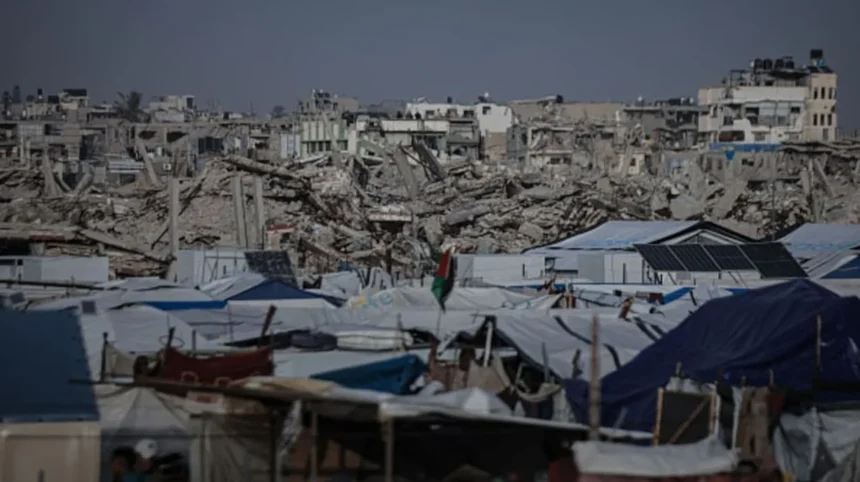
According to The Jerusalem Post, the White House is working to advance a Gaza ceasefire and reconstruction framework centered on a body known as the Board of Peace. The outlet reports that the United States is planning a key meeting of this body on February 19, described as part of ongoing efforts to push forward the second phase of a Gaza peace plan and consolidate a fragile ceasefire.
The Jerusalem Post notes that the Board of Peace has been tasked with supporting reconstruction in Gaza, backing an international security force, and promoting the disarmament of Hamas. It is reported that the board includes an executive structure and a High Representative for Gaza, and was ratified by US President Donald Trump on January 22 as part of a broader, US-led initiative to reshape governance and security arrangements in the territory.
As reported by The Jerusalem Post, US Envoy Steve Witkoff and adviser Jared Kushner have been promoting investment and reconstruction measures linked to this framework. Both officials were recently aboard the US aircraft carrier Abraham Lincoln amid heightened US-Iran tensions, underscoring how regional security dynamics intersect with the Gaza peace and reconstruction process.
The article explains that the second phase of the Gaza plan began in January and is intended to move from initial ceasefire arrangements toward longer-term stabilization. However, the report stresses that persistent armed activity by Hamas and growing concerns over militias on the ground in Gaza have complicated efforts to implement the envisioned political, security, and economic roadmap.
What Challenges and Reactions Are Shaping the Process?
According to The Jerusalem Post, one of the core obstacles to the US-backed plan is the continued presence and control of Hamas in Gaza. Despite the creation of new governance structures on paper, the report notes that Hamas remains armed and effectively in charge of large parts of the territory, limiting the ability of new institutions to operate and undermining attempts to change the local power balance.
The article reports that Dr. Ali Sha’ath, Chief Commissioner of the National Committee for the Administration of Gaza under the Board of Peace framework, publicly thanked President Donald Trump and his administration for their efforts and said they had “created the opportunity for a new future in Gaza.” At the same time, The Jerusalem Post notes that Sha’ath’s technical committee has not been allowed to carry out meaningful work inside Gaza, amid opposition from Israel to any structure perceived as linked to the Palestinian Authority.
According to the report, Israeli officials in Jerusalem have stated that the Palestinian Authority will have no role in governing Gaza under current arrangements. The Jerusalem Post emphasizes that officials have not explicitly ruled out a governance role for Hamas, which in practice has meant that Hamas continues to hold power on the ground despite formal peace and reconstruction plans.
The Jerusalem Post also highlights growing concern over the behavior of local militias, particularly groups operating around the Rafah crossing between Gaza and Egypt. Citing reporting from Israel’s Ynet, the article notes that Gazans have complained of harassment, interrogations, detentions, and alleged theft by Abu Shabab militiamen in areas near the crossing, contributing to a sense of lawlessness for civilians trying to move in and out of Gaza.
Supporting Details: Militias, Rafah Crossing, and On-the-Ground Realities
The Jerusalem Post, referencing Ynet, reports that conditions at the Rafah border crossing have become a major source of frustration for Gaza residents since its partial reopening. Four days after the crossing reopened, Ynet reported that only about 20 patients had been allowed to leave Gaza out of some 22,000 requests, while roughly 75 people had returned, all after lengthy inspections and with strict limits on what they could carry.
The report cites accounts of Gazans who described being stopped and questioned by the Abu Shabab militia, which Ynet reports is backed by Israel and operates in the Rafah area. According to these accounts, some individuals said they were interrogated, handcuffed, blindfolded, and subjected to theft, raising questions among observers about the legal authority and operational oversight of these armed groups.
The Jerusalem Post notes one case highlighted by Palestinian media, including Hamas-affiliated outlets, involving Rutanah al-Rakab, a woman returning from Egypt. She reportedly said that after standard inspections on the Palestinian side ended, militiamen arrived claiming to be “fighting Hamas,” and tried to hand her over to Israeli forces before European monitors at the crossing intervened.
In parallel, the article draws on comparisons from other conflict zones to illustrate concerns over militia-led security structures. It references the fate of armed groups in Yemen, Syria, and Iraq—where US-backed tribal “awakening” forces in Anbar province did not provide lasting security—and notes historical examples such as the professionalization of the US Continental Army during the American Revolution and Israel’s decision to integrate or dissolve pre-state militias after its War of Independence.
The Jerusalem Post uses these examples to underscore the argument that governance and security dominated by militias tend to generate instability rather than sustainable order. Within the Gaza context, the report suggests that the combination of Hamas control and militia activity risks entrenching a cycle of lawlessness and undermining the international vision of a more structured, civilian-focused administration supported by the Board of Peace.
What Are the Implications and Future Developments?
According to The Jerusalem Post, the partial reopening of the Rafah crossing, a key aspect of the second phase of the ceasefire and reconstruction plan, has so far fallen short of expectations. CNN is cited as reporting that the first week of the partial reopening was marked by “confusion and logistical hurdles,” with far fewer Palestinians crossing than projected and ambiguity over the daily quotas agreed by Israeli and Egyptian authorities.
The report notes that an Israeli security official told CNN that 150 Palestinians per day would be allowed to leave Gaza and 50 to enter, but Egyptian state media reported a different figure of 50 allowed in each direction. This discrepancy, coupled with on-the-ground confusion, has hindered the intended easing of movement and impeded broader efforts to normalize conditions in Gaza.
The Jerusalem Post further reports that, during the ratification of the Board of Peace, High Representative for Gaza Nickolay Mladenov framed the initiative as turning a “page” after years of conflict, destruction, and instability. US Special Envoy for Peace Missions Steve Witkoff said at the time that a peace deal in Gaza had been achieved, hostages had been returned, and new hope created for the future of Gaza and other areas where the Board of Peace would operate.
The planned February meeting of the Board of Peace is described as an important milestone, roughly one month after ratification, intended to push the Gaza plan forward and address practical hurdles such as border procedures, reconstruction mechanisms, and security arrangements. The Jerusalem Post notes that by then some of the operational issues at Rafah may have been mitigated, but significant questions remain over the role of militias and the ability of civilians to access services not controlled by Hamas.
In its analysis, The Jerusalem Post raises the broader strategic question of whether Gaza’s population is being left with a choice between continuing Hamas rule—entrenched since 2007—and governance shaped by armed militias. The article suggests that if Gazans perceive militia rule as more threatening or unstable than Hamas, they may continue to gravitate toward the status quo, complicating US-led efforts to reshape the political and security landscape.
The report adds that, over the years, some voices argued it was advantageous for Israel to keep Gaza separated from the West Bank by allowing Hamas to rule in Gaza. After the events of October 7, The Jerusalem Post notes that it is unclear whether this approach will persist. For now, the outlet concludes that Hamas has effectively reasserted control over roughly half of Gaza, underscoring how militias, border delays, and unresolved governance questions continue to challenge US-led peace efforts.

