
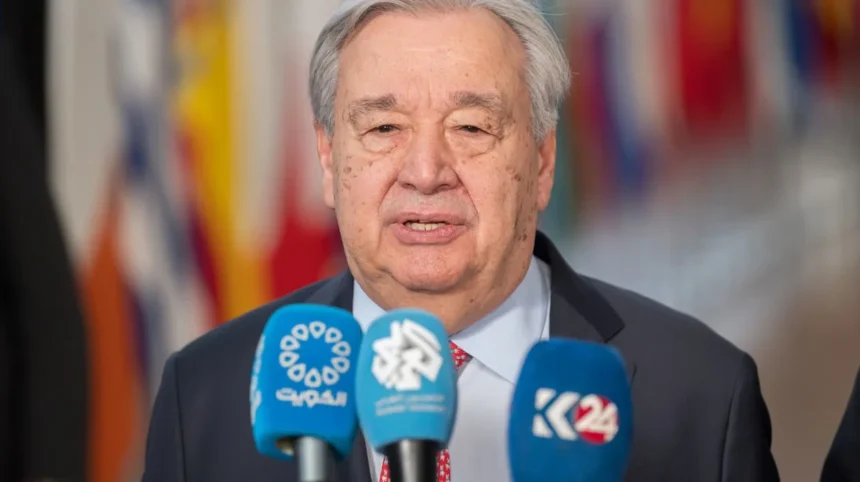
As reported by Reuters, United Nations Secretary-General Antonio Guterres said the UN is “cooperating actively” with US President Donald Trump’s Board of Peace on a Gaza reconstruction plan approved by the UN Security Council. According to Reuters, Guterres welcomed the board’s stated aim to fund and deliver basic elements of reconstruction, including rebuilding Palestinian homes and infrastructure in the enclave. He made the comments in an interview with Politico, citing the Security Council’s endorsement of the plan’s objective as the basis for UN engagement.
According to The Express Tribune’s account of the interview, Guterres stressed that cooperation is focused on implementing what the Security Council has already defined for post-war Gaza. The new body, personally headed by Trump, has been tasked with overseeing aspects of Gaza’s reconstruction and channeling international funding, according to multiple outlets summarizing Politico’s reporting. Reuters reported that Guterres said he has not spoken directly with Trump since the start of the war but has been in contact with other members of the US administration.
What did Guterres say about Gaza and Hormuz?
Guterres indicated that while he supports the Gaza-focused reconstruction mission, he does not see the Board of Peace as the appropriate vehicle for addressing wider regional crises, including maritime security in the Strait of Hormuz. As reported by The Express Tribune citing Politico, he said the current framework is “not the effective way to address the dramatic problems that we have now” and emphasized the need to uphold international law and the values of the UN Charter in any peace initiative.
According to Reuters, Guterres also called for an end to Iran’s closure of the Strait of Hormuz, describing it as essential to restore safe passage and reduce regional tensions. Reuters reported that he suggested the UN could help protect the waterway and form part of a broader plan to de-escalate attacks affecting the strategic shipping lane. In these remarks, Guterres signaled a preference for established multilateral mechanisms rather than extending the mandate of Trump’s Board of Peace into security operations around Hormuz.
Supporting details and wider context
According to the Jerusalem Post’s summary of the Politico interview, Guterres said the objective of the Board of Peace was defined and approved by the Security Council and reiterated that the UN is “cooperating actively with structures created by the Board of Peace.” The same report noted that the body is described as a new international mechanism, led personally by Trump, to oversee post-war Gaza and coordinate reconstruction efforts.
Other outlets relaying the interview stressed that Guterres drew a clear distinction between reconstruction tasks in Gaza and broader regional security questions. The Express Tribune, citing Politico, reported that Guterres warned against relying on the Board of Peace as a model for resolving “deeper crises” across the Middle East, underscoring that such issues require adherence to international law and collective UN-based processes.
Guterres’ call to reopen the Strait of Hormuz comes amid heightened tensions and economic concerns linked to Iran’s closure of the waterway, a vital route for global oil shipments. According to Al Jazeera, European leaders have recently rejected US requests for military involvement in efforts to secure navigation in the Strait, reflecting broader caution about expanding the conflict and about new security architectures in the region.
What are the implications and what comes next?
According to Reuters and other outlets summarizing Politico’s reporting, Guterres’ position suggests the UN will continue to work with Trump’s Board of Peace where its mandate aligns with Security Council decisions on Gaza reconstruction. At the same time, his comments indicate reluctance to see the board’s role broadened into areas such as maritime security in the Strait of Hormuz, where he favors solutions grounded in international law and UN-led frameworks.
Diplomatic discussions over reopening Hormuz and de-escalating attacks in the area are likely to continue in multilateral forums, with the UN potentially playing a coordinating role in any future protection arrangements for the waterway. According to Al Jazeera, European Union governments are already debating how, and to what extent, they might participate in efforts to secure the strait while avoiding deeper military entanglement. Guterres’ remarks suggest that upcoming negotiations over Gaza’s reconstruction and regional security will proceed on parallel tracks, with the Board of Peace confined to its existing reconstruction-focused remit as defined by the Security Council.
In his interview, as relayed by multiple outlets, Guterres underlined that any effective peace initiative in Gaza or the wider region must be anchored in respect for the UN Charter, international humanitarian law, and collective decision-making. His comments underscore that while the UN is prepared to cooperate with new mechanisms like Trump’s Board of Peace for specific reconstruction goals, it remains cautious about adopting such structures as templates for managing broader crises such as those unfolding in and around the Strait of Hormuz.

