


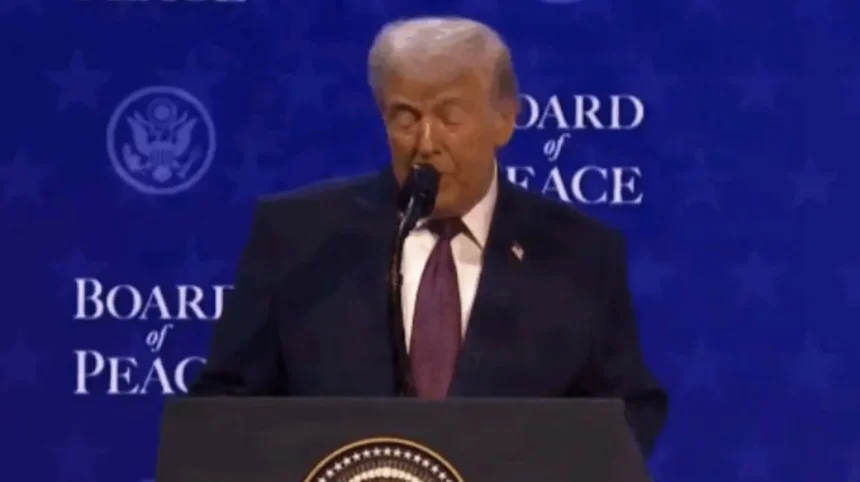
As reported by The Times of Israel, US President Donald Trump’s Board of Peace is holding its first formal meeting in Washington, D.C., with Gaza’s reconstruction and security arrangements at the top of the agenda. The gathering comes nearly four months after the Trump administration brokered a ceasefire in the Gaza Strip that led to the release of all remaining Israeli hostages and halted more than two years of full-scale war between Israel and Hamas.
According to The Times of Israel, the Board of Peace has been presented by the Trump administration as the central vehicle for postwar governance, reconstruction financing and security in Gaza, alongside a parallel diplomatic track that includes negotiations with Iran over its nuclear program and regional activities. The Board of Peace is also opening at a moment when fears of a wider confrontation with Iran are rising, as US forces and regional allies brace for potential escalation if nuclear diplomacy breaks down.
The Times of Israel reports that nearly fifty countries are represented at the Washington meeting, though most leaders have opted to send senior ministers rather than attend themselves. Bahrain’s King Hamad Al Khalifa is the only Middle Eastern head of state reported to be attending in person, while Israel, Jordan, the United Arab Emirates, Saudi Arabia, Egypt, Turkey, Qatar and others have dispatched foreign ministers or senior cabinet members.
While the Board of Peace is framed as inclusive, the Ramallah-based Palestinian Authority has not been invited, according to The Times of Israel. Instead, representation on the Palestinian side is channelled through the National Committee for the Administration of Gaza (NCAG), a technocratic body backed by some Arab governments and tasked with gradually replacing Hamas as Gaza’s governing authority.
Nickolay Mladenov, the Board of Peace’s High Representative for Gaza, has said the NCAG cannot fully enter or assume responsibility in the Strip until ceasefire violations subside. At the same time, a small group of European countries, which have stayed out of the Board of Peace due to legal concerns and worries it might undermine the United Nations, are expected to participate as observers rather than full members.
What is the Board of Peace trying to achieve in Gaza?
As reported by The Times of Israel, Trump has said the Board of Peace aims to push forward a phased reconstruction of Gaza that is conditioned on Hamas disarmament and a reconfiguration of security arrangements in the enclave. The US administration is promoting a model in which donor states, regional mediators and a new international force work in sequence to stabilize Gaza, rebuild critical infrastructure and prevent renewed large-scale conflict.
According to The Times of Israel, Trump has said that more than 5 billion dollars in pledges for humanitarian aid and reconstruction are expected to be announced at the Washington meeting. The outlet reported that key funders identified ahead of the summit include Qatar, the United Arab Emirates, Kuwait and the United States, each poised to contribute more than 1 billion dollars.
The Times of Israel notes that there is still uncertainty over whether additional governments will commit major funds, amid fears that any reconstruction could be destroyed in a future round of violence if Hamas remains armed and a durable political settlement is not reached. At the same time, UN officials and humanitarian agencies continue to highlight the scale of devastation inside Gaza, where large swaths of housing, public buildings and civilian infrastructure have been reduced to rubble.
The Board of Peace framework also includes an International Stabilization Force, or ISF, whose purpose is to help maintain the ceasefire and support demilitarization efforts on the ground. Italy and Indonesia are among the countries that have expressed interest in contributing personnel, although, as The Times of Israel reports, some governments have signaled they are only prepared to take on limited peacekeeping duties such as border security and humanitarian escort, rather than direct enforcement operations against Hamas and other armed factions.
According to The Times of Israel, Egypt, Qatar and Turkey have held sustained talks with Hamas on the decommissioning of weapons in Gaza. US officials are still finalizing a formal disarmament proposal, which, sources told the outlet, is expected to focus on stripping Hamas of tools used to threaten Israel, beginning with heavy weaponry and weapons manufacturing sites, and then incentivizing the handover of lighter arms through offers of jobs, funding and amnesty.
Context and reactions: How are key actors responding?
The Times of Israel reports that the success of the Board of Peace’s plans depends on several actors with diverging interests, including Israel, Hamas, regional mediators and international donors. Since the October-brokered ceasefire, both Israel and Hamas have accused each other of near-daily violations of the truce, and hundreds of Palestinians have been killed in Gaza during that period, according to Gaza’s Hamas-run health ministry cited by The Times of Israel.
A senior US official quoted by The Times of Israel argued that progress in Gaza has not stalled, while acknowledging the scale of the demilitarization challenge. “We are under no illusions on the challenges regarding demilitarization, but we have been encouraged by what the mediators have reported back,” the official said, pointing to ongoing discussions with regional partners and indirect contacts with Hamas through intermediaries.
Regionally, countries like Egypt, Qatar and Turkey have sought to position themselves as central brokers in both Gaza’s internal realignment and broader security arrangements. Their role in liaising with Hamas, maintaining the ceasefire and shaping the terms of disarmament has become integral to the Board of Peace’s strategy, even as some of these governments have had tense relations with Israel in recent years.
The Times of Israel notes that the Palestinian Authority’s exclusion has raised questions about long-term political governance in Gaza, given longstanding international support for a unified Palestinian leadership across Gaza and the West Bank. Instead, the NCAG, headed by engineer and former official Ali Shaath, has been tasked with developing a technocratic administration designed to be distinct from both Hamas and Fatah, although it has not yet been able to take control on the ground.
Within the wider international community, some European states have remained cautious about joining the Board of Peace as full members. According to The Times of Israel, their concerns include potential conflicts with existing international legal obligations and unease that a parallel structure might dilute or sideline the United Nations’ authority in conflict resolution and peacekeeping. This has prompted several of them to attend the Washington meeting only as observers.
Supporting details and expert commentary on the Board of Peace
As outlined by The Times of Israel, the Board of Peace structure features an Executive Board and a specialized Gaza Executive Board, blending political leadership with technocratic oversight. US Secretary of State Marco Rubio serves on the Executive Board, while senior figures such as Jared Kushner, Steve Witkoff, former UK prime minister Tony Blair and Nickolay Mladenov sit on the Gaza Executive Board. These bodies are expected to play a key role in supervising postwar management, including disarmament sequencing, economic planning and coordination with the International Stabilization Force.
The Thursday session in Washington is scheduled to begin with a breakfast, followed by opening remarks from Trump and the signing of resolutions related to Gaza, according to a schedule obtained by The Times of Israel. Each delegation head has been invited to make brief remarks, including announcements of financial or personnel contributions to the Gaza effort. Trump is expected to depart after a group photo, while the meeting continues for another hour of working discussions.
The Times of Israel reports that the US disarmament plan for Hamas is envisioned as a gradual, area-by-area process rather than an immediate Strip-wide campaign. Under this concept, heavy weapons and production facilities would be removed first in specific zones, with international monitoring, while economic and political incentives are offered to encourage fighters to surrender lighter arms. The approach is designed to reduce the risk of a sudden collapse of the ceasefire, but it also implies a prolonged transition period in which security and governance will remain fragile.
Experts and officials cited by The Times of Israel note that even a partially successful disarmament scheme would be unlikely to eliminate all weaponry held by Palestinian factions in Gaza. However, US officials argue that a combination of pressure from regional mediators and the presence of the International Stabilization Force could constrain Hamas’s ability to act as a spoiler and help maintain a lower-intensity security environment.
The funding structure described by The Times of Israel reflects a broader trend in which wealthy Gulf states and the United States underwrite reconstruction and humanitarian programs while also seeking political leverage over Gaza’s future. At the same time, potential contributors are balancing domestic scrutiny over supporting a process that could fail if the political track stalls or if tensions with Iran and other regional actors tip back into open conflict.
What are the implications and possible future developments?
According to The Times of Israel, the Board of Peace’s inaugural meeting will serve as a test of whether the United States and its partners can translate ceasefire arrangements into a sustainable framework for Gaza’s reconstruction and governance. The next phase will likely hinge on whether concrete disarmament steps can be implemented on the ground and whether Hamas, under pressure from mediators and local dynamics, is prepared to relinquish significant military capabilities.
The Board of Peace model also has direct bearing on the prospect of a wider confrontation with Iran. While The Times of Israel focuses on the Gaza track, the meeting is taking place in parallel with heightened concerns that stalled nuclear talks or regional clashes involving Iranian-aligned militias could spiral, drawing in US forces and allies. A breakdown in Gaza’s stabilization effort, combined with escalating tensions with Iran, would risk linking the two theaters in a broader regional crisis.
Future developments will also depend on Israel’s stance toward withdrawals and security coordination. As reported by The Times of Israel, there are open questions about how far Israel will agree to pull back from parts of the Strip to enable reconstruction projects and international deployments to proceed. Israeli decision-makers will weigh these steps against their assessment of the threat from Hamas and other armed groups, as well as domestic political pressures.
The evolving role of the NCAG and the absence of the Palestinian Authority raise further questions about Palestinian political representation in Gaza’s next phase. If the NCAG remains unable to enter the Strip due to ongoing violence, the gap between the Board of Peace’s institutional blueprint and realities on the ground may widen, potentially complicating donor engagement and the work of the International Stabilization Force.
The Times of Israel indicates that the disarmament plan will take months to implement even under favorable conditions, underscoring that the Board of Peace is embarking on a long-term process rather than a quick transition. Over this period, the Board of Peace is expected to reconvene and adjust its approach in light of events in Gaza, shifts in regional diplomacy, and the trajectory of tensions with Iran.
In the immediate term, Trump’s Board of Peace meeting in Washington marks the formal launch of a complex, US-led experiment in postwar governance and reconstruction in Gaza, built around new institutions, substantial funding pledges and a proposed international force. Its progress will be measured against both developments on the ground in Gaza and the broader regional landscape, where the risk of renewed large-scale conflict, including potential war with Iran, remains a central concern for policymakers and publics alike.

