


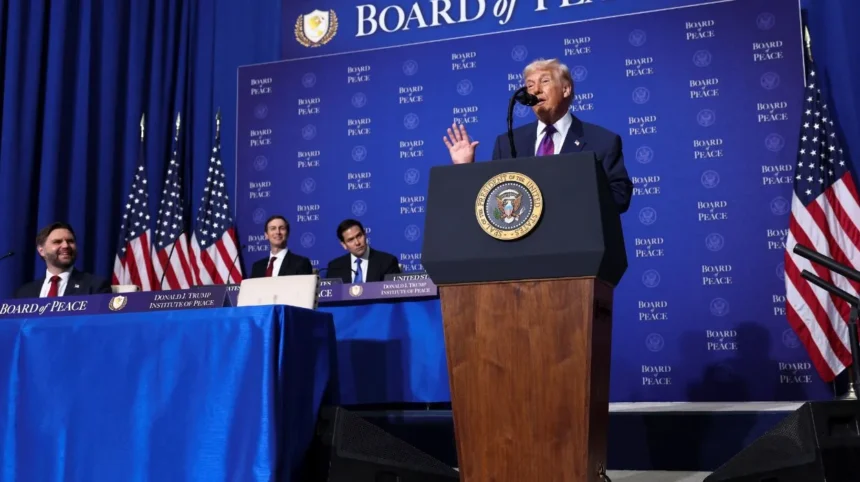
As reported by Reuters, U.S. President Donald Trump is set to preside over the first meeting of his Board of Peace on Thursday, with major questions over the future of Gaza still unresolved. According to Reuters, the gathering in Washington is expected to include delegations from 47 countries and the European Union, with Israel represented but no direct Palestinian delegation on the board itself. The meeting will be held at the Donald J. Trump U.S. Institute of Peace in Washington, a building the president recently renamed for himself.
According to Reuters, Trump is expected to announce that participating nations have raised 5 billion dollars for a Gaza reconstruction fund, which officials describe as an initial down payment on a much larger effort. Reuters reports that this sum is expected to include about 1.2 billion dollars each from the United Arab Emirates and Kuwait, two key Gulf allies of Washington. Senior U.S. officials cited by Reuters say several nations are also planning to send thousands of troops to an International Stabilization Force that would deploy to help keep the peace in Gaza.
Key Issues over Gaza and Hamas
According to Reuters, the disarmament of Hamas militants and the withdrawal of Israeli troops from Gaza are among the central unresolved issues that will test the Board of Peace in the coming weeks and months. The size of the reconstruction fund and the future flow of humanitarian aid to Gaza’s war-battered population are also seen by officials as major challenges. Trump’s 20‑point Gaza plan, which helped secure a fragile ceasefire last October in the two‑year Gaza war, places demilitarization and security arrangements at the heart of the process.
Reuters reports that Hamas has been wary of disarmament, fearing Israeli reprisals if it hands over its weapons. A senior U.S. administration official told Reuters that Washington has “no illusions” about the difficulty of demilitarization but is encouraged by feedback from mediators. In Gaza, Hamas spokesperson Hazem Qassem told Reuters that any international force must “monitor the ceasefire and prevent the (Israeli) occupation from continuing its aggression,” adding that disarmament could be discussed without explicitly committing to it.
Context / Reactions: How Are Stakeholders Responding?
According to Reuters, Hamas has resumed administration of the devastated Gaza enclave and says it is prepared to hand over authority to a U.S.-backed committee of Palestinian technocrats led by Ali Shaath. Hamas officials told Reuters that Israel has not allowed this technocratic committee into Gaza, a claim on which Israel has yet to comment. Reuters reports that Shaath is nonetheless expected to attend the Washington event as part of the broader international presence.
A member of the peace board, speaking anonymously to Reuters, said the Gaza plan faces formidable obstacles, notably the need to establish security in an enclave where the police force is neither ready nor fully trained. The same official told Reuters that a critical unresolved question is who would negotiate with Hamas, suggesting representatives might work through countries with influence over the group, such as Qatar and Turkey, even as Israel remains deeply skeptical of both. The official also described the current flow of aid into Gaza as “disastrous” and in urgent need of scaling up, while raising concerns about who would actually manage distribution on the ground.
In Gaza, Palestinians interviewed by Reuters urged rapid reconstruction after two years of war. Displaced resident Atef Abu Al-Anein from Rafah, now under full Israeli control, told Reuters that there is destruction across hospitals, health, education, infrastructure, electricity, water, housing and the environment, and said people hope for very fast rebuilding. Gaza businessman Tamer Al-Burai told Reuters he is hopeful that Trump will compel Israel to respect the ceasefire “and that the war will be over for real, not just in words.”
Supporting Details and Background
Reuters reports that Trump’s Board of Peace includes Israel but does not include Palestinian representatives as full members, raising concerns among some observers about political balance. According to Reuters, Trump has suggested that the Board could eventually address conflicts beyond Gaza, causing anxiety that it might undercut the United Nations’ role as the central forum for global diplomacy and conflict resolution. Most permanent members of the U.N. Security Council, including France, Britain, Russia and China, are not expected to attend the Washington meeting, Reuters notes.
Speakers at the event are expected to include Trump, Secretary of State Marco Rubio, U.S. envoys Steve Witkoff and Jared Kushner, former British Prime Minister Tony Blair, U.S. ambassador to the U.N. Mike Waltz and High Representative for Gaza Nickolay Mladenov, among others, according to Reuters. A peace board member cited by Reuters stressed that security improvements in Gaza are a precondition for progress in reconstruction and governance. The same source underlined that even with a larger flow of aid, the lack of a clear mechanism or authority to manage distribution could hamper relief efforts.
Reuters reports that Palestinians in Gaza are living in a territory largely turned into a wasteland by the two-year war. According to Israeli tallies cited by Reuters, the conflict began when Hamas fighters attacked southern Israel in October 2023, killing more than 1,200 people. Reuters further reports that Israel’s subsequent air and ground campaign has killed more than 72,000 people in Gaza, according to the Palestinian health ministry, while the Gaza health ministry says Israeli fire has killed more than 600 people since the fragile ceasefire last October, and Israel says four of its soldiers have been killed by militants in the same period.
Implications / Future Developments: What Comes Next?
According to Reuters, the Board of Peace’s effectiveness will be tested by its ability to secure Hamas disarmament, oversee an eventual withdrawal of Israeli forces and manage an expanded, better-organized flow of humanitarian aid. The planned International Stabilization Force, if deployed, will play a central role in maintaining security, but its composition, mandate and timeline remain to be fully detailed. The peace board member who spoke to Reuters emphasized that establishing a credible local security apparatus and a functioning police force in Gaza is essential before broader reconstruction goals can be met.
Looking ahead, Reuters reports that a key open issue is who will lead political engagement with Hamas, given Israel’s skepticism toward mediators such as Qatar and Turkey. Another major variable is whether the promised 5 billion dollars in reconstruction funding can be scaled up and delivered quickly enough to address the level of destruction described by residents and officials. How the Board of Peace interacts with existing U.N. mechanisms and whether it reassures or further unsettles regional actors will likely shape diplomatic dynamics around Gaza in the coming months, according to the concerns cited in the Reuters report.
Ultimately, as outlined by Reuters, Trump’s first Board of Peace meeting will convene dozens of countries, substantial pledged funding and plans for an international force, while leaving fundamental questions about security, governance, aid distribution and political representation in Gaza still unresolved.

