


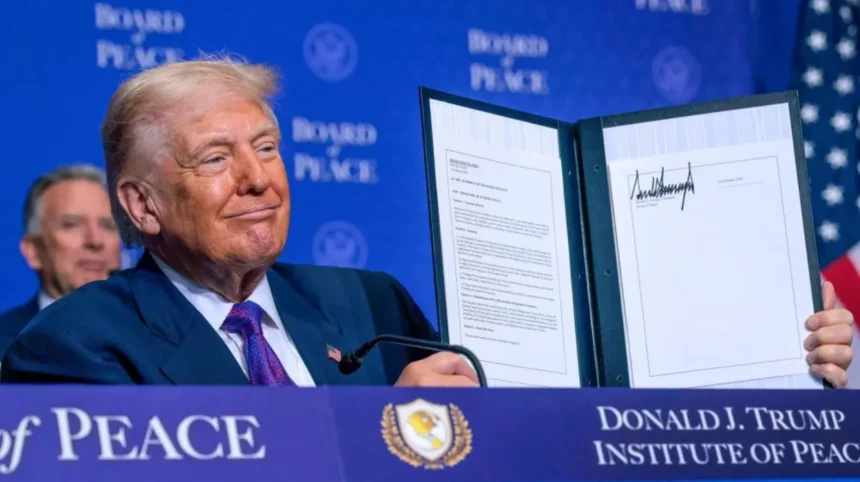
As reported by NBC News, President Donald Trump has pledged that the United States will provide 10 billion dollars to support his newly created Board of Peace, a multinational body he has positioned at the center of efforts to reconstruct Gaza and shape global conflict resolution. In remarks at the board’s inaugural meeting in Washington, Trump cast the body as a vehicle for “tremendous peace” and said the US commitment would help unlock broader international support.
According to NBC News, the meeting brought together representatives from dozens of countries for the first full gathering of the Board of Peace, which Trump unveiled earlier this year as part of a 20-point plan to end the Gaza war and extend its model to other conflicts. The board is tasked with coordinating reconstruction funding for Gaza and backing a United Nations–sanctioned stabilization force that would deploy to the territory under a mandate agreed in a US-brokered ceasefire.
NBC News reports that, alongside Trump’s pledge of 10 billion dollars from the US, other governments have promised billions more for Gaza’s rebuilding. Earlier estimates from The National News Desk and affiliated outlets indicate that board member states have collectively pledged around 5 to 7 billion dollars in reconstruction aid, including commitments from Qatar, Saudi Arabia and the United Arab Emirates. Trump’s announcement in Washington is intended to signal that the US will underwrite a significant share of the board’s work.
As Deutsche Welle has noted in separate reporting on the Board of Peace, the reconstruction of Gaza after more than two years of war is estimated by international institutions to cost around 70 billion dollars, far above the amounts pledged so far. Trump’s 10 billion dollar pledge, if appropriated and disbursed, would make the United States the single largest financial backer of the board and its Gaza-related initiatives.
How is Trump framing the Board of Peace and the UN?
As reported by Alexx Altman-Devilbiss of The National News Desk, Trump used the Board of Peace meeting to both criticize and embrace the United Nations, saying the UN “should have been more involved” in solving conflicts but insisting the US will work with it closely. At the same time, he said the Board of Peace is “almost going to be looking over the United Nations, and making sure it runs properly,” signaling his desire for the body to act as a parallel center of global diplomacy.
NBC News notes that Trump has repeatedly highlighted the Board of Peace as an example of his leadership on the world stage, even as he has previously cut back traditional foreign aid and criticized multilateral institutions. In his Washington remarks, he described the board as a “new kind of organization” where countries can work with the US on peace and reconstruction projects, starting in Gaza and potentially expanding elsewhere.
According to NBC News and related coverage, Trump has also used Board of Peace events to publicly endorse several foreign leaders, including some facing contested elections or criticism over democratic backsliding. These endorsements, delivered from the board’s stage, underscore how Trump is using the body not only for Gaza policy and fundraising but also to project influence within other countries’ internal politics.
The White House has promoted the Board of Peace as central to Trump’s comprehensive plan to end the Gaza conflict, as outlined in an administration statement in January. That plan places the board in charge of overseeing all 20 points of the initiative, including ceasefire maintenance, demilitarization steps, reconstruction, and the deployment of an international stabilization force.
What are the reactions and concerns around Trump’s Board of Peace?
How are other governments and donors responding?
According to Deutsche Welle and US local affiliates carrying national wire reports, several Muslim-majority states have responded positively to Trump’s Board of Peace, pledging funding and, in some cases, personnel for a future stabilization force in Gaza. Qatar, Saudi Arabia and the United Arab Emirates have each promised at least 1 billion dollars in support, on top of broader board-wide pledges.
However, NBC News and other outlets report that the total funds committed so far remain well below Gaza’s estimated reconstruction needs. The roughly 5 to 7 billion dollars pledged by board members, even when combined with Trump’s proposed 10 billion dollar US contribution, still falls short of the 70 billion dollar damage estimate cited by international institutions. Some governments have also been cautious about committing troops to the stabilization force, reflecting concerns about the risks and political sensitivities of deploying forces inside Gaza.
European countries’ engagement has been mixed. While some are attending the Board of Peace meetings as observers or participants, media reports note that certain European governments are wary of structures that might compete with or dilute the authority of the United Nations. Legal and diplomatic questions about how the Board of Peace relates to existing UN frameworks have contributed to a cautious approach.
What are domestic and international concerns about Trump’s approach?
NBC News and other outlets have highlighted domestic skepticism in the United States over Trump’s 10 billion dollar pledge, given his record of cutting foreign assistance and criticism from lawmakers who question both the size of the promise and the lack of detail on how the money will be allocated. The pledge would require congressional action, and no specific legislation has yet been passed to authorize or appropriate the full amount.
Internationally, analysts quoted in various reports have raised questions about whether the Board of Peace could become a rival power center to the UN and whether Trump’s use of the platform to endorse particular leaders could politicize its work. There are also concerns about transparency and accountability, including how reconstruction money will be monitored and how decisions will be made about stabilization force deployments.
Some observers have noted that, even as Trump emphasizes peace, the Board of Peace is intertwined with sensitive security issues, including plans for an International Stabilization Force and discussions over disarming Hamas and other armed groups in Gaza. This dual focus on reconstruction and security has prompted debate about the balance between humanitarian priorities and strategic interests.
Supporting details on the Board of Peace structure and Gaza focus
According to NBC News and earlier explanatory reporting by the outlet, the Board of Peace is structured as an international body with its own charter, signed at a high-profile event in Davos. The charter gives the board a broad mandate to address conflicts globally, though Trump and his advisers have made clear that Gaza is the immediate test case for its effectiveness.
The board’s Gaza agenda centers on three pillars: reconstruction, demilitarization and governance support. Reconstruction efforts are to be funded by pledges like Trump’s 10 billion dollar commitment and the billions promised by other member states. Demilitarization is to be supported by a United Nations–sanctioned stabilization force and political arrangements designed to reduce Hamas’s military capabilities. Governance support involves coordinating with regional partners and emerging local bodies that could take on administrative roles in Gaza.
NBC News has reported that Trump’s team intends the Board of Peace to convene regularly, both in Washington and in other capitals, to track progress, solicit further pledges and recalibrate strategy. The inaugural Washington meeting is expected to be followed by working-level sessions and specialized committees focused on issues like infrastructure, security, humanitarian needs and legal frameworks.
The White House statement on Trump’s comprehensive Gaza plan underscores that the Board of Peace is meant to “mobilize resources, coordinate military and civilian efforts, and provide strategic oversight” for implementation. This central role reflects Trump’s preference for a bespoke structure under his direct influence rather than relying solely on established international mechanisms.
What are the implications and future developments for the Board of Peace?
Will the 10 billion dollar pledge translate into concrete funding and projects?
One key question arising from Trump’s 10 billion dollar pledge is whether and how it will be translated into actual spending. Because major federal outlays require congressional authorization, the administration will need cooperation from lawmakers to fund the Board of Peace at the level Trump has promised. Future debates in Congress may shape the scale and pace of US contributions.
If fully realized, the 10 billion dollar commitment would significantly bolster the Board of Peace’s ability to finance large-scale reconstruction projects in Gaza, including housing, infrastructure, health facilities and education. Combined with the billions pledged by other states, it could help launch high-visibility projects that Trump can point to as evidence of progress under his plan.
However, the gap between current pledges and the estimated 70 billion dollars needed for full reconstruction highlights the likelihood that funding will remain a central challenge. Trump and his team are expected to continue pressing other governments and private donors to increase their contributions at future board meetings and international events.
How might the Board of Peace redefine Trump’s global role and Gaza policy?
NBC News emphasizes that Trump is using the Board of Peace to present himself as a global dealmaker and peacemaker, even as he maintains a critical stance toward various international institutions. The 10 billion dollar pledge is part of that effort, signaling a willingness to deploy substantial US resources under a structure closely associated with his name and political brand.
For Gaza, the Board of Peace’s effectiveness will hinge on how its funding, the planned stabilization force and diplomatic efforts interact with local realities, regional politics and Israeli-Palestinian dynamics. The board’s role in supporting or coordinating with entities on the ground, as well as its relationship with the United Nations, will shape its ability to turn financial commitments into lasting improvements.
Future meetings of the Board of Peace, including follow-up summits and working sessions, are expected to provide more detail on project timelines, stabilization force contributions and governance arrangements. Developments in Gaza’s ceasefire, regional tensions and international diplomacy will all influence whether Trump’s 10 billion dollar pledge marks the beginning of a sustained US-led investment in the Board of Peace or remains largely symbolic.
In Washington, the inaugural Board of Peace gathering has already positioned the body as a centerpiece of Trump’s second-term foreign policy narrative, with the 10 billion dollar US pledge serving as its headline promise. How that promise is implemented—and how the Board of Peace performs in Gaza and beyond—will be central to assessing the long-term impact of Trump’s bid for a larger global role through this new institution.

