


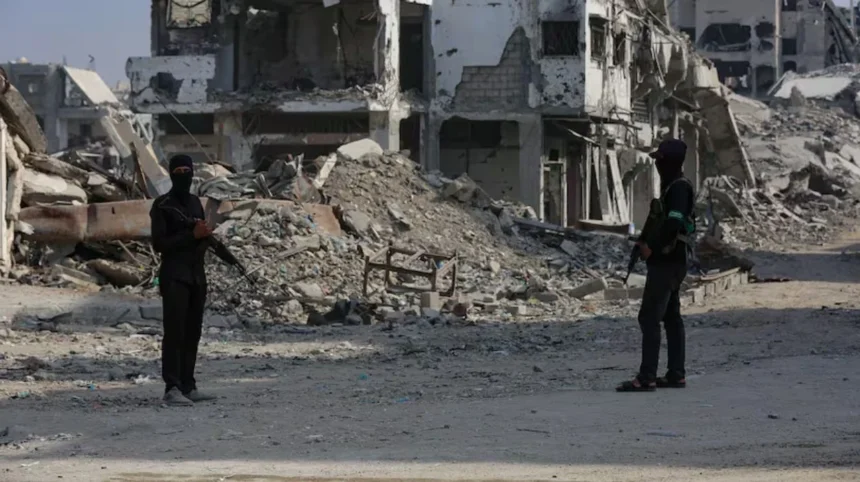
As reported by The National, the head of US President Donald Trump’s Board of Peace initiative on Tuesday urged the UN Security Council to press Hamas and other Palestinian factions in Gaza to disarm “without delay.” According to The National, Nickolay Mladenov, a veteran Bulgarian diplomat serving as High Representative for Gaza, told the 15‑member council there is a “real opportunity” to move from conflict to recovery under the Trump administration’s Gaza plan, endorsed by UN Security Council Resolution 2803 in November 2025. He warned that “every hour, every day wasted” carries a human cost and further erodes prospects for a credible and lasting peace in the territory, which has endured years of war and blockade. The National reports that Mladenov argued there can be “no credible pathway” to Palestinian statehood if Gaza remains under the control of Hamas and other armed groups.
According to The National, Mladenov briefed the council at the invitation of US ambassador Mike Waltz, who is serving as Security Council president for March. In his remarks, Mladenov said progress had been made in implementing Resolution 2803, which created the Board of Peace and laid out a multi‑phase framework for disarming militant groups in Gaza. The National notes that this framework was agreed by the guarantor states – the United States, Egypt, Turkey and Qatar – and has been formally presented to the parties. Under the plan, reconstruction aid for Gaza would be tied to measured progress on disarmament, with compliance independently verified.
The National reports that the plan is built around the principle of “one authority, one law, and one weapon,” requiring all armed factions in Gaza, including Hamas and Islamic Jihad, to surrender their weapons to a transitional Palestinian authority. According to the same report, the disarmament process would begin with the removal of heavy weapons, rockets and attack tunnels, with later stages focused on registering and collecting small arms. The framework also includes amnesty and reintegration programs aimed at helping fighters return to civilian life, in an effort to reduce incentives for continued militancy. The National further notes that the Trump administration, working with Qatar and Egypt, negotiated an October ceasefire that halted two years of devastating war in Gaza and paved the way for this second‑phase disarmament push.
What reactions and context have emerged?
According to The National, Mladenov appealed directly to Security Council members to “use all means at their disposal” to persuade Hamas and other Palestinian factions to accept the framework without delay. He framed the disarmament push as a decisive break with the cycles of violence that have defined life in Gaza for decades, telling the council that laying down arms by militant groups would mark a turning point toward stability and reconstruction. The National reports that his remarks underscored concerns that continued armed control by Hamas would block any credible route to a two‑state solution and a viable Palestinian state.
As reported by The National, US ambassador Mike Waltz strongly backed Mladenov’s call and urged other council members to “seize this moment” and pressure Hamas to “immediately disarm.” According to The National, Waltz warned that anything short of “full demilitarisation of Gaza” would undermine Gaza’s recovery, Israel’s security and regional stability. The National notes that several states have already signaled support for the stabilisation phase, with five countries – Albania, Indonesia, Kazakhstan, Kosovo and Morocco – pledging troops to an International Stabilisation Force designed to support the transition. This force would operate alongside the transitional Palestinian authority as it takes control of security and oversees disarmament.
The National’s report places the latest Security Council briefing within the broader context of the Trump administration’s Gaza peace initiative, which moved into its second phase in mid‑January. According to The National, the first phase centered on achieving and consolidating the October ceasefire, while the current phase focuses on disarmament, security sector restructuring and economic recovery. The article notes that guarantor states have committed to supporting reconstruction, contingent on verifiable steps by armed groups to surrender heavy and eventually light weapons. This linkage is intended to create both pressure and incentives for Hamas and other factions to comply with the framework.
Supporting details and expert‑style analysis
According to The National, the disarmament framework presented to the Security Council sets out a phased approach intended to manage both security risks and political sensitivities on the ground. Heavy weapons, rockets and tunnels are to be dismantled first, reflecting international concern about cross‑border attacks and large‑scale strikes. The National reports that subsequent stages would address small arms through registration and collection schemes, backed by international monitoring to confirm compliance. By tying reconstruction funds to verified steps, the plan aims to align humanitarian and economic assistance with concrete progress on demilitarisation.
The National notes that the framework’s “one authority, one law, and one weapon” principle is intended to end the fragmentation of armed control in Gaza, where multiple factions currently operate outside a unified chain of command. According to the report, all arms would be placed under a transitional Palestinian authority, which in turn would be supported by the International Stabilisation Force pledged by Albania, Indonesia, Kazakhstan, Kosovo and Morocco. The National explains that amnesty and reintegration programs are a core component of the proposal, with the goal of reducing the likelihood that disarmed fighters rejoin clandestine groups or criminal networks. These measures echo elements of disarmament, demobilisation and reintegration efforts seen in other post‑conflict settings.
As reported by The National, the Trump administration views the October ceasefire and the launch of the Board of Peace as prerequisites for the more ambitious goals of political reconciliation and eventual statehood negotiations. The article notes that US officials and guarantor states see demilitarisation of Gaza as essential for any sustainable political process with Israel and for bridging internal Palestinian divisions. According to The National, Mladenov’s briefing suggested that the coming months will be critical in determining whether armed factions accept the proposed framework or whether the peace initiative stalls, with significant implications for Gaza’s reconstruction and regional security dynamics.
What are the implications and possible future developments?
According to The National, the Security Council briefing signals that the Trump administration and its partners are moving to internationalise pressure on Hamas and other groups to accept the disarmament plan. If the framework is implemented as presented, it would lead to a gradual but far‑reaching restructuring of security in Gaza, shifting authority from armed factions to a transitional Palestinian body backed by foreign stabilisation troops. The National notes that successful implementation could unlock substantial reconstruction funding, improve humanitarian conditions and reduce the risk of renewed large‑scale conflict, though it remains contingent on buy‑in from local actors.
The National reports that the guarantor states – the US, Egypt, Turkey and Qatar – have already agreed on the comprehensive framework and delivered it to the parties, indicating that diplomatic groundwork has advanced beyond initial concept discussions. Future Security Council sessions and regional diplomacy are likely to focus on securing explicit commitments from Palestinian factions and building broader international support for the International Stabilisation Force. According to The National, the Trump administration’s timeline envisions continued progress through 2026, with the disarmament phase linked to incremental reconstruction and political steps.
As reported by The National, outstanding questions include whether Hamas will agree to surrender heavy weapons and tunnels under international supervision and how the transitional Palestinian authority would be structured and legitimized. The article indicates that failure to secure acceptance of the framework could jeopardize the October ceasefire and delay or derail major reconstruction projects in Gaza. According to The National, Mladenov’s appeal to the Security Council to act “without delay” reflects concerns that prolonged negotiations or stalemate could erode public confidence in the peace initiative and risk a return to violence.
The latest briefing to the UN Security Council, as detailed by The National, underscores the Trump administration’s effort to make Hamas’s disarmament the central condition for Gaza’s reconstruction and a broader political horizon. Mladenov’s call for immediate acceptance of the disarmament framework, the pledges of troops from multiple countries, and the linkage of aid to verified demilitarisation highlight a strategy that seeks to transform Gaza’s security landscape through coordinated international pressure and incentives. How Hamas, other Palestinian factions, and regional stakeholders respond to this initiative is expected to shape Gaza’s trajectory in the months ahead.

