


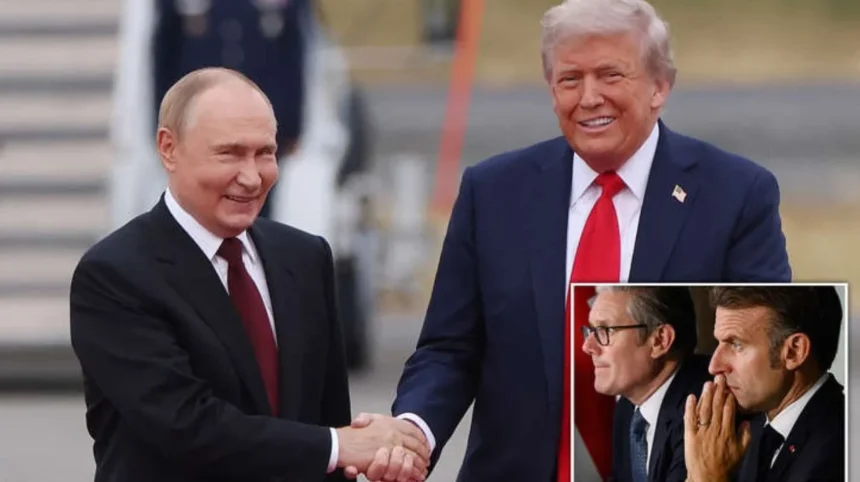
US President Donald Trump has confirmed that he invited Russian President Vladimir Putin to join a proposed “Board of Peace” that would oversee postwar governance and reconstruction in Gaza, according to multiple international outlets. As reported by Bloomberg News, Trump responded “yes” when asked by reporters in Florida whether he had extended an invitation for Putin to join the Gaza body, which the Kremlin had earlier disclosed.
According to the BBC, the invitation to Putin is part of a broader Trump plan described as a 20‑point strategy aimed at managing Gaza after the current conflict between Israel and Hamas and coordinating reconstruction. The BBC reports that Moscow has acknowledged receiving the invitation, while noting that the Kremlin has not publicly confirmed whether Putin will accept the role on the board.
As reported by Al Jazeera, Kremlin spokesperson Dmitry Peskov told journalists that Putin had received an invitation to join what Trump calls a “Board of Peace,” and said Russia was seeking to “clarify all the nuances” of the proposal with Washington. Al Jazeera notes that the initiative appears to extend beyond Gaza alone, with Trump also approaching other international figures and leaders to join the board.
Who is being asked to join and what is the board?
According to Al Jazeera, Trump’s list of figures associated with, or approached for, the Gaza “Board of Peace” includes former UK Prime Minister Tony Blair and Trump’s son‑in‑law and former adviser Jared Kushner. The same reporting states that Trump has also reached out to Turkish President Recep Tayyip Erdogan and Egyptian President Abdel Fattah el‑Sisi regarding participation.
As reported by the BBC, Trump has framed the board as an international mechanism that would temporarily oversee Gaza’s administration and reconstruction in the aftermath of the war. The BBC notes that the US has been reaching out to “various global leaders” to join the body, presenting it as a US‑led but multinational effort.
Bloomberg’s reporting underscores that Trump’s confirmation in Florida came after the Kremlin publicly revealed the invitation, effectively turning what was initially a diplomatic approach into a matter of international debate. According to Bloomberg, this positions Putin alongside a small set of high‑profile political actors whom Trump envisions as central to his Gaza initiative.
Context and reactions: How have allies and rivals responded?
According to the BBC, the invitation to Putin has coincided with rising tensions between Trump and some European allies, particularly France. The BBC reports that Trump threatened tariffs of up to 200 percent on French wine and champagne after French President Emmanuel Macron declined to participate in the Gaza “Board of Peace.”
The BBC cites a source close to Macron as saying that “using tariffs as a means to sway our foreign policy is both unacceptable and ineffective,” indicating resistance in Paris to linking trade measures with participation in the Gaza initiative. The same source told the BBC that Macron had proposed arranging a Group of Seven‑style meeting, including Russia, to discuss broader issues, highlighting an alternative diplomatic track.
Al Jazeera notes that the invitation to Putin has come while Russia’s war in Ukraine continues, with no comprehensive peace agreement in place, and while Moscow maintains a critical stance toward Israel’s military actions in Gaza. According to Al Jazeera, the Kremlin has repeatedly called for restraint in Gaza and emphasized Russia’s support for the Palestinian people, adding another layer of complexity to Putin’s potential role on a Gaza‑focused board led by Washington.
Supporting details and broader geopolitical stakes
According to NDTV, citing Kremlin spokesperson Dmitry Peskov, Moscow is working to understand the details of the US proposal and the precise role envisaged for Russia on the Gaza “Board of Peace.” NDTV reports that Russia has not yet announced whether Putin will accept the invitation, leaving the future composition of the board uncertain.
Bloomberg reports that Trump’s confirmation of the invitation came during a briefing with reporters in Florida, in which he was asked directly whether he had extended the offer to Putin and answered affirmatively. This public confirmation, according to Bloomberg’s account, has drawn attention to Trump’s broader strategy of involving rival powers in his approach to Middle East conflict management.
Al Jazeera’s coverage points out that Trump has repeatedly claimed he could help halt the Ukraine conflict quickly, even as fighting continues and diplomatic efforts remain stalled. The outlet notes that inviting Putin to participate in a Gaza body comes at a time when Russia’s relations with Israel, Ukraine, and Western powers are all under strain, heightening international scrutiny of the proposal.
What are the implications and what happens next?
According to the BBC, the invitation to Putin and the associated tariff threats toward France have raised fresh questions about cohesion within NATO and broader transatlantic relations. The BBC notes that Trump’s approach, juxtaposing security cooperation, Middle East diplomacy, and trade pressure, has prompted concern among some European partners about the direction of US policy.
Al Jazeera reports that Trump’s “Board of Peace” is intended to act as a framework for postwar governance in Gaza, including disarmament and reconstruction, though the precise mandate and powers of the body remain to be fully defined in public. The Kremlin, according to Al Jazeera and NDTV, is still seeking clarification from Washington, suggesting that further diplomatic exchanges will determine whether Russia ultimately participates.
Bloomberg and other outlets note that Trump’s decision to invite Putin, alongside figures such as Tony Blair and Jared Kushner, signals an attempt to assemble a politically diverse group with influence over key parties in the Gaza and wider regional conflicts. Whether this alignment will gain broad international support, particularly among US allies wary of Russia’s role, remains an open question that will depend on upcoming diplomatic negotiations and the evolving situation in Gaza and Ukraine.
In sum, verified reporting from multiple outlets shows that President Donald Trump has invited Russian President Vladimir Putin to join a proposed Gaza “Board of Peace,” alongside other international figures, as part of a broader plan for Gaza’s postwar governance and reconstruction. The move has drawn mixed reactions, including tariff threats against France and calls for clarification from Moscow, and its eventual impact on both the Gaza conflict and relations within NATO and between the US, Russia, and European allies will hinge on whether key leaders ultimately agree to participate and how the board is structured.

