


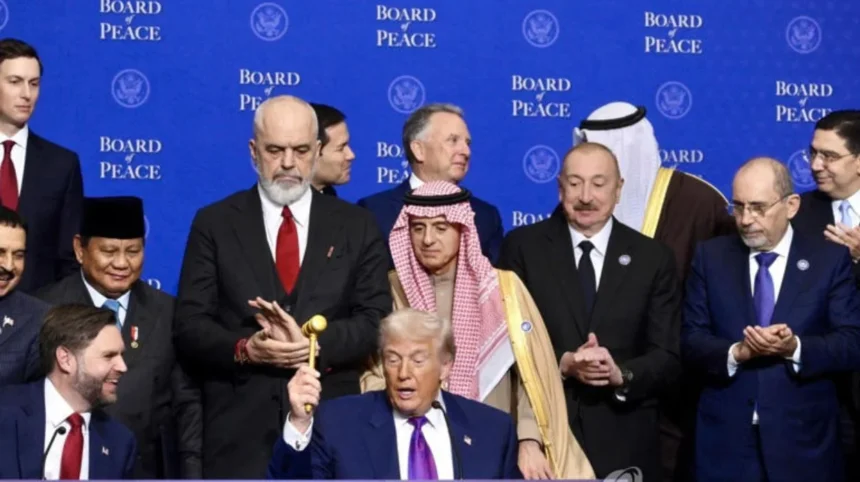
As reported by Yonhap News Agency, South Korea took part in the first meeting of the Board of Peace for Gaza, an initiative proposed by United States President Donald Trump, with the country sending a representative as an observer rather than a full member. According to Yonhap, the meeting was held in Washington on Thursday local time and is part of wider efforts to coordinate international support for stabilizing and rebuilding the Gaza Strip after months of conflict. The South Korean Ministry of Foreign Affairs said the participation reaffirmed Seoul’s backing for international moves aimed at enhancing peace and security in the war‑torn enclave.
According to the foreign ministry, former ambassador to Egypt Kim Yong‑hyon represented South Korea at the session, reflecting Seoul’s decision to engage with the board’s work while maintaining a degree of flexibility over any future formal role. The Board of Peace for Gaza is described by officials and diplomats as a US‑led framework intended to coordinate reconstruction plans, security arrangements, and governance issues in Gaza in cooperation with participating states. Diplomats cited in international reporting say invitations were extended to dozens of countries, with more than 20 having agreed to take part so far in some capacity.
Context and reactions: how is Seoul positioning itself?
As reported by The Korea Times, the South Korean government has emphasized that it joined the inaugural meeting as an observer and is not yet a formal member of the board. The paper quoted the foreign ministry as saying the government “has supported President Trump’s leading efforts to enhance peace at Gaza” and intends to keep contributing to broader Middle East peace and security initiatives alongside the international community.
According to coverage of the ministry’s regular briefing, spokesperson Park Il told reporters that Seoul would “prudently review” whether to become an official member of the board, taking into account various diplomatic and policy considerations. Regional media note that South Korea has traditionally balanced its close alliance with the United States with a cautious approach to Middle East conflicts, focusing on humanitarian aid, reconstruction support, and multilateral diplomacy rather than direct political intervention. Reporting on related developments also highlights that other countries, including Hungary and Türkiye, have accepted invitations to join the structure, underlining Washington’s attempt to assemble a broad coalition around its Gaza plan.
Supporting details and broader initiative
According to Yonhap and other outlets, the Board of Peace for Gaza forms part of a wider, multi‑phase strategy outlined by the Trump administration to manage the post‑war phase in Gaza. Reporting on the initiative says the structure foresees several components, including a Peace Board, a Peace Board Executive Committee, and a Gaza Administration Board, designed to coordinate political oversight, implementation, and day‑to‑day governance issues.
International media, citing documents and diplomatic sources, have reported that around 60 countries were invited to engage with the board, with roughly 20 to 25 taking part in the early stages. According to The Globe and Mail, some diplomats have expressed concern that the new mechanism could overlap with or complicate United Nations‑led efforts, even as several governments signal a willingness to explore the US‑proposed framework. The same reporting indicates that the board’s mandate, as currently framed, is focused on Gaza through at least 2027, with the possibility of expanding its remit to other conflicts later on.
Implications and future developments: what comes next?
According to South Korea’s foreign ministry, Seoul intends to “continue to join efforts for Middle East peace and security by the international community,” suggesting that its observer role at the inaugural meeting could be followed by sustained diplomatic engagement. Officials have not set a timetable for deciding on full membership, indicating that any move to change status on the board will depend on how the mechanism evolves and how it aligns with South Korea’s broader foreign policy priorities.
International reporting notes that the Board of Peace for Gaza is still in an early phase, with key questions remaining over financing, governance structures, and coordination with existing multilateral bodies. Diplomats quoted in these accounts say subsequent meetings are expected to refine the board’s mandate, membership, and operational plans, including concrete steps on reconstruction, security arrangements, and humanitarian support in Gaza. For South Korea, analysts cited by regional media suggest that continued participation could offer both an avenue to support international peace efforts and an opportunity to reinforce its profile as a middle‑power contributor to global security discussions.
In summary, South Korea’s attendance at the inaugural meeting of Trump’s Board of Peace for Gaza as an observer underscores its support for US‑led and multilateral efforts to stabilize the Gaza Strip, while leaving open the question of whether it will seek a more formal role as the new body’s work takes shape.

