


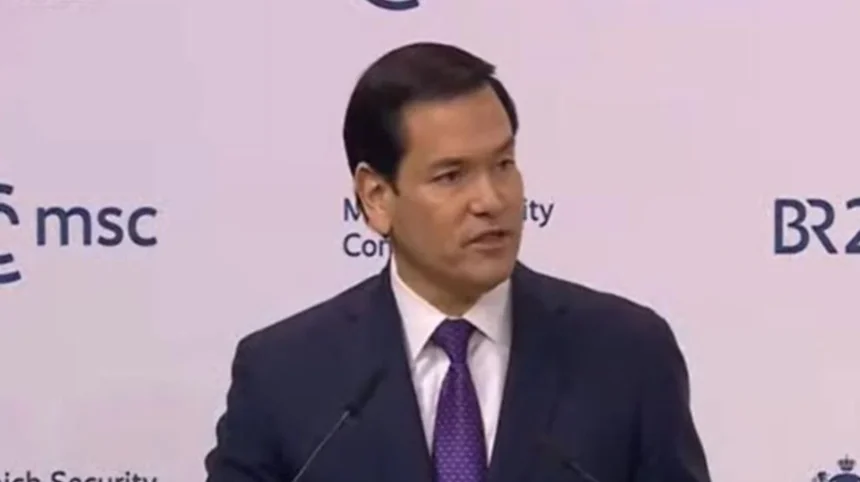
Washington (February 22, 2026) – US Secretary of State Marco Rubio has sharply criticized the United Nations for what he described as its failure to resolve major global conflicts in Ukraine and Gaza, while arguing that American leadership has been decisive in securing ceasefires, freeing captives and advancing peace talks. Speaking at the Munich Security Conference, Rubio said the UN has “no answers” and has played “virtually no role” on some of the world’s most urgent crises, contrasting that record with recent US-led initiatives under President Donald Trump. He cited US efforts to bring Russia and Ukraine into negotiations, secure the release of hostages in Gaza and confront Iran’s nuclear program as examples of Washington stepping in where multilateral bodies have fallen short.
Rubio’s criticism of the UN
According to reports on Rubio’s speech in Munich, the secretary of state framed his remarks as both an indictment of the UN’s recent performance and a call for reform of global institutions. “The United Nations still has tremendous potential to be a tool for good in the world,” he said, before arguing that on the most pressing issues, it “has no answers and has played virtually no role.” He pointed specifically to the wars in Gaza and Ukraine, saying the UN had been unable to stop the fighting or deliver decisive diplomatic breakthroughs.
As reported by The Times of Israel and other outlets, Rubio told the Munich audience that “it could not solve the war in Gaza” and “has not solved the war in Ukraine,” casting these conflicts as emblematic of what he sees as the UN’s limitations in today’s security environment. Coverage by UN Watch and other organizations noted that he described the UN as “powerless” in constraining Iran’s nuclear program and in addressing the security threat posed by Venezuela’s leadership. Rubio argued that adversarial governments have used “abstractions of international law” as shields while continuing to violate global norms, and insisted that Washington should not allow such behavior to go unchecked.
According to summaries of his remarks published by CNBC, the BBC and other outlets, Rubio’s critique was part of a broader message that global governance structures are struggling to keep pace with rapidly evolving security threats. He said international organizations risk irrelevance if they cannot respond effectively to wars, hostage crises and nuclear proliferation, adding that they must be reformed to become more responsive and capable.
What did Rubio say about Ukraine and Gaza?
Rubio’s comments focused heavily on the conflicts in Ukraine and Gaza, which he said highlighted the contrast between UN inaction and US-led diplomacy. According to reports by New Kerala, Republic World and other outlets, he argued that it was the United States, not the UN, that brought Russia and Ukraine to the table for high-stakes peace negotiations beginning in late 2025. He said US engagement had been crucial in pushing the sides toward a framework for talks, even as he cautioned that Moscow’s commitment to ending the war remained uncertain.
On Gaza, Rubio said the UN “could not solve the war” and had “played virtually no role” in ending the fighting or freeing captives held in the territory. Outlets including CNBC, Yahoo News and UN Watch reported that he credited “American leadership” with securing the release of hostages from what he described as “barbarians” and helping to broker a fragile truce. He also highlighted the mandate given to Trump’s “Board of Peace” to administer post-war Gaza for a limited period, a move that some diplomats view as potentially undercutting the UN’s traditional role.
In his remarks on Iran, Rubio said the UN had been “powerless to constrain the nuclear program of radical Shia clerics of Tehran,” according to coverage from Republic World and related reports. He claimed that halting a specific threat required “14 bombs dropped with precision by American B-2 bombers,” presenting this as another example of Washington acting decisively where international institutions could not. He also cited US involvement in the capture of Venezuelan leader Nicolás Maduro as further evidence of American willingness to act when multilateral mechanisms fail.
How have Rubio’s remarks been received internationally?
Reports from the BBC, Time and other outlets suggest that Rubio’s speech was aimed in part at reassuring European allies about the durability of the transatlantic relationship under President Trump. He emphasized that US and European interests “belong together” and are “intertwined,” even as he criticized multilateral frameworks in which many European states have long invested. This dual message reflected efforts to balance skepticism toward existing institutions with an affirmation of Western cooperation.
According to The Times of Israel and other regional media, some diplomats and analysts have expressed concern that Trump’s Board of Peace initiative, which Rubio promoted, could erode the UN’s authority by creating an alternative forum for managing conflicts. Critics quoted in these reports worry that bypassing the UN might deepen divisions within the international system and reduce the space for broader multilateral consensus. However, Rubio and other US officials have argued that new mechanisms are necessary when long-standing bodies fail to deliver results.
Coverage of the Munich Security Conference by outlets including CNBC, the BBC and Time indicates that Rubio’s remarks came amid wider debates over the future of multilateralism. European leaders, including Ukrainian President Volodymyr Zelensky, used the event to press for sustained military and political support while lamenting the slow pace of collective decision-making. Zelensky warned that “weapons evolve faster than political decisions meant to stop them,” underscoring frustrations with the international system’s ability to respond to aggression and humanitarian crises.
Supporting details on US leadership claims
Reports from New Kerala, Republic World and other outlets outlined the specific examples Rubio cited to support his argument for US leadership. On Ukraine, he referred to US-led diplomatic efforts that brought Russian and Ukrainian delegations into intensive talks over the winter of 2025–2026, though he acknowledged that questions remain over Russia’s long-term intentions. On Gaza, he emphasized American mediation in securing the release of hostages and in helping to establish a “fragile” ceasefire arrangement.
Rubio’s remarks also touched on US military actions, including precision strikes against targets linked to Iran’s nuclear infrastructure and operations targeting Venezuela’s leadership. According to these accounts, he presented these operations as examples of Washington using force selectively to address threats that, in his view, the UN lacked the will or ability to confront. He argued that states that “blatantly threaten our citizens, and endanger our global stability” should not be allowed to “shield themselves behind abstractions of international law which they themselves routinely violate.”
Analyses published by Time and other outlets noted that Rubio’s framing reflects a broader skepticism within parts of the US political establishment toward multilateral institutions. Supporters of his position argue that the UN’s structure – including the veto power in the Security Council and competing geopolitical interests – often paralyzes decision-making on urgent security matters. Critics counter that bypassing or sidelining the UN can undermine international law, weaken global norms and raise questions about accountability for unilateral military actions.
What are the implications for the UN and global governance?
Rubio’s comments are likely to fuel ongoing debate about the role and relevance of the UN in managing contemporary conflicts. Observers quoted in media coverage suggest that his remarks could add pressure on UN member states to pursue reforms aimed at making the organization more responsive, particularly in the Security Council and in crisis-response mechanisms. At the same time, the criticisms may deepen divisions between countries that favor a strong multilateral system and those that prioritize ad hoc coalitions or alternative frameworks.
For Washington, Rubio’s emphasis on “American leadership” reinforces a narrative of the United States as an indispensable actor in resolving high-stakes crises, from Ukraine and Gaza to Iran and Venezuela. Analysts quoted in outlets such as Time and CNBC note that this vision assumes continued US willingness to invest diplomatic, military and economic resources in conflict management – an assumption that may depend on domestic politics and public support. European partners, meanwhile, face the challenge of reconciling their long-standing support for multilateralism with the reality of relying on US power for security guarantees.
The discussion at Munich underscored that questions about how to reform, supplement or potentially bypass existing institutions will remain central to international diplomacy in the coming years. Whether the UN can adapt to meet these expectations, or whether alternative structures like Trump’s Board of Peace gain traction, will help determine how future conflicts such as those in Ukraine and Gaza are managed. Rubio’s speech signaled that, from the current US administration’s perspective, multilateral bodies will be judged primarily by their ability to deliver concrete results – and that Washington is prepared to act alone or with select partners when it believes those bodies fall short.
In the broader debate over global governance, Rubio’s intervention in Munich highlighted a widening gap between advocates of a reformed but central UN system and those who see national or ad hoc coalitions as more effective in crisis management. How that gap is navigated could shape responses to future wars, hostage crises and nuclear challenges, as well as perceptions of the UN’s place in the international order.

