


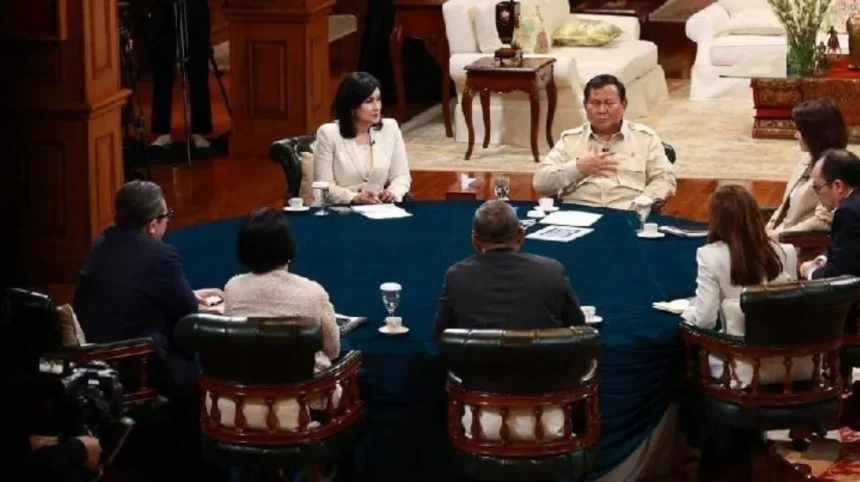
Indonesian President Prabowo Subianto has denied that he promised a US$1 billion payment for Indonesia’s participation in the Board of Peace fund linked to the Gaza reconstruction initiative and broader peace efforts. According to Tempo, Prabowo clarified that Indonesia is not under any obligation to provide a US$1 billion contribution as a condition for joining the Board of Peace and that any financial support would be voluntary.
As reported by the News Desk of The Jakarta Post, Indonesian Foreign Minister Sugiono previously stressed that Indonesia’s membership on the Board of Peace does not require paying the widely circulated US$1 billion contribution. Sugiono explained that contributions are voluntary and intended to support reconstruction in Gaza rather than serve as a membership transaction.
According to Bernama, Sugiono reiterated during a briefing in Washington that Indonesia had not paid US$1 billion to join the Board of Peace and that the figure discussed in public debates was not a mandatory membership fee. He emphasized that Indonesia is already recognised as a member of the body regardless of whether it makes such a large payment.
What Clarifications and Reactions Have Emerged?
As reported by Tempo, Sugiono said Indonesia’s commitment to the Board of Peace focuses on humanitarian objectives and financing reconstruction in Gaza, not purchasing influence or political leverage through large payments. He noted that the proposed US$1 billion figure has been framed as a voluntary contribution for countries seeking permanent status within the board rather than a flat requirement.
The Jakarta Post reported that domestic concerns have been raised in Indonesia over the optics of a US$1 billion pledge, with critics warning it could be perceived as a “pay-to-play” mechanism if treated as a de facto entry fee. Analysts cited by the paper urged the government to underline that Indonesia’s involvement is grounded in humanitarian principles and international solidarity, not transactional diplomacy.
Bernama further noted that Sugiono described a flexible contribution structure in which states can support the Board of Peace through different means, including financial support, troop deployments, or individual donations channelled via mechanisms such as World Bank accounts. This framework was presented to address domestic criticism that Indonesia would be locked into a fixed US$1 billion payment to validate its membership.
Supporting Details
Tempo reported that Indonesian officials have repeatedly framed the US$1 billion figure as part of a broader menu of voluntary contributions, including the option for some countries to make large financial commitments in exchange for longer-term or permanent roles in the Board of Peace. The outlet noted that Indonesia’s participation was formalised when Prabowo signed the Board’s charter during the World Economic Forum in Davos, where the body was announced as a key vehicle for postwar reconstruction in Gaza.
According to Bernama, Sugiono highlighted that contributions to the Board of Peace are not limited to monetary payments; some countries contribute funds, others send troops, and some provide individual contributions. During the inaugural Board of Peace meeting in Washington, Prabowo reaffirmed Indonesia’s readiness to contribute up to 8,000 troops, or more if necessary, to an International Stabilisation Force in Gaza, with deployment costs to be borne by Indonesia.
The Jakarta Post reported that critics at home have questioned the risk that the Board of Peace funding structure could morph into a system where significant financial contributions translate into disproportionate influence. Commentators urged Jakarta to insist on transparent governance and decision-making for any reconstruction funds related to Gaza, ensuring that humanitarian priorities remain central.
What Are the Implications and Next Steps?
According to Tempo, Indonesian officials have signalled that the technical aspects of any potential financial contribution remain under review, indicating that Jakarta has not finalised whether it will commit to the full US$1 billion figure or opt for alternative forms of support. This ongoing assessment reflects both fiscal considerations and sensitivity to domestic concerns over the scale and symbolism of such a pledge.
Bernama reported that Sugiono’s comments in Washington were aimed at reassuring both international partners and Indonesian audiences that membership in the Board of Peace does not depend on a single high-value payment, but instead allows countries to tailor their contributions. This means Indonesia can prioritise troop contributions and other forms of support while continuing to evaluate any large-scale financial commitment.
The Jakarta Post suggested that as the Board of Peace moves ahead with detailed plans for Gaza’s reconstruction, the Indonesian government will likely face continued scrutiny at home over the balance between humanitarian engagement and fiscal prudence. Future developments are expected to clarify the exact size and nature of Indonesia’s role, with officials under pressure to maintain transparency over any negotiated contribution levels.
Indonesian President Prabowo Subianto’s denial of any binding US$1 billion promise for the Board of Peace fund aligns with repeated statements by Foreign Minister Sugiono that the figure is voluntary and not a membership requirement. As international discussions on Gaza’s reconstruction progress, Indonesia is positioning its involvement around humanitarian commitments and troop deployments, while leaving open the possibility of financial support that does not compromise domestic priorities or create perceptions of transactional diplomacy.

