


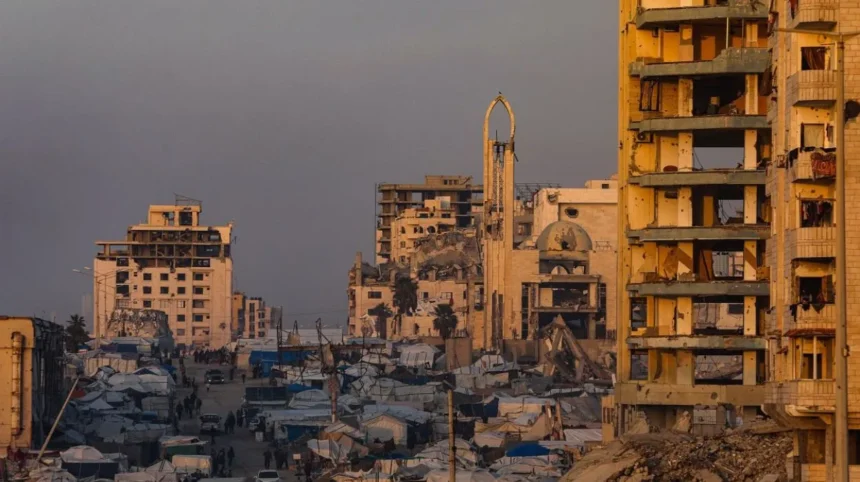
Hamas has announced it is prepared to transfer governance of the Gaza Strip to a Palestinian technocratic committee formed under an internationally backed ceasefire framework. The move would mark a significant shift away from the direct administrative role Hamas has exercised in Gaza since 2007. According to multiple reports, the step is tied to broader diplomatic efforts to consolidate a fragile ceasefire and reshape postwar governance in the territory.
As reported by Agence France-Presse (AFP), Hamas spokesperson Hazem Qassem said the group was ready for a “complete transfer of governance” to a technocratic body mandated to oversee day-to-day civilian affairs. He stressed that “protocols are prepared, files are complete, and committees are in place” to ensure that all sectors of governance in Gaza are handed over to this national committee. The announcement came from Deir al-Balah in central Gaza, underscoring that the message was delivered from within the enclave itself.
According to coverage by Dawn and other outlets, the committee—often referred to as a national or technocratic committee—is intended to manage civil administration, public services and coordination across government sectors. Hamas officials have framed the decision as part of their commitment to an agreed halt in the fighting and as a response to political arrangements included in a ceasefire package promoted by the United States and regional actors. The committee’s members are described as Palestinian technocrats, not partisan figures, with the aim of creating a more broadly acceptable interim governing structure.
How are key actors reacting?
Hamas’s leadership has linked the governance handover directly to conditions on Gaza’s borders and to the practical needs of the population. Hazem Qassem has insisted that the Rafah border crossing with Egypt must be fully reopened within days as part of the arrangement, arguing that movement in and out of Gaza must take place “with full freedom” rather than under restrictive conditions. He emphasized that managing the crossing and civilian mobility would be a central test for the new committee’s authority.
According to international media reports, the technocratic committee is expected to operate under the umbrella of a broader supervisory framework referenced in diplomatic discussions about Gaza’s postwar order. The National Committee for the Administration of Gaza, cited in several accounts, has been portrayed as an instrument to ensure continuity of essential services and administration after large-scale conflict. Israeli security assessments reported in regional outlets suggest that while Hamas may formally cede day-to-day governance, it could seek to retain political or military influence in the Strip.
Regional and international stakeholders have linked progress on governance to broader peace and reconstruction efforts. Reports note that foreign-backed frameworks envision a phased approach: stabilizing the ceasefire, establishing interim civilian administration and then moving toward longer-term political arrangements. Countries concerned with Gaza’s future, including Egypt and other regional mediators, have been closely watching how and when the technocratic committee will assume its responsibilities, particularly at key crossings and critical infrastructure points.
Supporting details and wider context
According to News of Bahrain and other outlets citing AFP, the proposed body, sometimes described as the National Committee for the Administration of Gaza, consists of Palestinian technocrats selected to manage civil affairs rather than engage in factional politics. It is reported to have around a dozen to 15 members and is headed by former Palestinian Authority deputy minister Ali Shaath, indicating an effort to draw from existing Palestinian administrative experience. The committee’s portfolio is expected to include public services, civil registry functions and coordination with international aid and reconstruction efforts.
Media reports indicate that this governance shift is embedded in what has been described as a multi-phase ceasefire and political plan, backed by the United States and endorsed by a group of international leaders. Under that framework, the technocratic committee would enter Gaza once the Rafah crossing fully reopens and security and logistical arrangements are in place. The body would then work under the supervision of an international “Board of Peace,” a forum of world leaders tasked with overseeing implementation of the postwar roadmap.
In separate diplomatic reporting, Vietnam has publicly backed global efforts aimed at achieving a lasting peace in Gaza, signaling support for initiatives that combine ceasefire mechanisms with political and humanitarian measures. Official statements referenced in regional peace platforms highlight the need for coordinated international support for any new governance arrangement, including those involving technocratic or national committees. Such endorsements underscore how Gaza’s internal governance is now closely linked to broader multilateral diplomacy over the conflict’s resolution and reconstruction.
What are the implications and next steps?
According to regional and international coverage, Hamas’s willingness to transfer governance could open the door to a reconfigured political landscape in Gaza, with reduced direct factional control over civilian administration. Analysts quoted in news reports suggest that an effective technocratic administration might help facilitate reconstruction, restore essential services and provide a more acceptable interlocutor for international donors. However, questions remain over how security will be managed and what role, if any, Hamas will retain in broader Palestinian politics and defense structures.
The sequencing of steps now appears critical. The reopening of Rafah, deployment of the technocratic committee to Gaza and the full implementation of the ceasefire’s second phase are described in reports as interdependent moves that must occur in a relatively short time frame. Any delays or disagreements over border control, mandate or composition of the committee could complicate or slow the transition.
For residents of Gaza, the success or failure of this governance shift will likely be measured in tangible improvements: freedom of movement, reliable public services and progress on reconstruction. International actors are expected to closely monitor how the technocratic committee operates, whether it can act with sufficient autonomy and how it coordinates with both Palestinian political institutions and external partners. The situation remains fluid, and future developments will depend on the durability of the ceasefire, regional diplomacy and the practical implementation of the new administrative arrangements on the ground.
In sum, Hamas’s stated readiness to hand over Gaza’s governance to a Palestinian technocratic committee represents a notable development within a wider ceasefire and postwar governance plan tied to international mediation. The outcome will hinge on border arrangements, the committee’s effective deployment and the broader political environment surrounding Gaza’s future.

