


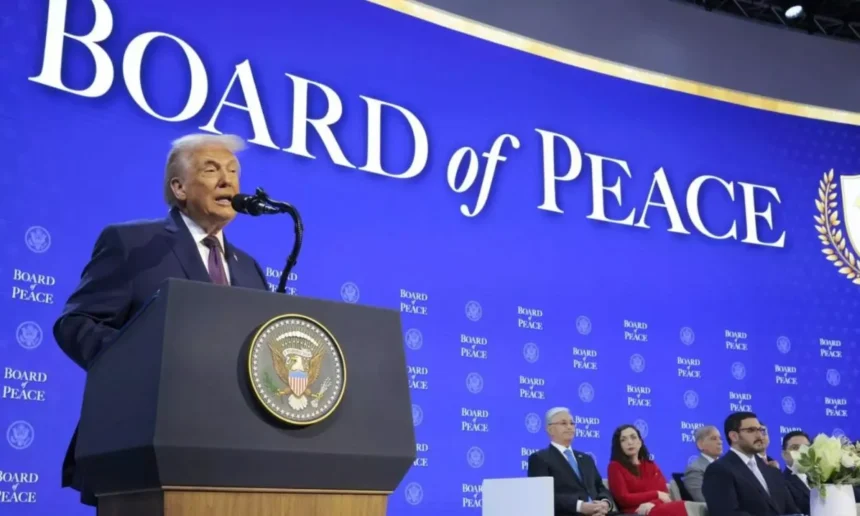
President Donald Trump plans to convene the first meeting of his Board of Peace in Washington on February 19, with the session focused on raising money for Gaza’s reconstruction. As reported by the Associated Press in a piece carried by Politico, the gathering will bring together world leaders who accepted Trump’s invitation in January, along with members of a Gaza executive committee responsible for governance, security and redevelopment of the territory.
According to a report by CTV News, the meeting is scheduled to take place at the U.S. Institute of Peace in Washington, a venue over which the Trump administration has asserted control following a legal dispute and staff dismissals. The Board of Peace, created by Trump as an international body to address conflicts beginning with war‑torn Gaza, is backed by a U.S.‑drafted resolution at the UN Security Council.
The New York Times has reported that while the initiative began with a narrow focus on Gaza’s reconstruction, its charter now envisions a wider role in “regions impacted or threatened by conflict.” The board is structured as a multi‑tier body, with Trump designated chairman for life, national leaders as core members, and a Gaza‑focused executive board headed by former UN envoy Nickolay Mladenov, according to background information summarized by major outlets.
An earlier report by Newsweek noted that the upcoming Washington meeting follows an inaugural session in Davos, Switzerland, where member states endorsed the founding charter. That charter requires countries to contribute significant funding, reportedly around 1 billion dollars, to become permanent members, and more than 20 nations have already joined, including Pakistan, Turkey, Saudi Arabia, Qatar and the United Arab Emirates.
What Is on the Agenda and Who Is Invited?
The detailed agenda for the Board of Peace’s first Washington meeting has not yet been publicly released, but several reports outline its main objectives. As reported by the Associated Press, officials say the core goal is to secure concrete funding commitments for Gaza’s relief and reconstruction, and to clarify the role of the Gaza executive committee that will oversee governance, security and redevelopment.
CNN, citing an invitation and U.S. officials, reported that the February 19 gathering will also discuss the board’s broader mission beyond Gaza, reflecting a shift from a narrowly focused reconstruction forum to a platform for addressing global conflicts. The invitation, obtained by CNN, included a draft charter that no longer mentions Gaza explicitly, underscoring how the agenda may extend to disputes elsewhere.
According to coverage in Newsweek, invitations were sent to dozens of global leaders, including those already serving on the Board of Peace and members of the Gaza executive committee. The exact number of heads of state and government expected to attend remains unclear, but administration officials quoted by AP and other outlets said they anticipate a “robust” level of participation from invited nations.
The New York Times has reported that countries seeking permanent membership must pledge substantial financial contributions, and more than 20 states have already joined. Italian officials, however, told Al Jazeera that Italy will not join the Board of Peace due to constitutional constraints, highlighting differing responses among U.S. allies to both the agenda and the structure of the body.
Supporting Details and Expert Commentary
According to PBS NewsHour’s reporting on the AP dispatch, two Trump administration officials speaking on condition of anonymity said the Board of Peace meeting is intended to lock in aid and investment pledges to support Gaza’s reconstruction. They added that the Gaza executive committee—linked to the board—will play a central role in channeling funds toward infrastructure, security reform and administrative capacities.
The New York Times further noted that the Board of Peace received formal backing at the UN Security Council through a U.S.‑sponsored resolution adopted in November. That resolution endorsed the organization as a vehicle to help “ensure lasting peace” in conflict‑affected regions, expanding the scope beyond Gaza and effectively positioning the board as a new international peace‑building entity.
In a separate piece cited by multiple outlets, French Foreign Minister Jean‑Noel Barrot stated that while France supports peace initiatives proposed by the United States, it opposes the creation of an organization that would “replace the United Nations.” His remarks illustrate concerns among some European governments that the Board of Peace could be perceived as a rival to existing multilateral institutions.
Background coverage has also pointed out that some invited states and analysts question the concentration of authority within the new body. Reporting on the board’s charter has emphasized provisions naming Trump as chairman for life and granting significant influence to the U.S. government, prompting debate over governance, transparency and how decisions about funding and interventions will be made.
What Are the Implications and Future Developments?
Looking ahead, officials and observers say the February 19 meeting in Washington will be a critical test of whether the Board of Peace can secure substantial funding and broad participation. According to AP and CNN reports, the outcome will shape how quickly resources can flow to Gaza’s reconstruction and whether the board gains momentum as a credible international actor.
The Gaza committee, quoted in coverage by Anadolu Agency and other regional outlets, has indicated it is waiting on decisions from the Board of Peace to confirm pledged relief and reconstruction funds. Its members see the Washington meeting as a key moment to translate political backing and early commitments into operational projects on the ground.
Diplomatically, upcoming sessions of the Board of Peace could redefine aspects of global conflict management, especially if more states sign on as permanent members and commit large‑scale financing. However, as highlighted in reporting by The New York Times and Al Jazeera, skepticism among some governments and civil society groups may influence how quickly and extensively the board can expand its role.
For now, the first Washington meeting will center on Gaza, funding pledges and clarifying structures such as the Gaza executive committee. The level of attendance, the size of financial commitments and the clarity of the final agenda will determine how the Board of Peace moves from concept to implementation—and how it positions itself alongside, or in tension with, existing international institutions dedicated to peace and reconstruction.

