


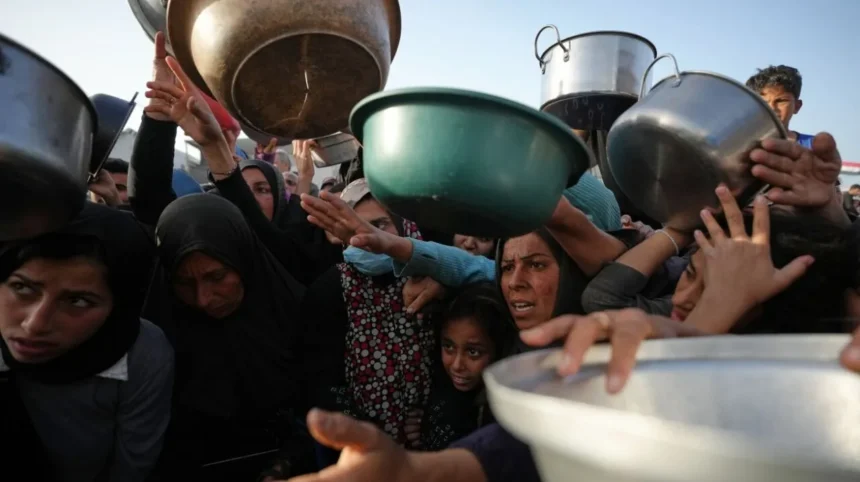
As reported by Scripps News, President Donald Trump will convene the inaugural meeting of his international “Board of Peace” on Thursday in Washington, with the future of the Gaza Strip at the center of the agenda. According to Scripps News, dozens of foreign delegations are expected, and 48 nations will send representatives, including Israel and key Arab states such as Qatar, Egypt, Saudi Arabia and Turkey that have been involved in earlier ceasefire efforts in Gaza. The meeting will be held at the “Donald J. Trump Institute of Peace,” where Trump is set to chair the session and deliver opening remarks before other senior administration officials outline various lines of effort.
According to Deutsche Welle, the agenda for the session is expected to focus on the prospects for Gaza beyond the current fragile ceasefire between Hamas and Israel, with particular emphasis on reconstruction and humanitarian assistance. Scripps News reports that one central topic will be the National Committee for the Administration of Gaza (NCAG), alongside the status of an International Stabilization Force (ISF) tasked with security, training a reconstituted Palestinian police force and overseeing demilitarization and redevelopment. The Board of Peace was authorized by the UN Security Council in November 2025 with a mandate currently running until the end of 2027, as noted by the Arab Center Washington DC.
As reported by Charles W. Dunne of the Arab Center, the Board’s charter, ratified at the World Economic Forum in Davos in January 2026, gives it responsibility for setting the framework and managing funding for Gaza’s redevelopment until the reformed Palestinian Authority is able to take control. The Council on Foreign Relations notes that at least 27 nations are formal members of the Board, while envoys from some 45 countries are expected to attend the Washington meeting, underscoring Trump’s central role in postwar planning for the enclave. According to the New York Times, the Board’s structure could grant Trump extensive authority over Gaza’s future governance and the well‑being of its population as part of a broader international arrangement.
Scripps News reports that Trump is expected to announce pledges of more than 5 billion dollars from member states toward Gaza humanitarian and reconstruction efforts, alongside commitments of “thousands of personnel” for the ISF and local police deployments. Deutsche Welle separately cites Trump’s claim on his social media platform that members have already pledged 5 billion dollars for Gaza reconstruction and aid. Reuters reports that at the Board’s debut meeting Trump has also highlighted a 7‑billion‑dollar reconstruction fund for Gaza, tied to the disarmament of Hamas, and a separate 10‑billion‑dollar US commitment to support the Board of Peace and its operations.
Context and Reactions: Who Is Backing the Plan?
According to Scripps News, the inaugural Board of Peace meeting follows a ceasefire that Trump helped broker between Israel and Hamas, which is described as “mostly holding” but still fragile. The Council on Foreign Relations notes that while many states are engaging with Trump’s Gaza initiative, outstanding questions remain about how Hamas’s demilitarization can realistically proceed and who will bear primary responsibility for security on the ground.
As reported by Deutsche Welle, some nations have opted not to join or send representatives, reflecting concerns about the Board’s US‑centric design and its wider global ambitions beyond Gaza. The Arab Center analysis points out that the Board’s charter positions it not only as a reconstruction mechanism but also as a body that could “remake the world” by applying its conflict‑management model to other regions, raising debate over its scope and legitimacy.
According to Scripps News, Israeli participation is confirmed, and several Arab countries that previously engaged in US‑backed Gaza ceasefire talks will attend Thursday’s meeting. Reuters reports that, despite the international turnout, the Board of Peace has been criticized for lacking direct Palestinian representation at its debut, even as it discusses Gaza’s future governance and reconstruction. The New York Times similarly notes that the emerging framework could hand Trump sweeping powers over Gaza’s administration, intensifying questions about local buy‑in and accountability.
Supporting Details and Expert Commentary
As detailed by Charles W. Dunne of the Arab Center, the Board of Peace’s “comprehensive plan” envisions overseeing Gaza’s redevelopment until the Palestinian Authority completes a reform program and is judged able to “securely and effectively take back control” of the territory. The plan emphasizes the creation of “modern and efficient governance” designed to serve Gaza’s population and attract international investment, guided by what the charter describes as “best international standards.”
According to Scripps News, the International Stabilization Force is intended to help provide security in Gaza, train a new Palestinian police force and supervise the territory’s demilitarization and redevelopment. Reuters reports that the reconstruction funding announced at the first Board meeting is conditional on Hamas’s disarmament, a condition that analysts and officials acknowledge will be difficult to fulfill in the near term. Deutsche Welle notes that Trump’s initiative also faces scrutiny from countries wary of committing troops or financial resources without clearer guarantees on political arrangements and long‑term security responsibilities.
The Council on Foreign Relations highlights that, with 27 formal member states and many additional delegations in attendance, the Board of Peace has quickly become the central international forum for discussions on Gaza’s postwar future. However, expert commentary cited by the Arab Center and CFR stresses that the absence of Palestinian actors in the Board’s decision‑making structure could complicate implementation and legitimacy on the ground.
Implications and Future Developments: What Comes Next for Gaza?
According to Scripps News, the Washington meeting is expected to address humanitarian access, reconstruction timelines, and the operational details of the NCAG and ISF, but many questions remain over how quickly these mechanisms can be implemented. The Council on Foreign Relations notes that the Board is meeting under pressure to map out a realistic sequence for Hamas’s demilitarization, the deployment of international forces and the eventual transfer of authority to a reformed Palestinian Authority.
As reported by Deutsche Welle, Trump has framed Thursday’s meeting as the start of a broader effort that could extend beyond Gaza to other conflict zones, though immediate attention will focus on securing funding and commitments specific to the enclave. The Arab Center underlines that the Board’s UN‑authorized mandate runs through December 2027, suggesting that international involvement in Gaza’s governance and reconstruction is likely to continue for several years, subject to renewal and political conditions at the UN Security Council.
Reuters reports that Trump’s announcement of 7 billion dollars in global contributions and a 10‑billion‑dollar US pledge sets a substantial financial baseline for Gaza’s rebuilding, but the disarmament requirement and lack of Palestinian representation could complicate disbursement and project implementation. The New York Times observes that the concentration of authority in the Board of Peace, and in Trump’s role as its chair, will be closely watched by regional actors and international organizations concerned about long‑term governance, accountability and the rights of Gaza’s residents.
In sum, the inaugural Board of Peace meeting in Washington brings together dozens of states, significant financial pledges and new international mechanisms for Gaza’s reconstruction and security, but leaves unresolved questions over Hamas’s disarmament, Palestinian participation and the balance of power within the emerging governance framework.

