

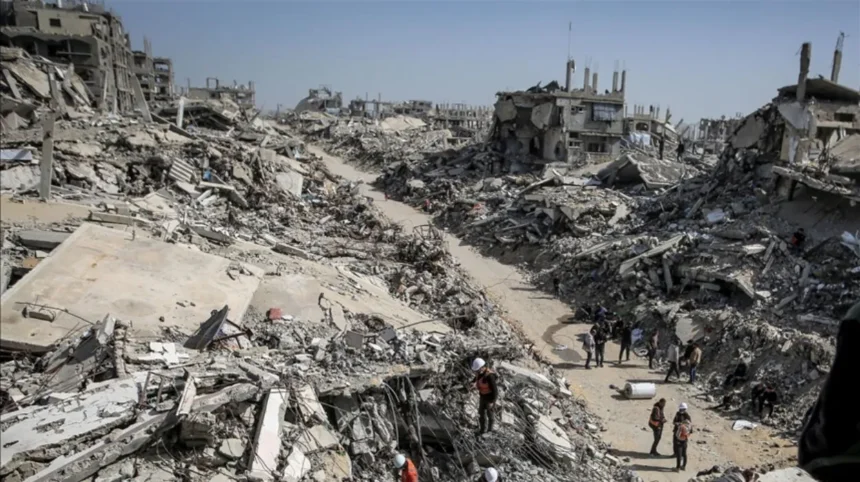
As reported by Anadolu Agency, senior officials on Thursday presented a postwar Gaza framework during a meeting of the Trump-backed Board of Peace, outlining proposals for governance, security and reconstruction in the territory. The framework is intended to guide Gaza’s transition from wartime conditions toward a new administrative and security order.
According to Anadolu Agency, the meeting took place under the auspices of the Board of Peace, which was launched by US President Donald Trump to oversee ceasefire implementation and long-term stabilization in Gaza. The framework presented at the session sets out a roadmap that combines institutional reforms, security restructuring and conditions for reconstruction funding.
Anadolu Agency notes that the postwar Gaza framework is closely linked to the broader Gaza peace plan endorsed by the Board of Peace and its member states. It seeks to operationalize key elements of that plan by detailing new structures such as a transitional administrative office, a Palestinian police force and mechanisms for demilitarization.
What are the main elements of the postwar Gaza framework?
As reported by Anadolu Agency, Nickolay Mladenov, director-general of the Board of Peace, announced the creation of a new entity called the Office of the High Representative for Gaza. He said the office will “support, guide and assist” the National Committee for the Administration of Gaza (NCAG) as it seeks to assume civilian and administrative control of the Strip.
Mladenov explained that the Office of the High Representative for Gaza will operate under the supervision of the Board of Peace and its executive body. It will coordinate with Israeli and Palestinian institutions and with an international stabilization force that is expected to deploy to Gaza as part of the broader postwar arrangements.
According to Anadolu Agency, the framework also includes the establishment of a new transitional Palestinian police force under the authority of the National Committee. This force is presented as a central pillar of the security component of the postwar Gaza framework, intended to help restore order and support the dismantling of armed factions.
Mladenov told the meeting that recruitment for this transitional Palestinian police force had already begun. He said that “as of this morning,” 2,000 people had applied in just the first few hours to join the new force, which is to be trained in Egypt with the support of the Board of Peace and then deployed in Gaza under NCAG authority.
How are key actors reacting to the postwar Gaza framework?
What did Board of Peace officials say about security and disarmament?
As reported by Anadolu Agency, Mladenov stressed that the transitional Palestinian police force will be crucial during the transition period. He said it would “allow us to ensure that all factions in Gaza are dismantled and all weapons are put under the control of one civilian authority,” linking the force directly to disarmament and consolidation of security structures.
Mladenov thanked Qatar, Egypt and Türkiye for their support of mediation efforts related to Gaza and emphasized that reconstruction is conditioned on disarmament. He stated there is “no other option except the full demilitarization and decommissioning of all weapons in Gaza for reconstruction to begin and for people to have a new way of life going forward.”
These remarks underline a core feature of the postwar Gaza framework: reconstruction funding and projects are tied to concrete steps on demilitarization. The Board of Peace is positioning disarmament and the transition to unified civilian control as prerequisites for large-scale rebuilding.
How did Tony Blair and other figures respond?
Former UK Prime Minister Tony Blair also addressed the Board of Peace meeting, according to Anadolu Agency. Blair described Gaza’s past governance record as marked by “extremism, corruption, ineffective institutions, and the complete absence of a route to prosperity for the Gazan people.”
Blair outlined a vision for postwar Gaza that centers on functioning public institutions, economic opportunity and technological development. He spoke of Gaza as part of a Middle East at peace, where people of different faiths or none can “rise by your own efforts, and feel your government by your side, not on your back.”
According to Anadolu Agency, Blair said President Donald Trump’s proposed framework “remains the best, indeed the only hope for Gaza, the region and the wider world.” His remarks reflect strong support from at least some international figures for the Board of Peace’s approach to Gaza’s postwar future.
Supporting details on governance, security and regional roles
In earlier reporting cited alongside Anadolu Agency’s coverage, The Media Line has described how the Board of Peace architecture places the National Committee for the Administration of Gaza at the center of day-to-day governance. The NCAG is presented as a technocratic, non-political Palestinian body, backed and overseen by the Board of Peace through entities like the newly announced Office of the High Representative for Gaza.
The Gaza peace plan framework, as summarized in open-source reference material, envisages Gaza being governed under temporary transitional governance by a technocratic committee. This committee is supported by international experts and supervised by the Board of Peace, which is headed by President Trump and includes an executive board and a Gaza Executive Board.
Anadolu Agency’s report on the postwar Gaza framework highlights how the new Office of the High Representative for Gaza is meant to “remove roadblocks” facing the National Committee as it takes over civilian administration. The office is designed to coordinate with both local actors and international partners, including the planned international stabilization force.
Regional actors also feature prominently in the framework. Anadolu Agency notes Mladenov’s explicit thanks to Qatar, Egypt and Türkiye for their role in mediation and support for the emerging structures. Other Anadolu reporting on the Board of Peace has cited Indonesian President Prabowo Subianto’s pledge of “8,000 or more” troops to the International Stabilization Force in Gaza, indicating that the security component of the framework is drawing commitments from multiple countries.
What are the implications and future developments for the postwar Gaza framework?
How might the framework shape Gaza’s governance and security?
The postwar Gaza framework presented at the Board of Peace meeting points toward a transition in which the National Committee for the Administration of Gaza, supported by the Office of the High Representative for Gaza, assumes responsibility for civilian governance. The creation and recruitment of a transitional Palestinian police force under NCAG authority is meant to underpin this shift by providing a locally staffed security structure.
If implemented as described, this arrangement would concentrate security responsibilities under a single civilian-led authority, with the goal of dismantling armed factions and consolidating control over weapons. The international stabilization force, backed by countries such as Indonesia and supported by regional mediators, is intended to reinforce this process and help maintain stability during the transition.
At the same time, the framework’s insistence on “full demilitarization and decommissioning of all weapons in Gaza” as a condition for reconstruction underscores the complexity of the path ahead. Achieving that level of disarmament, while building legitimate institutions and responding to humanitarian needs, will likely require sustained engagement from local, regional and international actors.
What are the next steps for implementing the postwar Gaza framework?
Anadolu Agency’s report suggests that implementation has already begun in at least one area: recruitment for the transitional Palestinian police force. With 2,000 applications reported in the first hours, the Board of Peace and the National Committee now face the task of screening, training and organizing these recruits, in coordination with Egyptian training programs and international partners.
Further steps include fully establishing the Office of the High Representative for Gaza, defining its relationship with the NCAG, and clarifying how it will coordinate with Israeli and Palestinian institutions and the stabilization force. Detailed procedures for demilitarization, as well as benchmarks for when reconstruction funding can be released, will also need to be developed and agreed.
Future Board of Peace meetings and regional consultations are expected to refine and expand the postwar Gaza framework. As the framework moves from presentation to implementation, its success will be judged by whether it can deliver improved security, functioning governance and tangible reconstruction for Gaza’s population, while navigating complex political realities and the requirements of full demilitarization.
In the immediate term, the presentation of the postwar Gaza framework at the Board of Peace meeting marks a significant step in formalizing international plans for Gaza’s transition. Through new institutions, a transitional police force and a stated commitment to demilitarization, the framework sets out a roadmap that will shape diplomatic, security and reconstruction efforts in the months and years ahead.

