


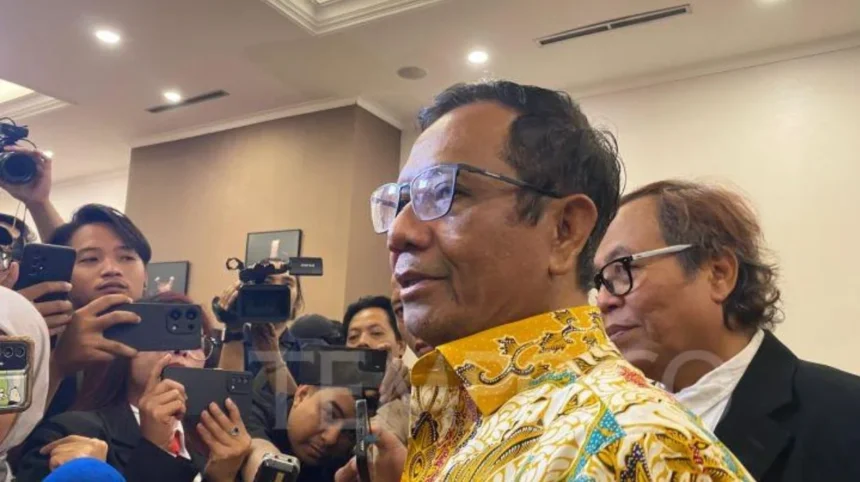
As reported in the Indonesian-language political section of Tempo, constitutional law expert and former Coordinating Minister for Political, Legal, and Security Affairs Mahfud Md said Indonesia would not suffer any losses if it decided to leave the international “Board of Peace.” The body, also referred to domestically as the Dewan Perdamaian, was initiated by United States President Donald Trump, with Israel listed among its member states.
According to Tempo’s reporting, Mahfud’s remarks came after a series of unprovoked attacks carried out by Israel and the United States on Iranian territory, which he described as a key moment for Indonesia to reconsider its participation in the Board of Peace. He also referred to earlier public comments by President Prabowo Subianto, who has stated that Indonesia is prepared to withdraw from the Board if its participation provides no tangible benefits.
Mahfud argued that, in the current regional and global security environment, Indonesia would not incur diplomatic or strategic damage by stepping away from the forum. He framed Indonesia’s potential withdrawal as consistent with the country’s long-standing foreign policy principles and its commitment to justice in conflict areas such as Palestine.
What Reactions and Context Surround Mahfud’s Remarks?
According to Tempo, criticism of Indonesia’s membership in the Board of Peace has been present since the government first decided to join the US-led platform. Mahfud noted that protests and objections have focused on what critics see as an imbalance within the board’s composition and agenda.
Tempo reports that Mahfud questioned why no state directly representing Palestinian interests sits on the Board of Peace while decisions touching on the Palestinian issue and wider regional conflicts are being discussed. He is quoted as saying it is not possible to talk about justice if the parties who will be directly affected by decisions are not represented in the mechanism.
Indonesia’s domestic debate has intensified amid broader concerns that involvement in the Board of Peace and potential troop deployments to Gaza could dilute Jakarta’s traditional pro-Palestinian stance. Reuters has reported that President Prabowo, responding to pressure from Islamic organizations and analysts, has pledged to withdraw from the board if it fails to serve the interests of Palestinians and Indonesia.
Supporting Details and Expert Commentary
Tempo’s article describes Mahfud as viewing recent military escalation involving the United States, Israel, and Iran as a turning point that exposes limitations of the Board of Peace as an effective channel for conflict resolution. In his assessment, the board’s structure and decision-making process do not adequately reflect the principles of fairness and inclusivity that Indonesia promotes in multilateral forums.
According to Reuters, Indonesia is the world’s largest Muslim-majority nation and has historically been an outspoken supporter of Palestinian statehood, a stance that shapes public expectations of its foreign policy choices. Domestic groups such as Nahdlatul Ulama have urged the government to use any international forum, including the Board of Peace, to push for de-escalation and a durable peace in the Middle East, particularly in Gaza.
Tempo’s coverage also links Mahfud’s comments to continued calls for Indonesia to prioritize established multilateral bodies, especially the United Nations, when advocating for peace and justice. In earlier public appearances, he has argued that the UN remains a more appropriate and legitimate arena for Indonesia to voice its positions on conflicts involving the United States, Israel, Iran, and Palestine.
What Are the Implications and Possible Future Developments?
Reuters reports that President Prabowo has signaled a conditional stance, stating that Indonesia will remain in the Board of Peace only as long as it advances Palestinian and Indonesian interests, and will withdraw if it does not. This position, combined with Mahfud’s assertion that Indonesia would “lose nothing” by leaving, suggests that Jakarta is keeping the option of exit open while monitoring developments in the Middle East and within the board itself.
According to Indonesian media reports, some Islamic organizations and political figures have urged the government to formally reassess its membership, arguing that withdrawal would realign Indonesia more clearly with its traditional diplomatic posture and public opinion at home. Others see potential value in remaining, at least temporarily, to press for de-escalation and humanitarian considerations from within the forum.
Tempo notes that Mahfud’s comments could add further momentum to internal discussions on whether Indonesia should pivot away from the Board of Peace toward more established multilateral frameworks, particularly the UN system, for its peace diplomacy. Any official decision to leave or remain is expected to depend on how the board’s agenda evolves in relation to the ongoing conflicts and whether it can demonstrate concrete benefits for Palestine and Indonesia.
In sum, Mahfud Md has publicly argued that Indonesia would face no significant costs if it chose to leave the US-initiated Board of Peace, underscoring long-running domestic concerns about the forum’s balance and effectiveness. His remarks align with growing scrutiny of Indonesia’s role in the body and place additional pressure on the government as it weighs its next steps.

