


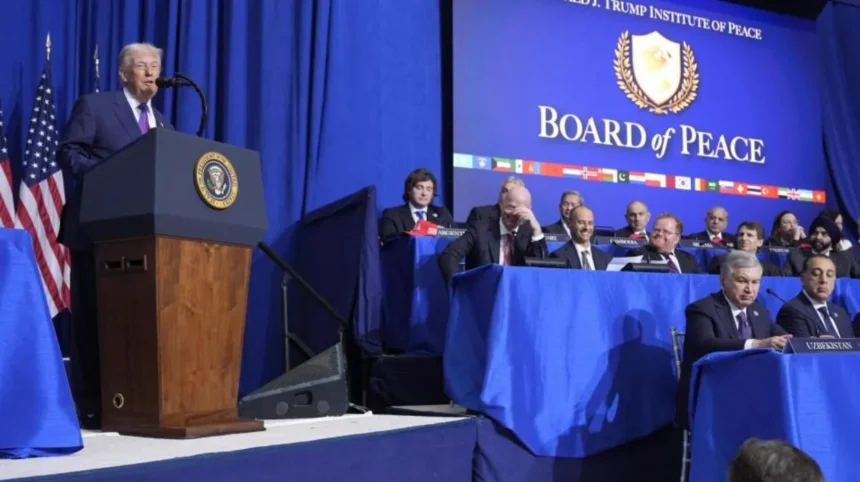
As reported by multiple international outlets, President Donald Trump hosted the first full meeting of his Gaza Board of Peace in Washington, bringing together delegates from more than 40 countries to discuss postwar plans for the Gaza Strip. The body is central to Trump’s Gaza peace plan, which combines ceasefire arrangements, reconstruction funding and a proposed international stabilization force.
According to coverage by US, European and Middle Eastern media, the agenda for the Gaza Board of Peace meeting focused on three main areas: mobilizing money for reconstruction, securing troops and police for a new security architecture, and presenting a postwar framework for Gaza’s governance. The event also served as a platform for Trump to project a global leadership role and for participating governments to highlight their own contributions.
Across the day, seven main developments stood out: major funding pledges for Gaza; troop commitments to an International Stabilization Force; unveiling of elements of a postwar governance framework; specific national initiatives, such as Romania’s and Indonesia’s offers; political endorsements for Trump and his plan; signs of caution or absence from some traditional allies; and renewed questions about the relationship between the Gaza Board of Peace and the United Nations.
What were the major funding pledges for Gaza reconstruction?
Several outlets, including Deutsche Welle and CBC, reported that members of the Gaza Board of Peace collectively pledged between 5 and 7 billion dollars for reconstruction and stabilization in Gaza, in addition to a separate US commitment announced by Trump. This money is earmarked for rebuilding homes, infrastructure and public services, and for supporting security and governance reforms.
Trump told delegates that the United States would provide 10 billion dollars for the Gaza Board of Peace, positioning Washington as the single largest backer of his plan. Local US affiliates carrying national reports noted that this pledge will require congressional approval, and its eventual scale and timing remain subject to domestic political debate.
Regional outlets highlighted that Qatar and Saudi Arabia each pledged 1 billion dollars to the Gaza Board of Peace, joining contributions from the United Arab Emirates and other states. The United Nations was also cited in broadcast reports as preparing around 2 billion dollars in humanitarian support for Gaza, to run in parallel with the board’s reconstruction and security initiatives.
Which countries offered troops and police for Gaza?
A central feature of the Gaza Board of Peace meeting was troop commitments to the planned International Stabilization Force for the territory. Military-focused outlets and regional media reported that Indonesia, Morocco, Kazakhstan, Kosovo and Albania all offered personnel for the force, which is envisaged at around 20,000 troops when fully assembled.
Indonesian President Prabowo Subianto said his country was ready to send “8,000 or more” troops to help stabilize Gaza and support the peace plan. This would make Indonesia by far the largest single troop contributor, and Indonesian officers are expected to take senior roles in the force’s command structure.
Egypt and Jordan, according to Anadolu Agency and other regional reports, committed to training a new Palestinian police force that will operate under emerging governance structures in Gaza. Recruitment drives for a transitional Palestinian police service have already begun, with thousands of applications reported in the first hours. This police component is meant to work alongside, and ultimately outlast, the international troops.
How was a postwar Gaza framework presented and explained?
Anadolu Agency reported that, alongside the main plenary, officials presented a detailed postwar Gaza framework at the Gaza Board of Peace meeting. Nickolay Mladenov, appointed as High Representative for Gaza within the board’s structure, outlined the creation of the Office of the High Representative for Gaza and its role in supporting a National Committee for the Administration of Gaza.
The framework envisions a technocratic Palestinian body taking charge of civilian administration, supported and overseen by the Gaza Board of Peace. Mladenov said the new office would work to “remove roadblocks” to the National Committee’s work and coordinate with Israeli and Palestinian institutions, as well as with the International Stabilization Force.
The postwar framework also ties reconstruction funding to demilitarization. Mladenov stated that “there is no other option except the full demilitarization and decommissioning of all weapons in Gaza for reconstruction to begin,” linking donor money and long-term rebuilding to progress on disarming Hamas and other armed groups.
How did individual countries use the meeting to showcase their roles?
Several leaders used the Gaza Board of Peace meeting to outline specific national initiatives. Anadolu Agency reported that Romanian President Nicusor Dan pledged to expand medical evacuation flights for children from Gaza, saying Romania was ready to help 4,000 children and 4,000 accompanying family members access treatment in Romanian hospitals.
Dan also offered Romanian expertise in emergency response systems, including ambulances and fire services, and vowed to support the rebuilding of Gaza’s emergency infrastructure. He said Romania would expand scholarship programs for Palestinian students and help refurbish schools in Gaza under the Gaza Board of Peace framework.
Indonesian President Prabowo emphasized his country’s troop commitment and linked it to a broader message of solidarity with Palestinians. Other states, such as Qatar and Saudi Arabia, used their statements to highlight financial pledges and to underline political backing for a settlement they described as needing to be fair to both Palestinians and Israelis.
Hungarian Prime Minister Viktor Orban positioned Hungary as the only European Union founding member represented at head-of-government level at the Gaza Board of Peace. He said Hungary valued Trump’s “tireless peace efforts” and argued that new initiatives like the board were needed because existing international organizations had failed to maintain global peace and stability.
How did Trump and his allies frame the meeting politically?
According to multiple news organizations, Trump presented the Gaza Board of Peace meeting as proof of his ability to rally the world around a US-led peace and reconstruction agenda. He spoke of the board as a “new kind of organization” that would “look over the United Nations” while working with it, suggesting that it could act as both partner and watchdog for traditional multilateral institutions.
At various points, Trump used the Gaza Board of Peace platform to endorse or praise foreign leaders, including some facing contested elections or criticism over democratic standards. This added a political layer to what was formally billed as a multilateral policy and pledging conference.
Supportive leaders echoed Trump’s framing. Orban, for example, described the Gaza Board of Peace as an important new global mechanism and argued that security in Gaza was directly linked to security in Europe. Other leaders stressed that Gaza’s reconstruction under the Gaza Board of Peace would serve as a model for addressing conflicts elsewhere.
What reservations and criticisms emerged around the Gaza Board of Peace?
While the meeting featured strong backing from a cluster of states, reporting by outlets such as NPR, the BBC and regional analysis platforms pointed to significant reservations among other governments and observers. Some major European allies either stayed away from the Gaza Board of Peace or participated only at lower levels, wary of appearing to endorse a structure that might compete with the UN and existing peace processes.
Critics, including human rights advocates and policy analysts, raised concerns that the Gaza Board of Peace lacked Palestinian representation in its upper echelons and resembled a top-down approach to the territory’s future. Commentaries noted that the board’s Executive Board and Gaza Executive Board include a range of international political and business figures but no publicly named Palestinian decision-makers at the highest level.
Others questioned the transparency of funding and decision-making, and the extent to which the Gaza Board of Peace’s security-heavy approach might entrench foreign control. Some opinion and advocacy outlets urged journalists to scrutinize how the Gaza Board of Peace interacts with Israel’s occupation policies, Gaza’s siege conditions and longstanding structural inequalities.
What are the implications and potential next steps from the meeting?
The Gaza Board of Peace meeting left several major questions open. One is whether the announced funding—5 to 7 billion dollars from member states plus the US pledge of 10 billion dollars—will be fully appropriated and disbursed, given legislative constraints and competing priorities. Another is how quickly and effectively the International Stabilization Force can be deployed and integrated with local security structures.
Implementation of the postwar Gaza framework will require the National Committee for the Administration of Gaza and the Office of the High Representative for Gaza to take shape in practice, not just on paper. Their success will depend on cooperation from Palestinian actors, coordination with Israel, and support from regional mediators like Qatar, Egypt and Türkiye.
The Gaza Board of Peace is expected to convene further meetings, working groups and technical sessions in the coming months. These will focus on detailed planning for housing projects, infrastructure reconstruction, education and health services, as well as on demilitarization benchmarks and the rules of engagement for international troops.
For Trump, the Gaza Board of Peace meeting has already become a centerpiece of his foreign policy narrative, allowing him to present large numbers—billions in funding, tens of thousands of planned homes, and thousands of pledged troops—as evidence of progress. For Gaza’s residents, the real test will be whether the decisions and pledges made at the Gaza Board of Peace translate into tangible improvements in safety, housing, services and political agency on the ground.

