

Kazakhstan has outlined the scope of its humanitarian participation in the Board of Peace, an international initiative proposed by U.S. President Donald Trump to support stabilization and reconstruction in Gaza. According to reporting by The Astana Times, Foreign Ministry spokesperson Yerlan Zhetybayev told a March 4 press briefing in Astana that the country joined the Board without taking on mandatory financial obligations.
As reported by Yerlan Zhetybayev of the Foreign Ministry, the charter’s mention of a voluntary 1 billion dollar contribution “is not a condition of membership” but remains at the discretion of each participating state. He stressed that Kazakhstan’s role will be confined to humanitarian engagement and that any specific assistance, including personnel or logistics, will be decided strictly in line with national legislation.
Deputy Prime Minister and Minister of National Economy Serik Zhumangarin also clarified that Kazakhstan has not made any financial contributions to the Board to date. According to The Astana Times, he said the country’s planned support will focus on medical teams with field hospitals, grants for student education, and humanitarian aid such as food supplies.
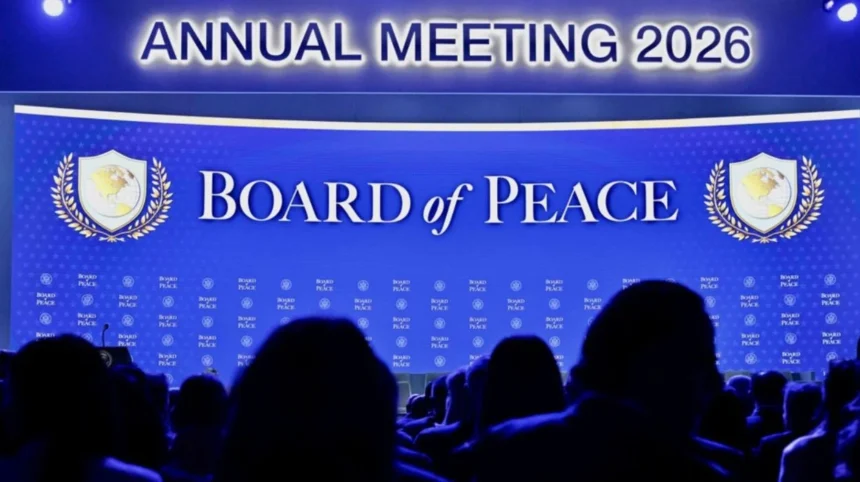
President Kassym-Jomart Tokayev signed the Board of Peace charter on Jan. 22 in Davos, Switzerland, alongside leaders and representatives from 18 countries, formalizing Kazakhstan’s participation. At the inaugural Board meeting in Washington on Feb. 20, Tokayev detailed the country’s planned contributions and argued that lasting peace requires “concrete, targeted steps rather than endless conferences and resolutions based on goodwill alone.”
How Is Kazakhstan Framing Its Humanitarian Role?
At the Washington meeting, President Tokayev described a package of humanitarian and reconstruction-focused measures that Kazakhstan is prepared to pursue within the Board framework. According to The Astana Times, he said the country is interested in taking part in reconstruction and construction projects in Gaza via international companies with a proven business record and high competence.
Kazakhstan is positioning its agricultural capacity as a key element of its assistance. As one of the world’s leading wheat producers, the country has signaled readiness to provide humanitarian aid aimed at bolstering food security in Gaza and neighboring areas, with a priority on food supplies.
Education and digital governance are also central to Kazakhstan’s offer. Tokayev announced plans to allocate more than 500 educational grants for Palestinian students to study at Kazakh universities over the next five years, and he offered to share Kazakhstan’s internationally recognized experience in e‑government and digital solutions.
In terms of security-related support, Tokayev stated that Kazakhstan is ready to back the International Stabilization Force in a limited humanitarian capacity. According to The Astana Times, he said Kazakhstan could send medical units with a field hospital and dispatch observers to the Civil-Military Coordination Center, while reiterating that participation would remain strictly humanitarian.
Supporting Details and International Coordination
The Board of Peace brings together a group of countries pledging financial, humanitarian, and technical support for Gaza’s recovery. During the inaugural meeting, President Trump reported that participating states, including Kazakhstan, Azerbaijan, the United Arab Emirates, Morocco, Bahrain, Qatar, Saudi Arabia, Uzbekistan, and Kuwait, have collectively committed over 7 billion dollars toward Gaza relief and reconstruction, according to Reuters reporting cited by The Astana Times.
Additional multilateral funding is planned. The Astana Times reports that the United Nations intends to provide a further 2 billion dollars in humanitarian aid, while FIFA expects to raise 75 million dollars for youth- and football-related projects in Gaza under the same broader effort.
According to Reuters, Trump first proposed the Board of Peace in September of the previous year as part of his plan to help end Israel’s war in Gaza. The initiative has since been broadened to address other global conflicts, with Trump serving as chair, and 27 countries have so far accepted invitations to join.
The governance structure of the initiative is designed to connect strategic oversight with implementation on the ground. The founding executive board consists of nine members with experience in diplomacy, development, infrastructure, and economic strategy, each responsible for a critical aspect of Gaza’s recovery, while a separate Gaza executive board will manage the governing framework in the territory; four members will serve on both bodies to ensure coordination.
What Are the Implications and Next Steps for Gaza?
Kazakhstan’s emphasis on humanitarian, educational, and reconstruction support aligns its role with civilian-focused recovery rather than military engagement under the Board of Peace. According to The Astana Times, the combination of medical units, food aid, education grants, and technical expertise in e‑government is intended to reinforce Gaza’s long-term social and economic resilience once conditions on the ground allow implementation.
The broader funding picture suggests that Kazakhstan’s contributions will operate alongside substantial multilateral and regional commitments. With reported pledges of more than 7 billion dollars from participating countries, plus planned United Nations and FIFA contributions, the Board of Peace framework aims to mobilize significant resources for rebuilding infrastructure, supporting public services, and investing in youth and community programs in Gaza.
The institutional design of the Board, with its founding executive board and dedicated Gaza executive body, indicates that the initiative is structured for phased recovery and governance support. According to The Astana Times’ account of the Reuters reporting, the Board has also been envisioned as a platform that can be applied to other global conflict zones, which may shape how Kazakhstan and other members calibrate their humanitarian and reconstruction efforts over time.
For now, Kazakhstan’s officials continue to underline that any deployments or specific projects will be undertaken in accordance with national law and focused on humanitarian aims. As outlined by Zhetybayev and Zhumangarin, the government has not committed funds under the Board’s voluntary contribution framework but has set out a defined package of medical, educational, and food security support to be activated within the parameters of the Board of Peace’s operations.

