


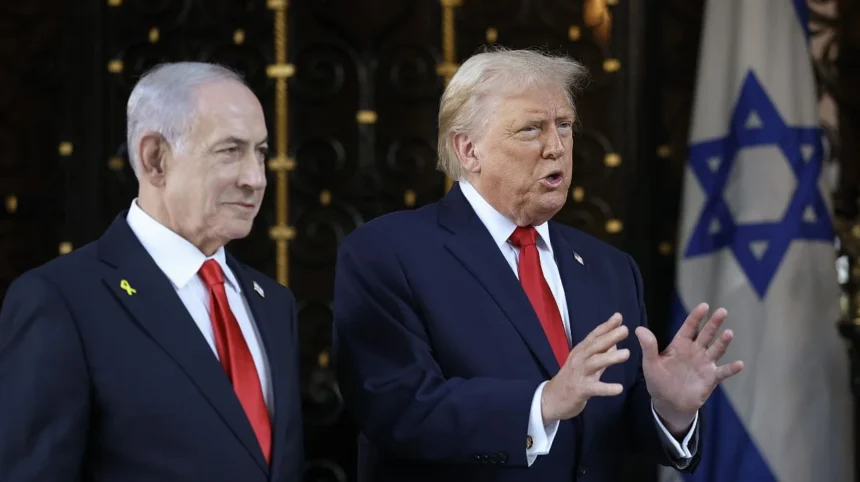
Israeli Prime Minister Benjamin Netanyahu met President Donald Trump at the White House as indirect negotiations over Iran’s nuclear program continue. According to reporting from WBFF based on a TNND dispatch, Trump said he believes Iran “wants to make a deal” while Netanyahu arrived with a push to widen the agenda beyond nuclear issues alone.
As reported by WBFF, Netanyahu said he had signed Israel’s accession to Trump’s newly created “Board of Peace” ahead of the meeting in Washington. In a post on X, he wrote that Israel would “continue strengthening the unbreakable alliance between Israel and the United States,” underscoring the security partnership framing the talks.
According to WBFF’s account, Trump described the encounter on Truth Social as “a very good meeting,” highlighting what he called the “tremendous relationship between our two countries.” The visit marked the seventh meeting between the two leaders during Trump’s second term in office, reflecting the frequency of high-level coordination on Iran and regional issues.
What did both sides say about Iran and regional security?
As reported by WBFF, Trump wrote that “nothing definitive” was decided in the White House discussions but emphasized that he had “insisted that negotiations with Iran continue to see whether or not a deal can be consummated.” He said that, if possible, reaching an agreement would be his “preference,” while leaving open the prospect of other outcomes if talks fail.
In the same Truth Social post, Trump referred to a previous round of tensions with Tehran, saying that when Iran last declined to make a deal “they were hit with Midnight Hammer,” which he claimed “did not work well for them.” He added that Washington and Jerusalem also discussed what he called “tremendous progress being made in Gaza, and the region in general,” asserting that “there is truly PEACE in the Middle East.”
According to WBFF, Netanyahu has urged the US administration to expand negotiations with Iran to address a broader set of Israeli concerns. These include Iran’s ballistic missile program and its support for militant proxies such as Hamas and Hezbollah, issues he wants embedded in any future framework alongside nuclear constraints.
Before departing Israel, Netanyahu said he would present “our positions regarding the principles of the negotiations, the important principles,” adding that in his view they were significant “not only for Israel — but for everyone in the world who wants peace and security in the Middle East,” WBFF reported. The comments reflected his effort to frame Israeli demands as part of a wider regional and international security agenda.
Supporting details: Board of Peace, prior war and US posture
According to WBFF, Netanyahu told reporters he had signed Israel’s accession to the “Board of Peace” prior to his White House talks, aligning his government with the new Trump-backed forum. In his social media message, he linked that step to a broader commitment to deepen the US–Israel alliance.
WBFF reported that the Israeli leader had recently met Trump envoys Steve Witkoff and Jared Kushner, with the Prime Minister’s Office saying they discussed “regional issues.” The American team briefed Netanyahu on the first round of negotiations with Iran held in Oman the previous Friday, indicating that the Board of Peace figures are closely involved in the diplomatic track.
The WBFF report noted that Iran is still recovering from a 12‑day war with Israel in June, during which the US carried out strikes on Iranian nuclear sites. At that time, Trump said US actions had “obliterated” Iran’s nuclear capabilities, a claim that continues to shape perceptions of leverage and risk as the new talks proceed.
Recently, the United States has reinforced its military posture in the region, deploying an aircraft carrier, guided‑missile destroyers and additional air defense assets, WBFF added. During his Washington visit, Netanyahu stayed at Blair House, the US president’s official guest residence, underscoring the formal nature of the engagement as Iran discussions move into a new phase.
What are the implications and what happens next?
According to the WBFF report, Trump’s insistence that negotiations with Iran continue suggests Washington intends to pursue further rounds of indirect talks after the initial Oman meeting. Netanyahu’s bid to link any future deal to ballistic missiles and proxy activity signals that Israel will keep pressing for a comprehensive approach rather than a narrow nuclear-only agreement.
The creation of the Board of Peace, and Israel’s decision to join it, positions the forum as a potential platform for coordinating policies on Gaza, Iran and broader Middle East stability, based on WBFF’s account. With the US maintaining a reinforced military presence and both leaders publicly stressing alliance ties, the next stages of diplomacy are likely to focus on whether Tehran engages on the expanded agenda outlined by Netanyahu while talks over its nuclear program continue.
Together, the Washington meeting, Israel’s accession to the Board of Peace and the ongoing Oman channel underline a dual track of diplomacy and deterrence aimed at Iran. As reported by WBFF, both Trump and Netanyahu are signaling that they prefer a negotiated outcome while keeping military options and regional security considerations firmly on the table as discussions move forward.

