


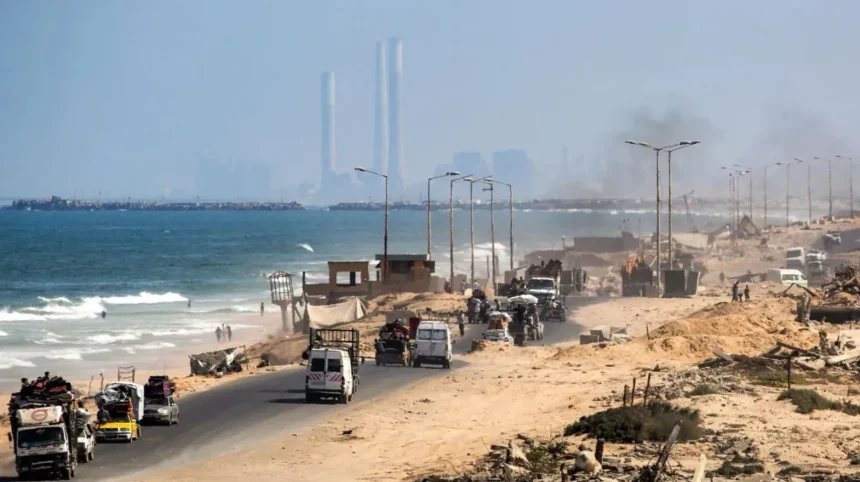
According to a report by Middle East Eye, Israeli government officials and senior finance ministry staff have been discussing ways for Israel to derive economic benefit from the post-war reconstruction of the Gaza Strip. The report, citing Israeli newspaper Haaretz, says these discussions have involved senior Israeli army officers and focus on infrastructure, energy and access routes linked to Gaza’s rebuilding. The talks reportedly take place against the backdrop of international planning for large-scale reconstruction funded by donor states.
As reported by Middle East Eye, proposals raised in these internal Israeli discussions include the construction of a new highway on Israeli territory connecting to Gaza. Under the ideas described, countries that want to send reconstruction materials and personnel into Gaza via Israel would help finance new road infrastructure. One suggested project is a highway along Israel’s southern Route 232, which would also facilitate movement for Palestinians traveling between Gaza and the occupied West Bank via Israeli-controlled crossings.
The article states that Israeli officials have also examined potential economic opportunities related to supplying electricity to Gaza during reconstruction. While donor countries have reportedly debated building a power plant in Egypt or a new plant inside Gaza, the report says Israel is promoting a third option centered on power exports from Israeli territory. This would involve expanding an existing power plant near the Gaza border and channeling additional electricity into the enclave as reconstruction advances.
According to Middle East Eye, these discussions are unfolding as international agencies and donor governments assess the scale of Gaza’s destruction and the long-term costs of rebuilding. A United Nations assessment cited in the report estimates that reconstruction of the Strip could cost tens of billions of dollars over the coming decades. Israeli officials are described as exploring how this anticipated flow of reconstruction funding might intersect with Israel’s own infrastructure projects and energy sector.
How Are These Plans Being Framed and Received?
What Do Israeli Discussions Focus On?
Middle East Eye reports that, based on Haaretz’s account of internal meetings, senior Israeli finance ministry officials and army officers have framed the ideas as part of planning for a post-war regional infrastructure landscape. In this context, the proposed Israel–Gaza highway and expanded power supply are presented as projects that could serve both reconstruction needs in Gaza and broader Israeli economic interests. The discussions reportedly suggest that international donors might be asked to help underwrite these projects in exchange for reliable land and energy access to Gaza.
The article notes that the Ashkelon power plant, situated near the Gaza border, is central to the energy-related proposals described. Under the vision attributed to Israeli officials, donor countries would support an expansion of this plant so that it can supply more electricity to Gaza while simultaneously boosting power availability inside Israel. Supporters of the idea reportedly argue that this would ensure a stable energy supply for reconstruction while integrating Gaza’s power needs into Israel’s grid-based system.
What Criticism or Concern Has Been Raised?
According to Middle East Eye’s reporting, the prospect of Israel profiting from Gaza’s reconstruction has drawn sharp criticism from Palestinian advocates, analysts and human rights voices quoted or referenced in the article and related commentary. Critics argue that it is inappropriate for a country whose military campaign contributed to Gaza’s widespread destruction to seek economic gains from rebuilding the territory. Some describe the dynamic as part of a broader “war economy” that ties reconstruction to strategic and commercial interests.
The article also reports that United Nations bodies have issued stark warnings about the state of Gaza’s economy and the scale of the reconstruction challenge. A UN trade and development assessment cited in the report describes Gaza’s economy as having contracted dramatically during the war, with GDP per capita collapsing to among the lowest levels worldwide. Against this backdrop, critics of the Israeli discussions contend that reconstruction should prioritize restoring basic livelihoods and rights for Palestinians, rather than creating new profit streams for external actors.
Supporting Details
Reconstruction Costs and International Frameworks
Middle East Eye notes that UN estimates place the cost of rebuilding Gaza at around $70bn over an extended period. This figure reflects destroyed housing, infrastructure, utilities, public facilities and economic assets across the Strip. International institutions and donor states are reportedly considering multi-decade frameworks involving grants, loans, and trust funds to support both immediate humanitarian recovery and long-term reconstruction.
According to the report, an international civil-military coordination center has been established in Kiryat Gat, southern Israel, as part of the emerging reconstruction architecture. At least 28 countries are said to have representation at this hub, which includes working groups on stabilization, security, intelligence, humanitarian assistance and engineering. The article states that there is an Israeli representative on each team, underscoring Israel’s central role in discussions around access, logistics and security parameters for reconstruction.
Energy and Infrastructure Proposals
The Middle East Eye article explains that donor countries have been considering two primary energy options: constructing a power plant in Egypt that would serve Gaza via cross-border transmission lines, or building a plant within Gaza itself. Israeli officials, as reported via Haaretz, have raised concerns that a plant located inside Gaza could grant local authorities, including Hamas, a more independent power base. This concern underpins the third option Israel is said to be advancing: increased electricity exports from Israel in exchange for donor support to expand Israeli generating capacity.
In the case of road infrastructure, the report indicates that a proposed highway along Israel’s Route 232 would not only facilitate the flow of reconstruction materials and personnel into Gaza but also improve connectivity between Gaza and the West Bank under Israeli control. Donor states seeking reliable, secure access for their reconstruction projects could be asked to cover some of the costs. The article suggests that these ideas reflect a broader trend in which reconstruction planning is coupled with long-term infrastructure and security arrangements centered on Israel.
What Are the Implications and Possible Future Developments?
How Could These Plans Shape Gaza’s Reconstruction?
According to Middle East Eye’s account, tying key reconstruction mechanisms—such as energy supply and land access—to projects on Israeli territory could give Israel significant leverage over the pace and scope of Gaza’s rebuilding. If donor countries agree to fund expansions of Israeli infrastructure in order to deliver aid and reconstruction services, Israel could emerge as a principal economic beneficiary of Gaza’s recovery. This structure may influence how reconstruction contracts are awarded, how goods move, and how dependent Gaza remains on Israeli-controlled systems.
At the same time, the UN’s warnings about Gaza’s economic collapse highlight the scale of humanitarian urgency. Any reconstruction path that centers on external infrastructure and conditional access could shape Gaza’s long-term economic model, including whether it moves toward greater self-sufficiency or deeper dependence. The article implies that decisions taken now on power, roads and border management will have lasting effects on trade patterns, labor markets and the territory’s ability to rebuild independently.
What Political and Diplomatic Questions Arise?
Middle East Eye reports that these Israeli discussions are unfolding alongside wider debates about governance, security arrangements and Palestinian political representation in post-war Gaza. Donor states, particularly in the Gulf and Europe, are weighing how to channel reconstruction funds without entrenching occupation structures or rewarding policies they view as contributing to the devastation. The possibility that Israel could profit from reconstruction while maintaining significant control over movement and resources raises questions for those donors about conditionality and accountability.
Looking ahead, the article suggests that the emerging reconstruction architecture will likely be shaped by negotiations among Israel, donor states, international organizations and Palestinian actors. Whether the highway and power export proposals proceed will depend on political decisions in multiple capitals and on how ceasefire and governance frameworks evolve. As those talks continue, the idea of Israel “exploring opportunities” to benefit economically from rebuilding Gaza remains a focal point in wider discussions about justice, responsibility and the future of the Strip.
In sum, the report describes Israeli officials examining infrastructure and energy schemes that could turn the massive task of Gaza’s reconstruction into an economic opportunity for Israel, particularly through new highways and expanded power exports. These ideas sit at the center of sensitive debates over who will control, finance and ultimately profit from rebuilding a territory devastated by war, and how that process will shape Gaza’s long-term political and economic landscape.

