


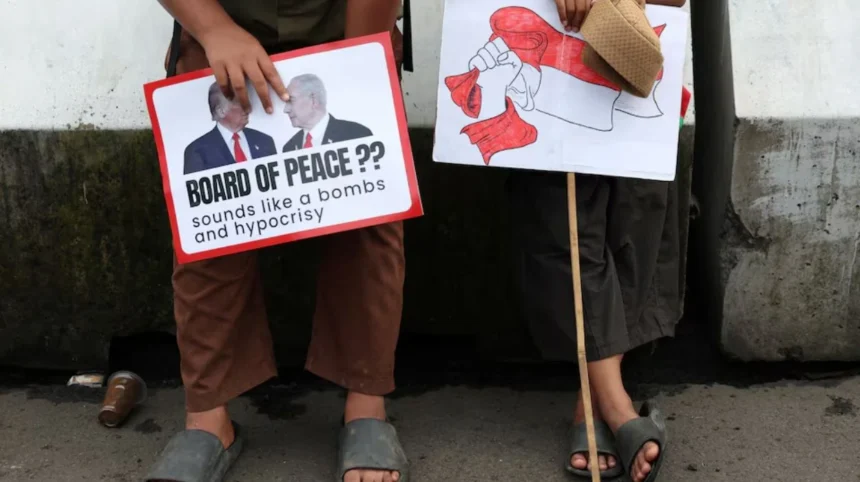
As reported by Reuters, Indonesian President Prabowo Subianto has told domestic Islamic groups that Indonesia will pull out of the Board of Peace if the body does not deliver tangible benefits for Palestinians and align with Indonesia’s national interests. According to Reuters, the assurance was conveyed in a government statement after Prabowo met leaders of Islamic organizations in Jakarta on the evening of March 5. Indonesia, the world’s largest Muslim-majority nation, has faced criticism at home over its decision to join the board and to contribute troops to a prospective stabilization force in Gaza.
As reported by Reuters, critics, including scholars and Muslim groups, argue that participation in the board could undermine Indonesia’s longstanding and explicit support for the Palestinian cause. According to Reuters, the government’s communication office said Prabowo used the meeting to reiterate his reasoning for joining the platform, emphasizing that Indonesia saw it as a way to help shape outcomes in Gaza and support Palestinians. Reuters has previously reported that Indonesia views the Board of Peace as an international body intended to oversee post-conflict stabilization and rehabilitation in Gaza and, more broadly, in Palestine.
How are Indonesian groups and officials reacting?
As reported by Reuters and other international outlets, the backlash has been particularly strong from domestic Muslim organizations that question the role of the United States and former U.S. President Donald Trump in the initiative. According to Reuters, the Indonesian Ulema Council, a leading clerical body, has called for Indonesia to leave the board, citing concerns over U.S. actions in the Iran conflict and their implications for regional stability.
In the government statement cited by Reuters, Hanif Alatas of the Islamic Brotherhood Front said Prabowo made clear he would not hesitate to withdraw if the Board of Peace failed to help Palestinians or conflicted with Indonesia’s interests. “The president said that if he sees that there is no longer any benefit for Palestine and that it is not in line with Indonesia’s national interests, he will withdraw,” Hanif was quoted as saying. According to coverage by regional media, some organizations see the platform as an opportunity for Indonesia to press for de-escalation in the Middle East, even as others insist that participation risks legitimizing policies they view as harmful to Palestinians.
Supporting details and background
According to an official statement from Indonesia’s foreign ministry and the presidential secretariat, the Board of Peace was established as an international body to supervise administration, stabilization and reconstruction efforts in Gaza after major hostilities. The government has said that Indonesia decided to join after a series of consultations among mostly Muslim-majority countries and discussions at international forums, including meetings in Sharm El Sheikh and on the sidelines of the World Economic Forum in Davos.
As stated by Indonesia’s foreign minister in an earlier briefing, Jakarta views participation as consistent with its longstanding policy of supporting Palestinian independence and a two-state solution. The minister stressed that the Board of Peace is not intended to replace the United Nations but to complement broader international efforts to promote peace and stability in Gaza. Reuters has reported that Indonesia’s commitment to sending troops to a Gaza stabilization force under the board’s framework has been a focal point of domestic debate, with supporters arguing it would strengthen Indonesia’s role in protecting Palestinians on the ground.
What are the implications and what happens next?
As reported by Reuters, Prabowo’s warning that he will withdraw if the Board of Peace does not benefit Palestinians appears aimed at addressing domestic concerns while keeping Indonesia engaged in the platform for now. According to Reuters, Indonesian officials have also indicated that some discussions with the Board of Peace are effectively on hold due to the ongoing Iran war and broader regional tensions, which could affect the pace and scope of the initiative’s work.
Regional commentary cited by international media suggests Indonesia will continue to balance its desire for an active diplomatic and security role in Gaza with strong domestic expectations that any engagement clearly advances Palestinian rights and statehood prospects. Future developments are likely to hinge on whether the board can demonstrate concrete progress in Gaza and whether its activities are perceived in Indonesia as aligned with the goal of Palestinian independence and a negotiated two-state solution, as repeatedly emphasized by Indonesian officials.
In sum, Indonesia has reaffirmed its participation in the Board of Peace but has explicitly set a condition that it will step away if the body fails to benefit Palestinians or contradicts Indonesia’s national interests, a position that reflects both its foreign policy priorities and domestic political pressures.

