


Key Points
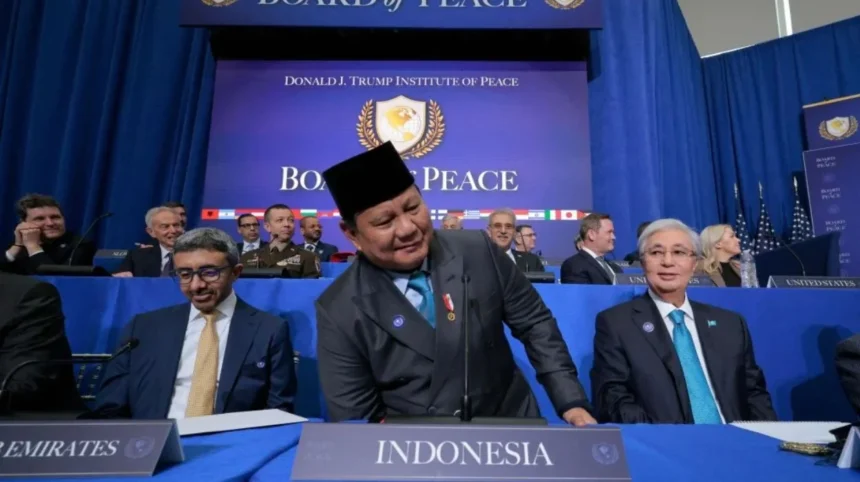
- Indonesia has paused its work related to the US-led “Board of Peace”, a proposed framework for peace talks linked to the conflict in Gaza, amid rising tensions over Iran.
- The decision comes as conflict involving Iran, the United States and Israel escalates following recent strikes and military exchanges in the Middle East.
- Indonesia’s Foreign Minister, Retno Sugiono, said discussions on the Board of Peace are currently “on hold” while Jakarta reassesses its role and consults partners.
- The Board of Peace initiative was launched by US President Donald Trump to support a ceasefire and stabilisation arrangements in Gaza, including a proposed multinational force.
- Indonesia had previously pledged up to 8,000 troops for a Gaza peacekeeping mission under the Board of Peace framework, subject to international approval and domestic processes.
- Domestic critics, including the Indonesian Ulema Council, have questioned Jakarta’s participation, saying the forum has not advanced “genuine independence” for Palestine.
- At the same time, Indonesia is seeking to position itself as a mediator between the US and Iran, with President Prabowo Subianto expressing readiness to travel to Tehran if both sides agree.
- The pause in Board of Peace engagement could affect the timeline for any Gaza stabilisation mission and may shape wider diplomatic efforts around the Iran crisis and Israel–Palestine conflict.
Indonesia pauses work on US-led peace board amid Iran crisis
Indonesia has placed its work on the United States-led “Board of Peace” on hold as conflict involving Iran intensifies, while signalling it still hopes to play a mediating role in the wider Middle East crisis. Foreign Minister Retno Sugiono confirmed that Jakarta’s talks related to the Board, an initiative linked to efforts to stabilise Gaza, have been paused as the government reviews its options and consults regional partners affected by the violence.
- Key Points
- Indonesia pauses work on US-led peace board amid Iran crisis
- Board of Peace activities ‘on hold’
- Indonesia’s planned Gaza deployment
- Domestic criticism and calls to withdraw
- Rising tensions with Iran reshape priorities
- Mediation bid between US and Iran
- Questions over neutrality and regional role
- Impact on Gaza peace and US-led talks
- Legal and political considerations at home
- What happens next
Board of Peace activities ‘on hold’
Speaking in Jakarta, Mr Sugiono said discussions on Indonesia’s involvement in the Board of Peace were currently not moving forward, citing the deteriorating security environment following US and Israeli strikes on Iran and concerns over regional escalation. He noted that Indonesia was in contact with partners in the Gulf and other members of the proposed Board, but did not give a timetable for when talks might resume.
The Board of Peace was announced by President Donald Trump as a mechanism to underpin ceasefire and reconstruction arrangements in Gaza, bringing together a group of states to support security, humanitarian access and political talks. According to The Straits Times, reporting by its Jakarta bureau, Indonesian officials have described the Board as a forum through which the country could contribute both peacekeeping troops and diplomatic engagement, while maintaining support for Palestinian statehood.
Indonesia’s planned Gaza deployment
Indonesia, the world’s largest Muslim-majority country, had earlier pledged to prepare up to 8,000 troops for a potential Gaza peace mission under the Board’s security component, contingent on international agreement and domestic approval. National Herald India reported that if deployed, Indonesia would have been among the first states to signal formal troop readiness for the proposed multinational stabilisation force.
Officials in Jakarta have argued that participation in such a mission could allow Indonesia to help safeguard Palestinian interests from within the framework, particularly as Israel has a seat at the table but there is no formal Palestinian representation on the Board. They have also stressed that any deployment would have to comply with Indonesia’s legal procedures and international mandates, including United Nations authorisation where required.
Domestic criticism and calls to withdraw
The prospective role in the Board of Peace has attracted criticism at home, with some politicians, civil society groups and religious authorities questioning whether the initiative can deliver tangible progress towards Palestinian self-determination. A commentary in Jakarta-based outlet Tempo noted that a number of parties had called on the government to withdraw from the Board following the US and Israeli attacks on Iran, arguing that Indonesia risked being associated with a process seen as favouring the interests of major powers.
According to The Straits Times, reporting by its Asia desk, the Indonesian Ulema Council, the country’s highest Islamic authority, urged the government on 1 March to step back from the forum. In its statement, the council said the Board had not proved effective in promoting what it described as “genuine independence” for Palestine and raised concerns about the political optics of Indonesia aligning itself too closely with a US-designed framework while Washington and Israel conduct operations in the region.
Rising tensions with Iran reshape priorities
The pause in Board of Peace activity comes against the backdrop of a sharp escalation in tensions involving Iran, the US and Israel. Bernama reported that the latest flare-up followed the collapse of earlier negotiations, prompting reciprocal strikes and raising fears of a broader conflict that could disrupt regional stability and global energy supplies.
Indonesia has repeatedly called for restraint and urged all parties to prioritise dialogue and diplomacy, while emphasising respect for sovereignty and territorial integrity. The Foreign Ministry said that President Prabowo Subianto expressed “deep regret” over the attacks and warned that further escalation would risk unnecessary civilian casualties and undermine efforts to resolve longstanding disputes through peaceful means.
The conflict has also affected Indonesia’s own economic outlook, particularly through higher oil prices and global financial volatility. Bloomberg reported that Bank Indonesia intervened in foreign-exchange markets to support the rupiah as the Iran war put downward pressure on the currency and added to existing external headwinds.
Mediation bid between US and Iran
Even as it slows work on the Board of Peace, Jakarta is seeking to position itself as a potential mediator between Washington and Tehran. Indonesia’s Foreign Ministry said in late February that President Prabowo was ready to facilitate dialogue to restore a more stable security environment, and, if both sides agreed, was willing to travel to Tehran to help broker talks.
Anadolu Agency reported that Foreign Minister Sugiono spoke by phone with his Iranian counterpart Abbas Araghchi, conveying Indonesia’s readiness to play what he called a “constructive role in advancing peace”. The ministry said Jakarta stands prepared to offer mediation or host talks, with the stated objective of preventing further escalation and “stopping the unnecessary loss of innocent lives”.
Indonesia’s parliament speaker has publicly backed these mediation efforts, describing diplomacy as the most viable path to easing tensions after the latest strikes. Antara News reported that the speaker urged all sides to use channels of communication and called on the international community to support credible mediation initiatives that respect international law.
Questions over neutrality and regional role
Indonesia’s dual track of pausing its Board of Peace engagement while pursuing mediation between the US and Iran has highlighted broader questions about how it positions itself in Middle Eastern diplomacy. South China Morning Post reported that some analysts believe joining President Trump’s Board of Peace has already made it harder for Jakarta to present itself as a fully neutral broker, particularly in the eyes of Iran and parts of the wider Muslim world.
According to the same report by the South China Morning Post, critics argue that Indonesia’s close association with a US-led framework could limit its influence with parties who view Washington as a participant in, rather than a referee of, regional conflicts. Supporters of Indonesia’s engagement counter that having a seat in such forums may increase its ability to advocate for Palestinian rights and encourage de-escalation in the broader region.
Indonesia has long maintained no diplomatic relations with Israel and has consistently backed a two-state solution, frequently highlighting support for Palestinian statehood in international fora. Officials insist that any involvement in the Board of Peace or other initiatives does not alter these core positions and that Jakarta will continue to stress international law, humanitarian principles and negotiated settlements.
Impact on Gaza peace and US-led talks
The pause in Indonesia’s Board of Peace activities comes as broader US-led peace efforts continue to face uncertainty, not only in Gaza but also in relation to Russia and Ukraine. Bloomberg reported that despite the Iran war, Russia and Ukraine still expect planned talks under US auspices to go ahead this week, though the venue may shift from Abu Dhabi to Istanbul due to airspace closures in the United Arab Emirates.
For Gaza, Indonesia’s decision could slow momentum behind the security and stabilisation elements of the Board of Peace, particularly if other states reconsider their roles amid the wider regional crisis. The absence or delay of a large troop contributor such as Indonesia may complicate planning for any multinational force, especially one that requires significant ground presence and logistical support.
At the same time, Jakarta’s focus on mediation between the US and Iran could, if successful, contribute indirectly to a more stable environment for discussing Gaza and broader Arab–Israeli issues. Indonesian officials have linked their diplomatic outreach to a wider goal of preventing the Middle East from sliding into a larger regional war that would overshadow efforts to address the Palestinian question.
Legal and political considerations at home
Any deployment of Indonesian troops abroad, particularly to a conflict zone such as Gaza, would be subject to domestic legal scrutiny and parliamentary oversight. Officials have stressed that decisions on participation in international peace operations must align with Indonesia’s constitution, defence laws and foreign policy principles, including non-alignment and respect for sovereignty. This information could not be independently verified.
Public opinion is also a significant factor. Commentary in Indonesian media suggests that while there is broad sympathy for Palestinians, there is also caution about entanglement in complex security arrangements perceived as being shaped by external powers. Religious and civic groups have called on the government to ensure that any international engagement does not undermine Indonesia’s longstanding reputation as a supporter of Palestinian self-determination.
The debate around the Board of Peace has therefore become a test of how Indonesia balances its growing diplomatic ambitions with domestic expectations and its traditional foreign policy identity. It also underscores the sensitivity of decisions taken in the context of rapidly shifting regional dynamics, where developments in Gaza, Iran and wider US–Middle East relations are closely intertwined.
What happens next
Indonesia has not set a public deadline for reviewing its engagement with the Board of Peace, and officials have indicated that the pause will remain in place while the Iran crisis evolves and consultations continue. Future steps are likely to depend on whether tensions with Iran can be reduced, whether a clearer roadmap emerges for Gaza stabilisation, and how domestic opinion in Indonesia responds to unfolding events.
If conditions improve and mediation efforts gain traction, Jakarta could revisit its plans to contribute troops and diplomatic support under the Board of Peace framework, potentially with adjustments to address concerns raised by critics. Alternatively, prolonged instability or further escalation could strengthen calls inside Indonesia to step back from the initiative altogether and focus instead on broader diplomatic engagement through multilateral institutions such as the United Nations.

