


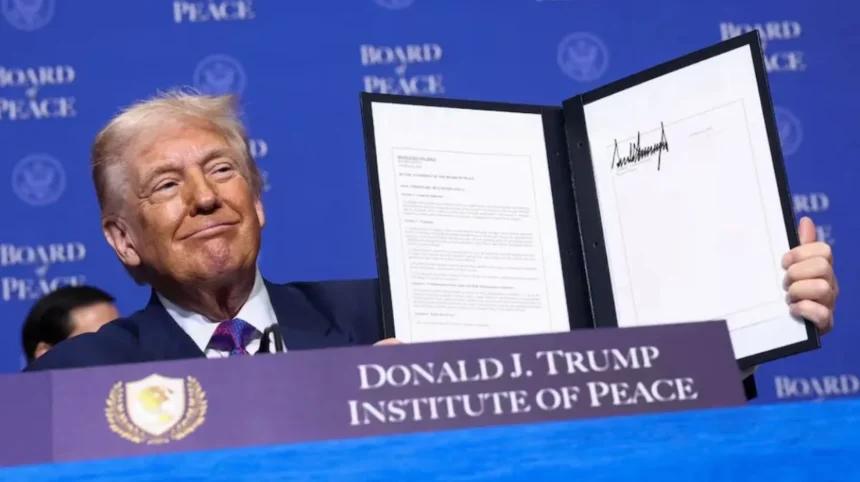
As reported by Kiki Siregar of Channel NewsAsia (CNA), influential religious bodies, academics, former diplomats and civil society groups in Indonesia are mounting pressure on President Prabowo Subianto’s government to review or even revoke the country’s membership of United States President Donald Trump’s Board of Peace (BoP), following coordinated US-Israeli strikes on Iran that began on Feb 28, 2026.
According to CNA, Indonesia joined the BoP as a founding member on Jan 22 during meetings in Davos, with the body tasked with overseeing Gaza reconstruction and security under a US-led framework. The Indonesian Ulema Council (MUI), the country’s top clerical body, has argued that as the world’s largest Muslim‑majority nation, Indonesia should not be institutionally tied to Washington through the BoP while the US and Israel are engaged in a war against Iran.
CNA reports that at the first BoP meeting in Washington on Feb 19, Indonesia accepted a deputy commander role within the International Stabilization Force (ISF) for Gaza, with Prabowo announcing a commitment to deploy 8,000 troops within two months, although no formal deployment schedule has been set. Indonesian officials say that talks on the BoP are now “on hold” as attention has shifted to the Iran conflict, and the foreign minister has indicated Jakarta will consult Gulf partners who are also under attack before deciding next steps.
Context and Reactions: How Are Indonesian Stakeholders Responding?
According to CNA, the MUI has called on the government to revoke Indonesia’s BoP membership, questioning whether the US‑led initiative genuinely advances Palestinian independence or instead reinforces an unequal regional security architecture. In a press statement, MUI linked its stance directly to the US‑Israel strikes on Iran and warned that remaining in the BoP risks contradicting Indonesia’s long‑standing support for Palestinian statehood.
CNA notes that dozens of prominent public figures and at least 79 civil society organizations, including the Human Rights Working Group and Indonesia Corruption Watch, have co‑signed a statement urging a thorough evaluation of Indonesia’s commitments under the BoP charter. They argue that the Davos‑based BoP is not the body envisaged in UN Security Council Resolution 2803 on Gaza and that it lacks a clear road map to Palestinian independence, calling for Jakarta’s membership to be reviewed.
The Retired Indonesian National Armed Forces Soldiers Forum (FPP‑TNI) has publicly demanded that Indonesia leave the BoP and withdraw the plan to send 8,000 troops, warning that participation under a non‑UN mandate could violate constitutional and defence principles. Retired General Fachrul Razi, cited by CNA via local media, said Indonesia’s involvement in peacekeeping should proceed only under a United Nations mandate, adding that a force commanded through the BoP “headed by an American general” risks offending Palestinian sensitivities.
CNA also reports that former deputy foreign minister Dino Patti Djalal has urged the government to suspend the troop deployment and re‑anchor policy in international law and Indonesia’s “free and active” foreign policy doctrine. He warned that Indonesian forces would be “practically under the command of the US and Trump as chairman of the Board of Peace” and cautioned against being drawn into complications arising from the triangular conflict between the US, Israel and Iran.
Supporting Details and Expert Commentary
According to CNA, analysts and legal experts interviewed in Indonesia say that, in principle, Jakarta should be able to withdraw from the BoP if it deems the body’s actions incompatible with its constitution and foreign policy principles. International relations scholar Diah Kusumaningrum of Gadjah Mada University described an exit as primarily a political decision rather than a technical challenge, pointing to Indonesia’s past withdrawal from the United Nations in 1965 as precedent for leaving international forums when core interests are at stake.
CNA further reports that Diah argued Indonesia risks being seen as complicit in aggression if it remains in the BoP under current circumstances, thereby eroding its credibility at home and abroad. Another expert, Suzie Sudarman of the University of Indonesia, characterized the Iran conflict as a “force majeure” event that would make a formal withdrawal relatively straightforward, suggesting Jakarta could simply notify partners that it is leaving the group due to the changed situation.
From the political side, CNA notes that Ahmad Muzani, speaker of Indonesia’s People’s Consultative Assembly and a senior figure in Prabowo’s Gerindra party, has said Indonesia can leave the BoP “at any time”, describing joining and exiting international organizations as normal practice, while stressing that such a move would require mutual agreement. Former foreign minister Hassan Wirajuda has also confirmed that the BoP and the impact of the Iran war on its mandate were discussed in recent high‑level consultations convened by Prabowo with former presidents, ministers and party leaders.
CNA’s reporting adds that critics inside Indonesia contend the BoP has effectively become a “Board of War” because it is chaired and dominated by Trump, who ordered the military strikes on Iran, in their view undermining the peace‑building aims set out in the body’s charter. They also insist that any Indonesian troop deployment to Gaza should be authorized through the UN Security Council rather than through the BoP, arguing that the current arrangement is inconsistent with Resolution 2803.
Implications and Future Developments: What Could Indonesia’s Exit Mean?
According to CNA, analysts say a potential Indonesian withdrawal from the BoP would require Jakarta to prepare for possible US reactions, including consequences for trade ties and broader bilateral cooperation. The United States is Indonesia’s second‑largest export destination after China, and experts quoted by CNA argue that if Jakarta leaves the BoP it should simultaneously deepen economic and diplomatic engagement with other partners, including within Southeast Asia and the wider Indo‑Pacific.
CNA reports that Suzie Sudarman believes Indonesia should not over‑rely on the US and instead re‑emphasize its regional role in ASEAN and the Indo‑Pacific, areas she says have been relatively deprioritized since Prabowo took office. Diah Kusumaningrum similarly stressed that Indonesia’s foreign policy should be guided by national principles rather than the aspirations of individual leaders, warning that as long as Jakarta remains within the BoP while offering mediation and security contributions, its credibility in the eyes of Palestinians and global public opinion will be questioned.
For now, CNA notes that Prabowo has held multiple internal consultations on the BoP and regional crises but has not publicly committed to exiting the body or cancelling the Gaza troop deployment. The foreign minister has indicated that BoP processes are paused as the government reviews the evolving Iran conflict and consults partners, leaving Indonesia’s future role in Trump’s Board of Peace—and the scale of its participation in Gaza stabilization—still under active consideration.
In sum, current reporting indicates that Indonesia, as the world’s largest Muslim‑majority country, is facing intense domestic pressure to quit the Trump‑led Board of Peace in response to US‑Israel attacks on Iran, but has yet to formally announce a withdrawal as it weighs legal, diplomatic and economic ramifications.

