

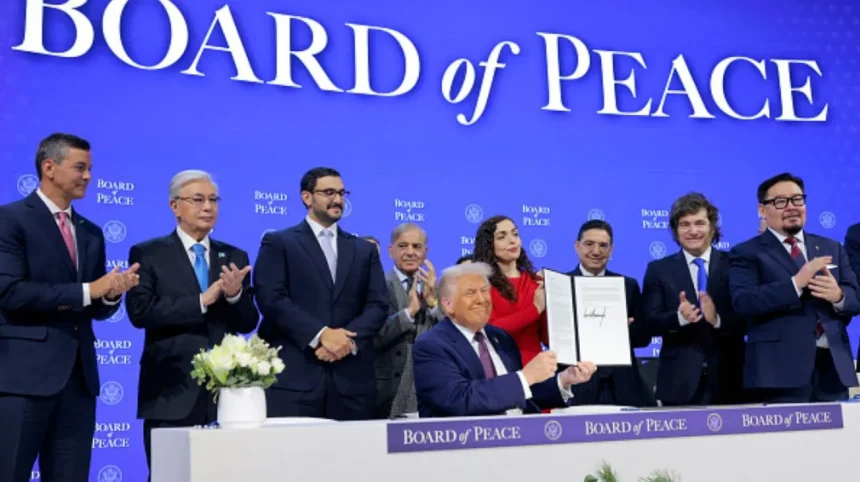
As reported by The New Arab, Hamas has called on Trump’s Board of Peace to pressure Israel to halt what it described as ongoing violations of the Gaza ceasefire. The appeal came on Tuesday, ahead of the first summit of the 28‑member body in Washington, where it is due to unveil further details of its reconstruction plans for Gaza.
According to The New Arab, Hamas spokesperson Hazem Qassem issued a statement urging Trump’s Board of Peace to take “serious action” to compel Israel to stop its actions in the besieged enclave. Qassem said “the war continues and the killings, displacement, siege and starvation in Gaza have not stopped,” despite a four‑month truce formally being in place.
The New Arab reports that Gaza’s health ministry accuses Israel of violating the ceasefire almost daily, killing at least 604 Palestinians and injuring more than 1,600 others since the truce took effect. Israeli authorities are also reported to have maintained heavy restrictions on aid entry and to have kept tight limits on crossings at Rafah, despite having pledged to open the border in the ceasefire’s first phase.
What is Trump’s Board of Peace and what is at stake?
According to The New Arab, Trump’s Board of Peace is a controversial, 28‑member council established by Donald Trump and framed as the central vehicle for Gaza’s reconstruction and political future. The body is scheduled to hold its first summit in Washington on Thursday, where it is expected to outline plans for extensive rebuilding and potential security arrangements.
The New Arab notes that Trump recently announced that member states had pledged around $5 billion for humanitarian and reconstruction efforts in Gaza. The council is also expected to discuss the possible deployment of a multinational force to replace Hamas security forces in the territory.
Critics, cited by The New Arab, argue that Trump’s Board of Peace centralizes power in the hands of the U.S. president and risks undermining the UN‑led international order. More than a dozen Western countries have declined invitations to join, while Mexico and the Vatican confirmed they would not participate, raising further questions about the council’s legitimacy and balance.
How is Hamas framing its demands to Trump’s Board of Peace?
As reported by The New Arab, Hamas is using the lead‑up to the Washington summit to publicly define what it expects from Trump’s Board of Peace. Hazem Qassem called on the council not only to halt Israeli killings but also to launch real reconstruction and secure greater freedom of movement for Palestinians.
According to The New Arab, Qassem urged the board to begin rebuilding Gaza and to press Israel to allow a newly formed Palestinian committee, designated to govern the territory, to enter the Strip. He emphasized the need to “lift the siege on Gaza and open the crossings,” criticizing what he described as partial and minimal openings and violations against travelers.
The New Arab reports that Qassem also warned against Israel using Trump’s Board of Peace “as a cover to continue the war on Gaza and to prevent reconstruction.” Hamas’s statement signals concern that the council could legitimize ongoing military pressure or restrictions while projecting an image of progress.
Supporting details: Ceasefire violations, casualties, and new attacks
According to figures cited by The New Arab from Gaza’s health ministry, Israel has violated the four‑month truce almost daily, causing at least 604 Palestinian deaths and more than 1,600 injuries in Gaza. These incidents reportedly span dozens of attacks across the territory since the ceasefire began on 10 October.
The New Arab notes that Israeli authorities have continued to tightly control the flow of humanitarian aid and the operation of crossings, despite earlier commitments tied to the ceasefire framework. Rafah crossing has remained heavily restricted, limiting the movement of people and goods and contributing to ongoing shortages and hardship.
Fresh incidents highlight the fragility of the truce. The New Arab reports that a Palestinian man was shot dead by Israeli troops east of Khan Younis on Wednesday morning, citing the Palestinian news agency Wafa. In parallel, the Israeli military announced that Staff Sergeant Ofri Yaffe had been killed in southern Gaza, saying he “fell in battle” without providing further details.
The New Arab adds that Yaffe is the fifth Israeli soldier to die in Gaza since the ceasefire came into effect. Israel says it has also killed dozens of Palestinian fighters during this period, underscoring that active hostilities continue despite the formal truce.
Who sits on Trump’s Board of Peace and who is staying out?
As reported by The New Arab, Trump’s Board of Peace includes 28 member states, among them several Arab and Muslim‑majority countries. Bahrain, Egypt, Indonesia, Jordan, Kuwait, Morocco, Pakistan, Qatar, Saudi Arabia, Turkey, and the United Arab Emirates are named as members participating in the council.
The New Arab states that Israel joined the council earlier this month and will be represented at the Washington summit by Foreign Minister Gideon Saar. Israel’s inclusion gives it a seat at the table where reconstruction, security, and governance in Gaza will be discussed.
However, not all invited states have agreed to join. The New Arab reports that Mexico and the Vatican announced on Tuesday that they would not take part in Trump’s Board of Peace, adding their names to more than a dozen Western countries that have declined invitations. This pattern reflects broader skepticism about the body’s structure and its relationship to existing international institutions.
What are the implications and possible next steps for Gaza?
According to The New Arab, the first summit of Trump’s Board of Peace is expected to set the tone for how reconstruction, security, and political arrangements in Gaza will be pursued in the coming months. The council’s decisions may influence how and when pledged funds—reported at $5 billion—are disbursed and under what conditions.
Hamas’s appeal positions Trump’s Board of Peace at the center of immediate humanitarian and political demands. As reported by The New Arab, the movement wants the council to leverage its influence to halt Israeli military actions that it says violate the truce, lift the siege, and enable a Palestinian governing committee to operate in Gaza. Whether and how the board responds will shape both Hamas’s stance and wider Palestinian perceptions of the body.
The New Arab notes that the council is also weighing a multinational force to replace Hamas security forces, an idea with significant implications for control and governance in the territory. Any such deployment would likely be contentious, affecting the balance of power between local actors, Israel, and international players.
Looking ahead, The New Arab’s reporting suggests that Trump’s Board of Peace will face competing pressures: from Hamas and other Palestinian factions demanding protection, reconstruction, and an end to the siege; from Israel concerned with security and the role of armed groups; and from member states wary of being seen as endorsing policies that prolong conflict. How the council navigates these tensions—and whether it can act in ways that reduce violence and improve conditions on the ground—will be critical tests of Trump’s Board of Peace in its early stages.

