


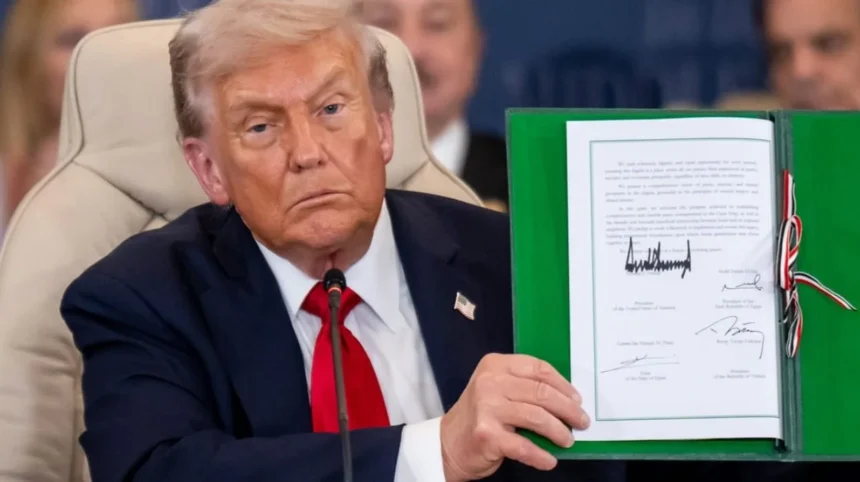
As reported by Xinhua, Germany has decided it will not join U.S. President Donald Trump’s proposed “Board of Peace” in its current form, according to an internal government assessment cited by Der Spiegel. The German Federal Foreign Office concluded that participation “in the present form is not possible,” even as Berlin signaled it remains open to dialogue on international peace initiatives. According to the same reporting, German officials view the proposal as a “counter-draft” to the United Nations-centered multilateral system that Berlin has long backed.
As reported by Xinhua, the internal document underscores that Germany is committed to strengthening the international order with the UN Charter at its core, framing Trump’s initiative as potentially running parallel to or in competition with existing UN structures. According to coverage summarized by Global Times, Berlin’s stance is that any new mechanism must be compatible with that UN-based order. The Der Spiegel-based reporting also notes that the U.S. proposal would grant Trump, as “chairman,” extensive decision-making powers within the body, raising additional concerns in Berlin.
According to Reuters reporting cited by outlets including Global Banking & Finance and the Times of Israel, German Chancellor Friedrich Merz publicly reiterated these reservations at a joint news conference in Rome with Italian Prime Minister Giorgia Meloni. Merz stated that he would be ready in principle to join the Board of Peace “for the sake of Gaza,” but emphasized that Germany could not accept the plan “in its current form.”
Context and reactions: Why is Berlin pushing back?
As reported by Xinhua and Der Spiegel, the core of Germany’s objection lies in how the Board of Peace would operate alongside, or potentially in place of, existing multilateral institutions. The internal foreign ministry document cited in those reports says Berlin fears the initiative could act as a counterweight to the United Nations rather than reinforcing its authority. According to Global Times’ summary of the same document, Germany sees itself as bound to an international order where the UN Charter remains the central legal and political framework.
At the political level, Merz has framed his response as a balance between openness to U.S. dialogue and adherence to German constitutional law. According to Deutsche Welle, the chancellor said he could not support the Board of Peace “in its current configuration” because of “constitutional” limitations in Germany, signaling that the board’s governance structure, and especially the powers concentrated in its chair, are incompatible with German legal norms. In Rome, Merz was quoted by Reuters as saying that “in the form in which the peace board is currently set up, we cannot accept its governance structures in Germany for constitutional reasons.”
According to Deutsche Welle, Merz has also indicated that Berlin remains “cautiously thankful” for Washington’s invitation and sees value in exploring new channels of cooperation with the United States on conflict resolution. Earlier reporting noted that Germany had initially welcomed the outreach but made clear that any engagement would have to fit within both German constitutional limits and the country’s multilateral commitments.
Supporting details and expert concerns
As reported by Xinhua, the Der Spiegel-based account describes Trump’s proposed role as “chairman” of the Board of Peace with “extensive decision-making powers,” a feature seen in Berlin as central to the constitutional and institutional concerns. According to the internal document described in those reports, the concentration of authority in a single political leader, outside the checks and balances of the UN system, is one of the key reasons Germany is holding back.
The German position also reflects a broader pattern in its foreign policy. According to Xinhua’s summary of the internal assessment, officials stressed that any new peace architecture should complement, rather than sideline, existing structures anchored in the UN Charter. Outlets citing the same document note that Berlin is wary of legitimizing parallel frameworks that might erode established norms of collective decision-making in international security.
According to reporting carried by Global Banking & Finance based on a Reuters dispatch, Merz underscored that Germany is “prepared to explore other forms – new forms – of cooperation with the United States of America if the aim is to find new formats that bring us closer to peace in different regions of the world.” This remark suggests that, while rejecting the current Board of Peace blueprint, Berlin is open to alternative designs or forums that would align with both its constitutional framework and its multilateral commitments.
Implications and future developments: What happens next?
According to Xinhua, one immediate implication is that Germany will not take part in a planned signing ceremony for the Board of Peace, which is expected to be hosted in Davos, with Chancellor Merz not scheduled to attend. The Der Spiegel-based reporting cited by Xinhua indicates that this absence is directly linked to the government’s negative assessment of the initiative’s current design.
Looking ahead, Germany’s stance increases pressure on Washington to adjust the Board of Peace’s proposed governance model if it wants broad European participation. According to Deutsche Welle, Berlin has signaled that any revised format would need to meet German constitutional standards and avoid undermining the UN-centered system. The combination of constitutional concerns and defense of multilateralism suggests that any compromise would require significant changes to the board’s mandate, decision-making rules, and leadership structure.
According to Reuters-based accounts cited by Global Banking & Finance and the Times of Israel, Merz’s willingness to consider “new forms” of cooperation, particularly in relation to Gaza and other conflict zones, leaves open the possibility of alternative U.S.–German initiatives if Trump’s team revises its approach. For now, however, Germany’s official position is that it cannot join the Board of Peace in its current form, even as it reiterates support for international efforts to advance peace within existing legal and institutional frameworks.
Germany’s decision, as described in the reporting by Xinhua, Deutsche Welle, and Reuters-based outlets, marks a clear line: Berlin is prepared to cooperate closely with the United States on peace efforts, but only within structures that respect both its constitutional constraints and its long-standing commitment to a UN-centered international order.

