


Key points
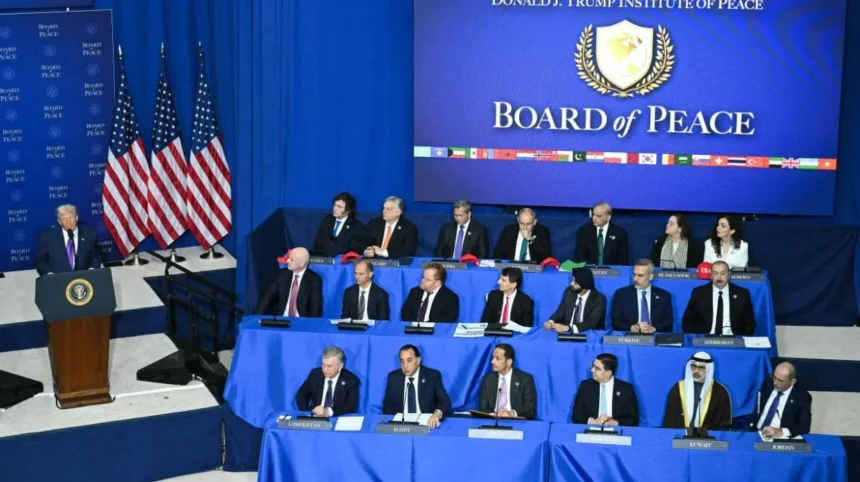
- An invitation-only “Board of Peace” linked to Gaza’s future is being promoted as an alternative to the United Nations and centred on the authority of US President Donald Trump.
- The proposed body is described as a pay-to-enter forum in which states secure influence through large, unaudited financial contributions.
- Analysts say the structure underlines Israel’s deep security and diplomatic dependence on the United States, even as Washington’s approach has fluctuated in recent years.
- The initiative is reported against the backdrop of post-war planning for Gaza and ongoing debates over who will oversee reconstruction, security and governance in the territory.
- The arrangement could give countries that pay to join an outsized role in shaping borders, security arrangements and aid flows affecting Gaza and Israel’s wider security environment.
- Critics warn that the “Board of Peace” risks offering a platform for authoritarian states to present themselves as peace-brokers without meaningful accountability.
- Israel faces a strategic choice over whether to join the body, potentially legitimising it while seeking to protect its interests, or stay outside and risk decisions being made without its input.
Gaza ‘peace board’ exposes Israel’s strategic dilemma
An invitation-only international “Board of Peace” linked to Gaza’s post-war future is being promoted as a US-led alternative to the United Nations, intensifying debate over Israel’s reliance on Washington and the concentration of authority in the hands of President Donald Trump. The mechanism, framed around large buy-ins from participating states, is raising questions in Israel about sovereignty, accountability and how Gaza’s reconstruction and security will be managed.
- Key points
- Gaza ‘peace board’ exposes Israel’s strategic dilemma
- A pay-to-enter ‘Board of Peace’
- Israel’s reliance on Washington
- Post-war architecture for Gaza
- Concerns over accountability and legitimacy
- A strategic choice for Israel
- Shifting contours of the US–Israel alliance
- Autonomy and dependence
- Wider regional implications
- What happens next
A pay-to-enter ‘Board of Peace’
According to the Jerusalem Report, the “Board of Peace” is presented as an exclusive body in which governments can secure a seat through substantial financial transfers running into the billions of dollars. The funds are described as unaudited, with membership effectively conditioned on the ability and willingness of states to pay, rather than on criteria such as human rights performance or adherence to international law.
The initiative is portrayed as an alternative to existing multilateral institutions, particularly the UN, with decision-making heavily centralised around the US presidency. This architecture is seen by observers as reinforcing Washington’s role as the primary arbiter of Gaza’s future and the region’s security order, while reducing the influence of broader collective frameworks.
Israel’s reliance on Washington
The report sets the proposed board against a broader pattern of Israeli dependence on US military resupply, diplomatic backing and strategic deterrence. It notes that Israel has long relied on American support for critical munitions, political cover in international fora, and mediation with regional partners.
The article cites a series of US decisions under President Joe Biden before Trump’s current term, including a pause in some weapons shipments in 2024 linked to concerns about operations in Rafah and civilian protection in Gaza. Washington later resumed certain deliveries while holding back specific heavy munitions, signalling that military assistance could be adjusted in response to Israeli conduct.
In November 2023, the White House announced that Israel would implement daily four-hour “humanitarian pauses” in northern Gaza, which US officials presented as measures secured through presidential engagement. Analysts quoted in the Jerusalem Report argue that these episodes illustrated how US domestic politics and presidential leverage can shape Israeli operational choices, particularly during intensive military campaigns.
Post-war architecture for Gaza
The “Board of Peace” is discussed as part of an emerging post-war architecture for Gaza, where questions remain over who will oversee security, reconstruction and governance after major hostilities. The framework would, in effect, create a forum in which paying states participate in decisions about borders, security arrangements and the flow of reconstruction funds, including into Gaza.
Israel, according to the analysis, is not only weighing whether to endorse the body in principle but also whether membership is necessary to protect its immediate security interests. Remaining outside the structure could mean that critical decisions affecting Gaza’s crossings, security coordination and economic links are shaped by others, while joining could be perceived as legitimising a pay-to-play institution whose oversight and transparency are uncertain.
Concerns over accountability and legitimacy
Commentators cited in the Jerusalem Report raise concerns that a peace body built on large, unaudited financial contributions risks diluting accountability standards. They warn that governments with limited democratic oversight or poor human rights records could gain prominent roles by paying the entry fee, presenting themselves as peace-builders irrespective of their domestic or regional conduct.
The article argues that this model could “blur principle into deal-making”, with political bargains and financial leverage potentially taking precedence over established multilateral norms. It adds that the concentration of authority in a single national leader, rather than in a treaty-based institution, may complicate long-term planning, as policies could shift quickly with changes in US domestic politics.
A strategic choice for Israel
The Jerusalem Report describes Israel’s position as a strategic dilemma, with few straightforward options. On the one hand, participation in the board could offer Jerusalem a seat at a table where its immediate security environment, including arrangements along Gaza’s borders and in adjacent maritime areas, is debated and decided.
On the other hand, Israeli policymakers must weigh the reputational risk of joining a body widely viewed as transactional and closely associated with a single US administration’s style of diplomacy. The article suggests that joining could be seen as endorsing a forum where financial contributions, rather than treaty obligations or multilateral processes, determine influence.
Shifting contours of the US–Israel alliance
The report emphasises that none of these developments mean the US–Israel alliance is dispensable; rather, it argues that the relationship is contingent and shaped by changing political conditions in Washington. It notes that both Republican and Democratic administrations have used forms of leverage, ranging from diplomatic backing to conditional defence support, in seeking to influence Israeli policy in Gaza and the wider region.
In this context, the “Board of Peace” is depicted as the latest manifestation of a system in which Gaza’s future is heavily mediated by US decision-making. By concentrating authority in one American leader, the body could amplify the impact of internal US debates on questions such as ceasefire terms, security guarantees and reconstruction priorities.
Autonomy and dependence
The article frames Israel’s response in terms of maintaining a degree of autonomy while remaining within the orbit of its principal ally. It suggests that Israel’s strategic aim is to stay closely aligned with Washington without becoming “fatally dependent” on any single administration’s preferences or negotiating style.
This balancing act involves managing relations not only with the United States but also with regional actors and potential contributors to Gaza’s reconstruction. Decisions over whether to engage with or distance itself from the “Board of Peace” will feed into wider discussions about burden-sharing, regional normalisation and the role of non-Western powers in the Middle East peace process.
Wider regional implications
Although centred on Gaza, the proposed board has potential implications for broader regional diplomacy, including relations with Arab states, European partners and emerging powers seeking a role in Middle East stabilisation. Countries that choose to join and contribute financially may seek reciprocal political concessions or visibility, influencing the balance of influence among external actors.
The model could also interact with existing mechanisms such as UN agencies, international financial institutions and ad hoc donor conferences, raising questions about duplication, coordination and authority. Observers note that how these overlapping structures are reconciled will affect the predictability of funding and the consistency of policy towards Gaza and neighbouring areas.
What happens next
The Jerusalem Report indicates that key decisions for Israel will revolve around whether, and on what terms, it engages with the “Board of Peace” as discussions over Gaza’s post-war arrangements advance. Further clarification is expected on how membership will be formalised, how funds will be managed and audited, and how the body will interact with existing international institutions involved in Gaza.
Future developments are also likely to depend on US domestic political debates, including congressional oversight of foreign funding mechanisms and broader discussions about America’s role in Middle East peacemaking. Regional responses, including from Arab governments and other potential contributors, will help determine whether the board becomes a central platform for decisions on Gaza or remains one among several competing initiatives.

