

Key Points
- The Board of Peace is an international body led by the United States, created to oversee aspects of Gaza’s post‑war reconstruction and security under a wider peace plan.
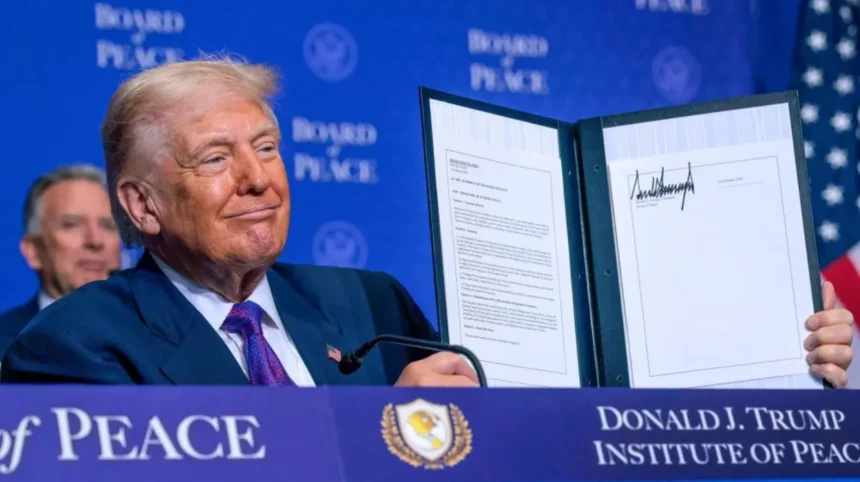
- Its first full meeting took place in Washington on Thursday 19 February 2026, with President Donald Trump presiding and delegates from more than 45 countries in attendance.
- The gathering focused on financial pledges for Gaza, plans for an International Stabilization Force, and the role of the National Committee for the Administration of Gaza (NCAG).
- The United States pledged 10 billion dollars, while other member states collectively pledged a further 7 billion dollars for reconstruction and related efforts, according to official announcements.
- Albania, Indonesia, Kazakhstan, Kosovo and Morocco committed to deploy troops to a 20,000‑strong stabilisation force, while Egypt and Jordan agreed to train an expected 12,000‑member police service.
- Many Middle Eastern and Asian states took part, but several European allies remained cautious or stayed away from the inaugural session.
- Key questions remain over the disarmament of Hamas, the durability of security arrangements, governance inside Gaza and how the Board of Peace will coordinate with existing international institutions.
- Further meetings and technical negotiations are expected in the coming months to turn broad commitments into operational plans for Gaza’s security, governance and reconstruction.
First Board of Peace session sets out Gaza pledges but leaves core questions open
The first meeting of the Board of Peace, an international body established under United States leadership to support Gaza’s post‑war reconstruction and security, has concluded in Washington with major financial and security pledges but significant political and practical questions still unresolved. President Donald Trump presided over the 19 February 2026 session, attended by representatives from more than 45 countries, including a number of Middle Eastern and Asian states, while several key European partners adopted a more cautious stance.
- Key Points
- First Board of Peace session sets out Gaza pledges but leaves core questions open
- What is the Board of Peace?
- How the inaugural meeting unfolded
- Financial commitments and reconstruction plans
- Security: troops, policing and stabilisation
- Who is in, who is out?
- Relationship with the UN and other institutions
- Unresolved issues and criticism
- What happens next
What is the Board of Peace?
The Board of Peace, sometimes referred to as the Peace Board, was created with the stated aim of supporting peacekeeping and reconstruction efforts, particularly in Gaza, under the framework of a broader Gaza peace plan. It was formally recognised in November 2025 in United Nations Security Council Resolution 2803, which welcomed its role in reconstruction, endorsed cooperation with the National Committee for the Administration of Gaza (NCAG) and authorised it to deploy a temporary International Stabilization Force.
According to publicly available documents, the board has a multi‑tier structure, including President Trump as chairman, a group of national leaders as board members, an Executive Board focused on diplomacy and investment, and a Gaza‑focused executive body headed by High Representative for Gaza Nikolay Mladenov. States that join are expected to contribute one billion US dollars over a three‑year period to renew their membership, and by early 2026, 25 of the 62 invited countries had signed the charter.
How the inaugural meeting unfolded
The inaugural gathering in Washington followed the formal launch of the board in January 2026 on the margins of the World Economic Forum in Davos and the start of the second phase of the Gaza Peace Agreement. The Washington meeting was convened at the United States Institute of Peace and was billed as an opportunity to present financial commitments, outline security contributions and offer a first detailed look at how the board intends to support Gaza.
According to reporting by Reuters, more than 45 countries sent officials to the event, with a core group of participating states having already signed the board’s charter and others attending as observers. Expected speakers included President Trump, senior US officials, former UK Prime Minister Tony Blair, and Gaza envoy Nikolay Mladenov, reflecting the mix of political, diplomatic and technical roles the board seeks to bring together.
Financial commitments and reconstruction plans
During the session, the United States announced that it would provide 10 billion dollars towards the board’s efforts linked to Gaza, including reconstruction, economic support and security measures. Nine other member states collectively pledged an additional 7 billion dollars, according to public summaries of the meeting and remarks carried in broadcast coverage.
Officials have indicated that these funds are intended to support large‑scale infrastructure repair, housing, essential services and economic stabilisation programmes in Gaza, channelled in part through the NCAG and in coordination with international agencies already present on the ground. Detailed project lists and disbursement schedules have not yet been made public, and independent verification of how and when funds will be allocated is not yet available; this information could not be independently verified.
Security: troops, policing and stabilisation
Security arrangements dominated much of the discussion around the Board of Peace’s first meeting, reflecting the central role that stability in Gaza will play in any reconstruction effort. The board has been authorised under UN Security Council Resolution 2803 to deploy an International Stabilization Force, and during the 19 February summit, several states confirmed their willingness to contribute.
Albania, Indonesia, Kazakhstan, Kosovo and Morocco pledged to send troops towards what is envisaged as a 20,000‑strong force, tasked with supporting security on the ground in coordination with local structures and other international actors. Egypt and Jordan agreed to assist in training an anticipated 12,000‑member police service for Gaza, which is seen as vital for internal security and the rule of law.
A board member quoted anonymously by Reuters cautioned that the Gaza plan faces substantial challenges, including the readiness and training of local police and the need to ensure that security arrangements are accepted by the population. The disarmament of Hamas militants, the size and mandate of the stabilisation force, and the terms under which foreign troops would operate remain among the most sensitive questions.
Who is in, who is out?
Participation at the first Board of Peace meeting highlighted emerging geopolitical alignments around the Gaza file. Reporting by Al Jazeera noted that a number of Asian and Middle Eastern partners, including Arab states, lined up to attend in Washington, reflecting their direct security and political interests in Gaza and the wider region.
At the same time, several European allies of the United States maintained a degree of distance, either limiting their representation or opting not to join the board at this stage, amid concerns about governance, legal frameworks and the relationship between the Board of Peace and existing multilateral bodies. Some commentators and opinion writers have raised questions about the concentration of authority within the board and its long‑term accountability mechanisms, though those views represent analysis rather than official positions.
Relationship with the UN and other institutions
The Board of Peace operates alongside, rather than formally within, the United Nations system, even though its establishment was welcomed in a Security Council resolution that authorised a specific stabilisation role in Gaza. Resolution 2803 did not create the board as a UN body but recognised it as a partner for reconstruction and security in Gaza, leaving the institutional relationship partly defined by practice and future agreements.
How the board will coordinate with UN agencies, international financial institutions and established non‑governmental organisations working in Gaza is expected to be a significant focus of upcoming technical talks. Questions also remain over legal jurisdiction, human rights monitoring and how any security presence will interact with local justice systems and existing international mandates.
Unresolved issues and criticism
Despite headline figures on funding and troop commitments, major uncertainties persist regarding the broader political framework and implementation on the ground. Among the unresolved issues are the future governance structure inside Gaza, the extent and sequencing of any disarmament process involving Hamas, and the conditions under which border controls and movement restrictions may be eased.
Analysts and commentators have pointed to the risk that reconstruction could stall if security benchmarks are not met or if political agreements between key parties falter. Some opinion pieces have described the Board of Peace as an ambitious but untested mechanism concentrating considerable influence in the hands of the US presidency and a select group of allies, while supporters argue that it offers a focused platform to mobilise resources quickly. These assessments reflect external analysis and are not official positions of the board or participating governments.
What happens next
In the coming weeks, follow‑up meetings between technical teams, defence officials and development experts are expected to refine the timelines for deploying the International Stabilization Force and launching priority reconstruction projects in Gaza. Member states are likely to move towards formalising their troop contributions, negotiating rules of engagement and agreeing oversight mechanisms for both security operations and financial disbursements.
Further political consultations are anticipated at foreign minister and head‑of‑government level to address the broader questions of governance, the integration of local actors and the board’s relationship with existing international frameworks. The effectiveness of the Board of Peace will depend on how rapidly these plans can be turned into concrete arrangements on the ground in Gaza, and whether pledges made in Washington translate into sustained, transparent support over the coming years.

