


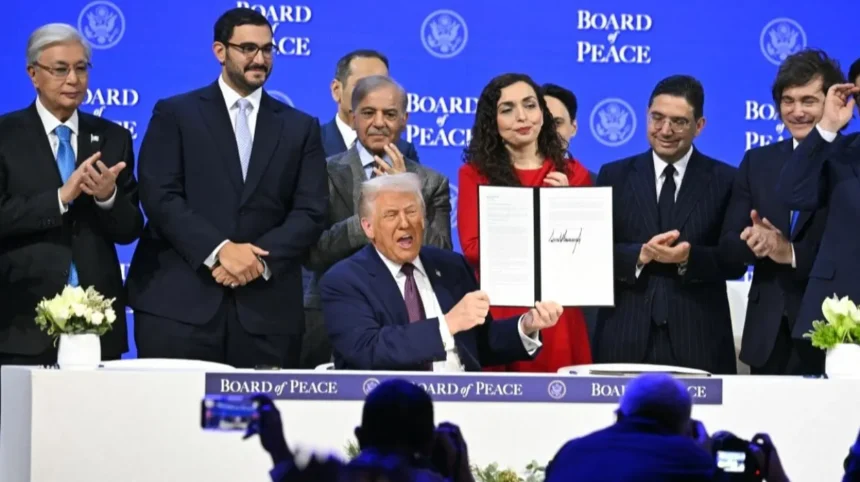
As reported by Sebastian Morello of The European Conservative, European Union institutions have accepted that they must engage with US President Donald Trump’s new Board of Peace if they want to retain meaningful influence over Gaza peace efforts and reconstruction. The article notes that Brussels had initially reacted coldly to the initiative but is now adjusting its stance.
According to The European Conservative, the European Union has decided to send a representative to the Board of Peace’s inaugural meeting in Washington. This decision marks a shift from earlier skepticism and reflects a calculation that key decisions on Gaza peace efforts and reconstruction will be shaped in that forum.
The European Conservative reports that the Board of Peace was launched under Trump’s leadership as an international body focused initially on Gaza’s post-war transition. The body has since expanded its mandate, but Gaza peace efforts and reconstruction remain central to its early agenda, drawing in international donors and regional actors.
Why Is the EU Engaging With Trump’s Board of Peace?
As reported by The European Conservative, the EU move to engage with Trump’s Board of Peace comes despite ongoing political and legal concerns in Brussels about the body’s structure and governance. EU officials are described as wary of appearing to endorse the Board fully, yet reluctant to remain outside a key arena for Gaza peace efforts.
According to Euronews, the European Commissioner for the Mediterranean, Dubravka Šuica, has been designated to travel to Washington and attend the first formal meeting of the Board of Peace. A European Commission spokesperson said Šuica will participate only in the specific part of the meeting dedicated to Gaza, underlining the EU’s focus on Gaza peace efforts and reconstruction.
Euronews reports that EU officials see participation as necessary to safeguard the bloc’s long-standing role as a major donor and political actor in Gaza. The EU wants to help shape decisions on funding, reconstruction priorities and institutional arrangements that could emerge from Trump’s Board of Peace process.
According to Democracy for Sale, internal EU discussions on whether to work with the Board of Peace have been influenced by lobbying from the Tony Blair Institute for Global Change. Documents cited in that investigation indicate that advisers linked to former UK prime minister Tony Blair urged EU officials not to stay away from the Board, stressing that the EU would inevitably have a role in Gaza peace efforts.
How Are European Leaders Reacting to the Board of Peace?
What concerns have EU leaders raised?
Middle East Eye reports that several European leaders have publicly criticized Trump’s Board of Peace, especially at the Munich Security Conference. EU foreign policy chief Kaja Kallas raised concerns that the Board’s statute does not reflect key elements of the underlying UN resolution that supported its creation.
According to Middle East Eye, Kallas noted that the original resolution envisioned a body that would be limited in time, explicitly reference Gaza and provide for Palestinian participation. She criticized the current Board statute for lacking these elements, highlighting a disconnect between the UN founding framework and Trump’s implementation of the body.
Middle East Eye further reports that Spain’s foreign minister, Jose Manuel Albares, questioned the Board’s exclusion of Europe and its approach to Gaza peace efforts. Albares argued that the EU, as a principal funder of the Palestinian Authority and a significant donor for Gaza, should not be sidelined in decisions about the territory’s future.
How do these concerns shape EU participation?
Despite these criticisms, Euronews notes that the EU’s decision to send Šuica signals that Brussels is not prepared to completely write off cooperation with the Trump-chaired Board. EU member states have declined formal permanent membership, but limited participation allows them to engage on Gaza peace efforts without fully endorsing the structure.
According to Euronews, EU foreign ministers are expected to discuss the Board of Peace and European engagement when they meet in Brussels. They will be joined by Nickolay Mladenov, appointed by Trump as High Representative for Gaza, who is tasked with linking the Board’s work with a technocratic Palestinian committee responsible for day-to-day management in Gaza.
Democracy for Sale reports that some EU officials remain uneasy about the Board’s membership and decision-making rules, including Trump’s permanent chairmanship and veto powers and the presence of controversial figures among proposed executive members. However, the same reporting indicates that EU decision-makers see practical advantages in having “a seat in the room” as Gaza peace efforts and reconstruction plans are developed.
Supporting Details: Structure of the Board and Financial Stakes
According to The European Conservative, Trump has hailed the Board of Peace as potentially one of the most consequential international bodies in history. He has claimed that members are poised to pledge more than 5 billion dollars for Gaza humanitarian and reconstruction efforts at the first meeting, alongside commitments of personnel for an international stabilization force and local policing.
Euronews reports that the Board of Peace was initially conceived as part of a 20-point peace plan focused on Gaza’s post-war transition. Over time, its mandate has widened to “global peace,” but Gaza remains the immediate priority, with the first meeting expected to concentrate on ceasefire support, reconstruction and institutional arrangements on the ground.
Democracy for Sale and other investigative outlets describe the Board’s executive membership as including Trump allies and high-profile political and business figures. Permanent membership reportedly requires a 1 billion dollar contribution in “cash funds,” giving major financial backers a formal role while Trump retains an absolute veto over Board decisions.
According to Middle East Eye and other regional reporting, some European governments view the Board’s design as bypassing traditional multilateral structures, including the United Nations. Critics argue that the Board centralizes decision-making in Washington, giving Trump and close partners outsized control over Gaza peace efforts and reconstruction policy.
European strategic calculations
The European Conservative and Euronews both highlight that the EU is one of the largest international donors to the Palestinians and a key trade partner for Israel. This dual role gives the bloc significant financial leverage but has not translated into equivalent political influence over Gaza peace efforts in recent years.
Democracy for Sale notes that internal EU documents reflect concern over being excluded from shaping the Board’s agenda despite substantial European financial commitments to Gaza. This concern has helped drive the decision to engage, even as EU officials stress that they are not seeking permanent membership in the Board of Peace.
What Are the Implications for Gaza Peace Efforts and EU Policy?
How might EU participation affect Gaza reconstruction?
According to Euronews, Šuica’s participation in the Board’s Gaza-focused session is intended to ensure that European priorities are reflected in discussions about reconstruction and post-war recovery. These priorities include transparency in fund allocation, support for ceasefire implementation and strengthening Palestinian institutional capacity.
Middle East Eye reports that European leaders want to avoid a scenario in which major financial pledges and reconstruction contracts are agreed without EU input, despite the bloc being one of the largest donors. Participation in the Board of Peace meeting is therefore seen as a way to maintain oversight and influence over how funds are used in Gaza.
The European Conservative suggests that, in practice, Europe’s willingness to engage with Trump’s Board acknowledges the concentration of political leverage in Washington. While many in Brussels remain skeptical of the Board’s structure and membership, they acknowledge that substantial decisions on Gaza peace efforts and long-term arrangements will likely be shaped there.
What are the political risks and next steps?
Democracy for Sale notes that EU engagement with the Board of Peace carries political and reputational risks. Critics within the bloc worry that working with a body chaired indefinitely by Trump and populated by controversial figures could undermine Europe’s commitment to multilateralism and established international legal frameworks.
Middle East Eye and other outlets indicate that European foreign ministers will need to balance these concerns against the practical need to protect EU interests and ensure that Gaza peace efforts reflect humanitarian and political priorities shared by most member states. Internal debates are expected to continue as the Board of Peace begins its work.
Euronews reports that further decisions on the depth of EU engagement with the Board will depend on how the inaugural meeting unfolds, the clarity of governance arrangements and the degree to which Palestinian representatives are meaningfully involved in Gaza-related decisions. Future EU positions may also be shaped by the response of member states that have declined to join the Board as permanent members.
In summary, reporting by The European Conservative, Euronews, Middle East Eye and investigative outlets such as Democracy for Sale indicates that the European Union is adjusting its strategy to remain involved in Gaza peace efforts shaped by Trump’s Board of Peace. By sending Commissioner Dubravka Šuica to the Board’s inaugural meeting in Washington, the EU seeks to protect its political and financial stakes in Gaza’s reconstruction, even as it continues to voice concerns over the Board’s design, membership and long-term implications for international governance.

