


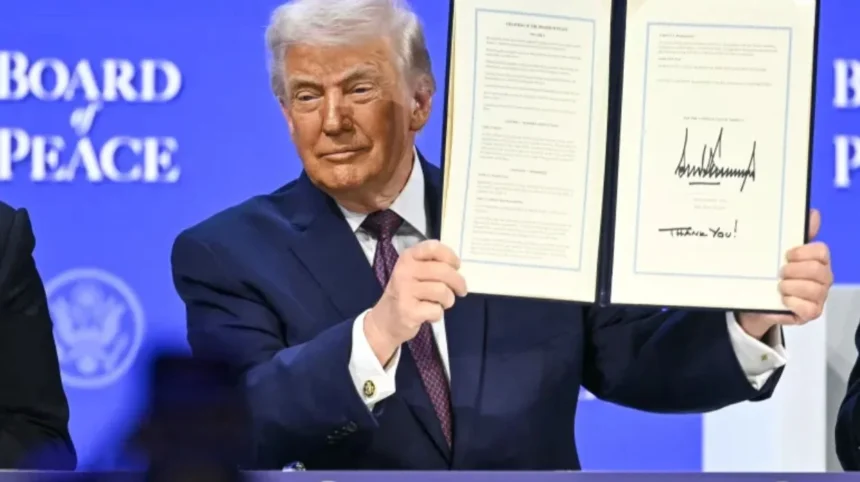
As reported by Zaha Hassan of Responsible Statecraft, the Board of Peace is a new international body launched by United States President Donald Trump to oversee reconstruction in Gaza and address other conflicts worldwide. According to Responsible Statecraft, the board was formally inaugurated in Washington, DC, with Trump serving as its chair and exercising extensive control over invitations, finances, and the agenda. Hassan reports that Trump described the Board of Peace as having “limitless potential” and promoted it as one of the most consequential international bodies ever created.
According to the New York Times, the Board of Peace was initially expected to focus on administering and supporting a ceasefire between Israel and Hamas in Gaza before its mandate expanded globally. The New York Times reports that the board’s charter gives Trump veto power over certain decisions and allows him to solicit large financial contributions from countries seeking long-term membership. More than 20 countries have joined as early members, while several U.S. allies in Europe have declined to participate, the Times notes.
Responsible Statecraft reports that Trump alone can appoint or remove the chair of the Board of Peace and can expel members of its executive board, underscoring what critics see as a highly centralized structure. According to the outlet, the charter allows Trump to determine which states receive invitations and how the board’s resources are deployed. Hassan writes that this concentration of authority has led some analysts to compare the entity to a Trump-branded enterprise rather than a conventional multilateral institution.
How are critics and observers reacting?
According to Responsible Statecraft, critics argue that the Board of Peace’s governance model resembles a Trump company because of its personalized control and pay-to-play features. Hassan reports that Trump can invite members, manage finances, and veto or shape key decisions, which analysts say mirrors the way he has run private businesses. The outlet notes that executive roles have been offered to high-profile figures such as former British Prime Minister Tony Blair and Israeli Prime Minister Benjamin Netanyahu, drawing additional scrutiny from opponents.
The New York Times reports that some experts view the Board of Peace as an attempt to build a rival power center to the United Nations, with Trump at the top. According to the Times, critics say the board’s broad and loosely defined authority could allow it to undertake initiatives with limited external checks, reinforcing perceptions that it operates more like a controlled Trump venture than a collectively governed body. Several European governments have expressed caution or declined to join, underscoring their concerns about legitimacy and balance of power.
Al Jazeera notes that many analysts question whether the Board of Peace can function as a neutral platform given Trump’s dominant role and close ties with selected allies. According to Al Jazeera, critics argue that the structure risks blurring lines between U.S. national interests, Trump’s political agenda, and the board’s formal mission. Commentators interviewed by the network say this perception feeds comparisons between the board and Trump-branded companies that centralize decision-making and rely heavily on his personal brand.
Supporting details and expert commentary
Responsible Statecraft reports that one controversial aspect of the Board of Peace is its funding model, which encourages countries to contribute large sums—described by some as up to the billions of dollars range—to secure an enduring role. Hassan writes that this approach has been criticized as a “pay-to-play” system, echoing structures found in some private ventures. The outlet notes that Trump’s authority over membership and financing could give wealthy states disproportionate influence in shaping priorities.
According to Al Jazeera, Jared Kushner, Trump’s son-in-law, has presented ambitious redevelopment plans for Gaza under the Board of Peace, including beach resorts and high-rise projects. The network reports that Palestinian advocacy groups have condemned these ideas as “imperialist,” arguing that they prioritize investor-driven schemes over locally grounded reconstruction. Analysts interviewed by Al Jazeera say these proposals contribute to perceptions that the board operates like a Trump-style development enterprise.
The New York Times notes that, while the Board of Peace is formally framed as a multilateral body, Trump’s veto powers and long-term chairmanship set it apart from many traditional international organizations. According to the Times, this structure allows him to maintain a central role even as member states provide funding and personnel. Responsible Statecraft adds that the board’s charter enables Trump to remain chair indefinitely unless he resigns or is unanimously deemed incapacitated, reinforcing the personalized nature of the institution.
What are the implications and what comes next?
According to Responsible Statecraft, the Board of Peace’s design raises questions about transparency, accountability, and long-term stability, particularly if it is perceived as closely tied to Trump’s personal leadership and brand. Hassan reports that critics warn the arrangement could entangle the United States in complex crises while weakening broader multilateral frameworks if the board’s initiatives diverge from U.N.-led processes. The outlet notes that these concerns underpin comparisons to a Trump company and calls for clearer safeguards.
The New York Times reports that the board’s evolving mandate and membership will determine how much influence it ultimately wields over Gaza reconstruction and other conflicts. According to the Times, the response of skeptical allies and international institutions will be critical in defining whether the Board of Peace operates alongside existing bodies or in tension with them. Al Jazeera adds that upcoming meetings and funding decisions will be closely watched to see whether governance mechanisms are adjusted to address concerns about concentration of power.
Together, the reporting from Responsible Statecraft, the New York Times and Al Jazeera indicates that the Board of Peace has rapidly become a focal point in debates over international governance under Donald Trump. Critics’ comparisons to a Trump company reflect worries about centralized control, financing structures and political influence, even as supporters frame the board as a vehicle for ambitious peace and reconstruction efforts in Gaza and beyond.

